Thursday, May 29, 2014

EXCLUSIVE: 'I am ready to APOLOGISE to Smriti Irani if...'

New Delhi: Congress has been utterly decimated, routed through the ranks in the just concluded 2014 parliamentary elections. And, if detractors of the grand old party are to be taken at their face value, the obliteration is there to stay stretched, may be till the day Rahul Gandhi wakes up with a sense of sensitivity for a situation and keeps his dimpled-cheek-smile in control, especially when publicly asked to elucidate the muddy show of his political unit. It should be no overstatement to make that the latest mandate by people is retribution or castigation for Congress for indulging in vulgar implementation of social welfare schemes which ultimately hit the final nail in the Congress’ coffin. Now, the party is not even fit to put up as major opposition force inside the Parliament. “Modi-fied” Bharatiya Janata Party (BJP) must be taking sigh of relief from this, thinking the dilapidated Congress will barely be able to tender plentiful resistance to them, meaning thereby, the shots are up to be taken for free without worrying about the bartender and the bill. Nonetheless, it was not to be! Social activist, feminist, academic and writer; known self-confessed Modi supporter (though she doesn’t agree by a bit of it) for long, as much as my memory serves me, has taken up the cause for the Congress – it’s actually what some of the BJP leaders have to say off-the- record. Anyone well aware of the journalist-activist must know about her vociferous defence of Narendra Modi on all accounts, including the latter's alleged involvement in the Gujarat 2002 riots. Kishwar has also written a book on Modi, titled "Modi, Muslims and Media". The fire-spitting activist who is known for carrying her heart on sleeve mostly, and doesn’t mind calling spade a spade even if it pains her most dearly, has been involved in number of controversies in the past, and the latest one is no lesser in magnitude as well. She takes on the youngest politician in the Modi cabinet, the 38-year old Smriti Irani, this time. To her, the TV actress of once is not fit to be the Union Human Resource Development (HRD) minister. She posted on a social networking site "Irani claims to be BCom part 1 frm correspondence school. No such degree exists. Means just took admission and left. Misrepresent in affidavit." Another post said, "Congress & Left have nurtured intellectuals, academics for decades. BJP neglected this arena. @narendramodi better put worthy person in HRD,” giving the listless and down beat Congress enough fodder to at least make them feel in the race after the historic catastrophe in the general elections. To know her version of the story, as all ethically active journalists should do, I contacted her over a call. Speaking to Daily Bhaskar over phone, Kishwar said, “It’s wrong to believe I hold allegiance to a certain group. No matter who it is, I will always speak the truth,” when asked what brought about such a sweeping shift in her stand that was always supposed to be sympathetic with Modi and his works. She stated “I have nothing personal against Smriti Irani. But, a ministerial post as esteemed and significant as HRD should be chaired by a person with a proven intellect and celebrated contribution towards the field.” Despite going all out against Irani for her lacking credentials as an HRD minister she was quick to add “if Smriti proves me wrong in the time to come, with her exceptional performance, I would not hesitate from begging apology for my remarks. But for this to happen, she must produce something exception, that hasn’t been witnessed ever before.”
Post commenting on the issue, the lady not only faced ire of certain sections in the BJP, various renowned academics (and some self-confessed ones) also went all out firing from all cylinders, reminding her if degree had been criteria for any position, trio of established academics such as Manmohan Singh, P Chidambaram and Montek Ahluwalia should have turned India into “golden sparrow” of past, once again, during the UPA’s 10 year rule. Some of the tweetizens offended by Kishwar’s remarks also asked her “What did PhD holders such as Murli Manohar Joshi do in their last term? Joshi was just busy in saffronization of NCERT text books.” An article in the Economic Times throws further light into the issue. Then, there was a fragment on social sites that attributed her bizarre comments to the Modi government’s indisposition towards accommodating the “old horses” of the party in the cabinet. An article in Firstbiz claimed there are 6 other ministers who aren’t even 12th pass. It reads:“And curiously enough, it turn out that three other women ministers have only studied up to class 12 or lower. As per their affidavits submitted to the Election Commission, it turns out that Uma Bharti, Harsimrat Kaur and Maneka Gandhi are as educated or studied less than Irani. While water resources minister Uma Bharti studied until class 5, food processing industries minister Harsimrat Kaur studied till class 10 and women and child development minister Maneka Gandhi, like Irani, studied only till class 12.The new aviation minister Ashok Gajapathi Raju only studied to class 10 while his minster of state GM Siddeshwara has also studied up to the same level. Minister for heavy industries Anant Geete and minister of state for mines and steel Vishnu Deo Sai also share the same educational qualification.” But, shouldn’t Madhu Kishwar’s point of view analyzed in a broader context? It’s not about holding certain educational qualifications by which one should be deemed suitable for the job. That way, it should have been former Army Chief VK Singh who should be holding the Defence Ministry in place of Arun Jaitley. It’s all about holding prior experience when presiding over matters that won’t only affect the present but the future generations too. Smriti has been a popular actress in her soap “Kyunki Saas bhi Kabhi Bahu Thi” and worked the hard way to reach where she is at present. She is doing a great job by working for under-privileged citizens by setting up the NGO "People for Change" to provide drinking water to the poor in remote areas. But she lacks administrative familiarity, unlike Jaitley who despite tasting loss in his Lok Sabha constituency is still considered foremost requisite in the newly formed government for his proven track record as a lawyer, academic and administrator. India has already witnessed a successive crop of failed HRD ministers who presided and went away without making a serious attempt to revive the educational system of the country including Kapil Sibal, from whom a lot was expected. So, for a new-comer without any experience whatsoever how things run in the administrative set-up, the job seems far too unworkable. Madhu Kishwar minces no words when she says “even Modi’s reputation as Gujarat CM can’t be taken for granted anymore.” Because governing state is completely different from leading a nation. Kishwar says, "HRD is very important ministry. The country can't afford to waste another five years.” Talking to CNN-IBN Kishwar said “as a HRD minister, she will be expected to deal with IIT and IIM graduates. She won't get any respect. Is this a joke? She doesn't deserve to be the HRD minister," the activist claimed. "A ministry isn't anyone's 'jaydat' that you distribute to anyone. Those who supported Modi are shell shocked. No one respects her in the BJP. On the other hand, senior people like Dr Harshvardhan and Maneka Gandhi have been given lower level ministries," she said. While contesting in 2004 elections from Chandni Chowk in Delhi, the actor-turned politician had claimed that she had a Bachelor of Arts degree. An Outlook report says: “While contesting in 2004 elections from Chandni Chowk in Delhi, the actor-turned politician had claimed that she had a Bachelor of Arts degree. "B.A. 1996 Delhi University (School of Correspondence)", she had written in the column which seeks details of University education and the year in which the course was completed. In the same column of the affidavit filed in the 2014 elections from Amethi, Irani has said, "Bachelor of Commerce Part-1, School of Open Learning (Correspondence), University of Delhi-1994." In 2012, the Supreme Court had ruled that false disclosures in an affidavit can be a ground for rejection of a candidate's nomination. Furthermore, if Smriti’s educational details in poll nomination affidavit prove wrong, provided they are contested in court, this could result as a big embarrassment to the BJP. But, the question that arises now is why has been Irani given a much powerful ministry when others, much superior to her in terms of experience and administrative skills, were asked to be content with much lower level berths? Is it for the tough fight she gave to Rahul in Amethi that impressed Modi and his think-tank? Are they objectively promoting Irani to tackle Rahul’s stronghold in Amethi for future? Whatever it’s, Congress has been provided an issue on a platter and it’s making right use of it as well. Former Sports Minister Ajay Maken had earlier commented “What a Cabinet of Modi? HRD Minister (Looking after Education) Smriti Irani is not even a graduate! Look at her affidavit at ECI site pg 11”. But Mr. Maken how many gold medals you won in 100 m race in Olympics when you were given the responsibility of the Sports Ministry……? Of course, it’s not about degree, but when under-achievers overrule the ones who deserve actually, questions are bound to stand up automatically!

Imran Khan’s hatred for PML-N knows no bounds: Pervez Rashid

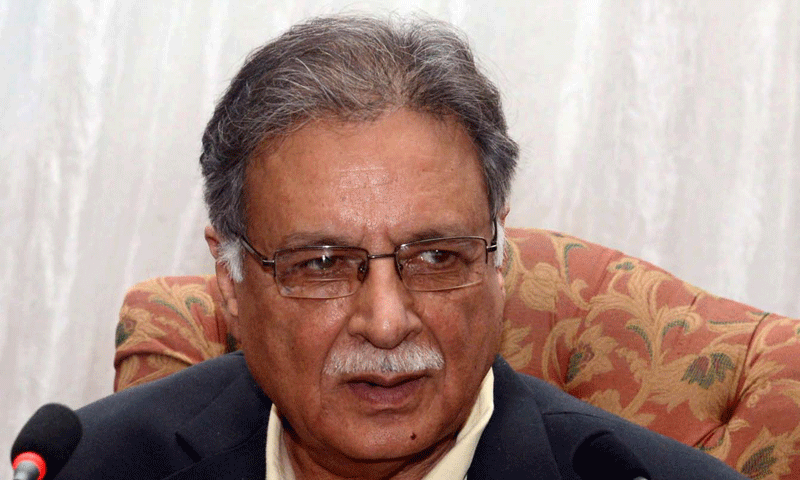
ISLAMABAD: Federal Minister for Information and Broadcasting Pervez Rashid on Thursday said Pakistan Tehreek-i-Insaf (PTI) chief Imran Khan's hatred for the Pakistan Muslim League - Nawaz (PML-N) was so deep that it could drive the cricketer-turned-politician to hurl abuses at the state itself, DawnNews reported. Addressing a workshop on budget reporting, Rashid said Khan should apprise the public about the last time he went to inquire after the health of an injured soldier. The minister said that if the war against terrorism was America's war as the PTI chief claimed, then whose war was being fought by those who attacked mosques, military installations and schools in Pakistan. In the same vein, Rashid said that while Khan flew in private jets himself, he could not appreciate the idea that the poor should be provided with a metro bus service. He accused Khan of punishing the public for his defeat in the May 2013 elections, adding that PTI would lose the 2019 election as well. The minister moreover said that while children suffering from measles in Khyber Pakhtunkhwa were dying due to bogus medicine, Khan did not have the decency to visit their families. Regarding the coming budget, Rashid said the government would prepare a transparent plan which would not entail any discretionary funds for any ministers and nor will there be any other secret funds. He said the government had only seven days to formulate last year's budget, adding that the PML-N still takes full responsibility for it even though it didn't have much of a role in the preparation. Rashid also claimed that after a period of five years, the country would be able to produce more electricity than it has produced in the past 60 years.

13-year-long hunger striker pins hopes on Modi

NEW DELHI: An Indian activist who has been on hunger strike for over 13 years said on Wednesday she was pinning her hopes of finally leading a normal life on new Prime Minister Narendra Modi. Irom Sharmila, 42, who is force-fed by a drip through her nose, said she wanted to meet Modi in hopes of ending the military’s alleged human rights abuses in her northeastern home state of Manipur. Escorted by more than a dozen police officers, Sharmila appeared in a court in New Delhi in connection with long-running charges against her of attempting to commit suicide, a crime in India. Sharmila told a judge that she wanted a “settled life as others do” but would not break her fast until a controversial law that covers large parts of restive northeastern India and Kashmir was repealed.—AFP Published in Dawn, May 29th, 2014

SC irked by misreporting of its proceedings

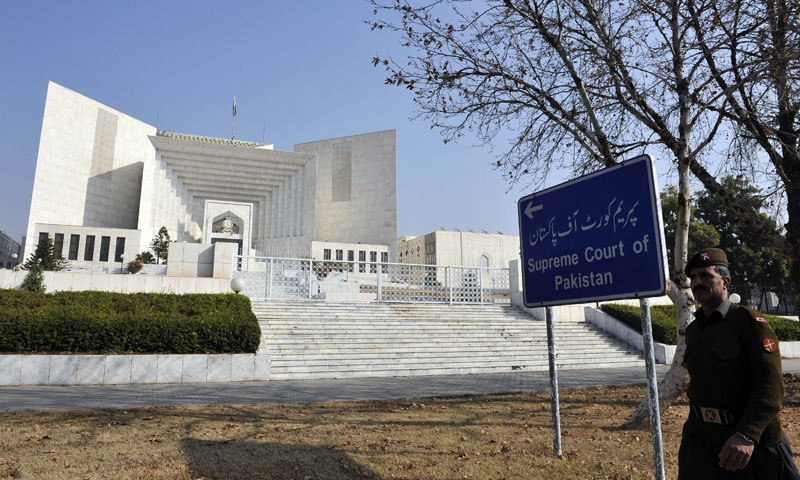
ISLAMABAD: A statement attributed to a Supreme Court judge in a section of the press dominated Wednesday’s hearing initiated on defamatory and objectionable banners placed against him in different places of the capital. A two-judge bench headed by Justice Jawwad S. Khawaja asked Attorney General Salman Aslam Butt to take up with the government the matter about what the court called deliberate misreporting of its proceedings and consider devising a code of conduct for the media and, if needed, introduce some legislation in this regard. “We cannot allow putting at stakes institutions of the state,” observed the court which had asked Interior Secretary Shahid Khan and Intelligence Bureau Director General Aftab Sultan to submit reports on the overnight display of banners critical to the judge. On Tuesday, the court had asked the attorney general to go through the transcript of a television talk show and find out who was trying to attack and damage the reputation of key national institutions like the judiciary. On Wednesday, the AG submitted reports on behalf of the two senior government officers informing the court that Shafiq Butta, a painter who painted the banners, had been arrested along with his two associates Mohammad Nazar and Mohammad Waqar. Police have registered a case against them, but one Rashid from Rawalpindi who hired them could not be traced. The AG sought time to complete the investigation. But Advocate Taufiq Asif, who had brought to the notice of the court the critical banners, rejected the information and said the banners had been placed in different parts of the capital between 11pm and 5am on May 22-23. The banners were brought in two SUVs to the red zone, the most protected area of the capital, and Rs9,000 was given to the painter. When the court asked about the source of information, Mr Asif said it was privileged information. The court observed that it was not concerned about the content of the banners but worried about how these inflammatory banners had been put up inside the red zone. The bench referred to the 2012 petition of anchorperson Hamid Mir about a media commission and recalled that the court had also emphasised the need for developing a code of conduct to discourage irresponsible reporting in the print and electronic media. “Freedom of the press does not mean unbridled independence,” the court observed. The court then cited the news story in which it was reported that Justice Jawwad S. Khawaja had observed that banners against the judiciary had been put up when the court took up the missing persons’ case. The court regretted that some elements were bent upon creating a wedge and adding fuel to the fire. “No one can be given a free hand to do whatever they like to do,” it said. Khudayar Mohla, president of the Press Association of the Supreme Court, a body that regulates the reporters covering the apex court proceedings, informed the court that the association had drafted a code of conduct which had been circulated among its members for feedback. The code would be approved after the members came up with their suggestions, he added. Matiullah Jan, a senior court reporter, suggested that the government should not be asked to develop a code of conduct without consulting the stakeholders. He requested the court to issue contempt notices against a particular television channel and its anchorperson for hurling accusations against the judge in their talk show. Published in Dawn, May 29th, 2014

Pemra disowns another private members’ meeting

ISLAMABAD: Despite being ‘disowned’ by officials of the Pakistan Electronic Media Regulatory Authority (Pemra), its five private members convened another board meeting on Wednesday where they decided to push for the implementation of their earlier decisions. In their last meeting, the private members had resolved to suspend the licences of three Geo TV channels; Geo News, Geo Tez and Geo Entertainment. The decision was followed by a statement by a Pemra spokesperson who termed the meeting illegal and said that the private members did not have sufficient numbers or the authority to summon a meeting. The five private members who attended Wednesday’s meeting included Fareeha Iftikhar, Mian Shams, Israr Abbasi, Zeba Hassan and Shama Parveen Magsi. Speaking to the media after the meeting, Abbasi said the members had decided to push for the implementation of their earlier decision. “We will work to get the decision of May 20 meeting implemented,” he said. None of the seven government members of the Pemra board attended the meeting and a Pemra official told Dawn, “Today’s meeting, just like the meeting of May 20, was not notified by the authority, therefore no invites were issued, nor were minutes of the meeting taken down.” An official meeting of the regulator was scheduled to be held on Tuesday, May 27, but was cancelled on the orders of the Islamabad High Court (IHC) when the appointment of Kamaluddin Tipu as an executive member was struck down. “The next meeting will be held on the order of the high court,” the official added. In the absence of a chairman and executive member, a meeting of the Pemra board can now only be called if six or more of the 11 members agree to it. The five private members do not have the necessary numbers to summon a meeting without cooperation from official members. Published in Dawn, May 29th, 2014

Three arrested over Wadh killings; tribal leader booked

QUETTA: Law enforcement agencies have arrested three suspects after registration of an FIR against a tribal elder, Mir Shafiq-ur-Rehman Mengal, and 100 others in connection with the killing of eight Levies personnel on Sunday in Wadh area of Khuzdar district. “Law enforcement agencies have arrested three suspects, including an injured man, in connection with the deadly attack on Levies check-post,” Balochistan Home Secretary Akbar Hussain Durrani said. A joint investigation team comprising officials of police, army and Inter Services Intelligence would conduct an investigation into the incident and submit a report in a month after which the case will be sent to court. He said an FIR had been registered against Shafiq Mengal, son of former Balochistan caretaker chief minister Mir Naseer Mengal, and 100 others, including some prominent tribal elders of the area, under relevant sections of the Pakistan Protection Ordinance, Anti-Terrorist Act and Pakistan Penal Code. Mr Durrani said the injured suspect had divulged information which would help in the investigation. Meanwhile, law enforcement agencies have launched a search operation in Wadh area. Abdul Wahid Shahwani adds from Khuzdar: Shafiq Mengal, chief of Haq-na-Tawar, has denied that the injured man arrested from Hub is a member of his organisation. Speaking at a press conference at his residence in Wadh, he alleged that Chief Minister Dr Abdul Malik Baloch had directed security forces to take action against workers of his organisation and tribal elders at the behest of a tribal chief and his political party. He claimed that some criminals wearing police and Levies uniforms had been deployed at check-posts along with personnel of law enforcement agencies to eliminate some tribal elders in fake encounters. He claimed that the criminals had killed Nazeer Ahmed and Mira Jee Das which caused the tragic incident of Sunday. He said that the case against him and his supporters had been registered three days after the incident at the behest of two tribal chiefs (Sardars). He alleged that the provincial chief and home secretaries had met the tribal chiefs in Karachi before the registration of the FIR. The home secretary was in Wadh on Sunday and had attended funeral of Levies personnel, he said and asked why the FIR was not registered on the same day. Shafiq Mengal alleged that after the formation of present federal and provincial governments, atrocities were being committed against activists of his organisation and 23 workers had gone missing after being kidnapped so far. However, he vowed to continue struggle against those “involved in the killing of innocent people”. Mir Attaullah Mengal, the brother of Shafiq Mengal, was present. Published in Dawn, May 29th, 2014

Govt completes first year without enacting a single law

ISLAMABAD: The Pakistan Muslim League-Nawaz (PML-N) government completed its first year in power with a unique distinction – it did not enact a single law. Although 11 bills were passed by the National Assembly in this period, apart from the finance bill for 2013-2014 (which does not require approval of the upper house), the current government could not get a single bill passed through the Senate and signed by the president. However, 12 ordinances were tabled in the first parliamentary year ending on May 31. The PML-N enjoys a near-absolute majority in the National Assembly but cannot even claim a simple majority in the Senate, where the main opposition PPP holds a majority. The second parliamentary year is set to begin on June 2 and a joint sitting of both houses has already been convened. According to data obtained from the National Assembly Secretariat, the lower house passed the finance bill in June last year, five bills in February this year, followed by three in March and two in April. These are currently awaiting debate in the Senate. As many as 43 private members’ bills and 13 government bills were introduced in the National Assembly during the first parliamentary year. However, all 56 are pending discussion in standing committees. On the other hand, the government tabled 12 ordinances, including four controversial anti-terror laws, before the parliament amid protests by opposition members. A comparative analysis of this data reveals that the current parliament’s legislative performance in its first year has been quite poor as compared to the first year performance of parliaments elected since 1985. In its first year of the government of Mohammad Khan Junejo, parliament approved 23 laws from March 20, 1985 to March 20, 1986. Benazir Bhutto’s first government approved 13 laws in its first year. The first Nawaz Sharif government got 24 laws approved from parliament in its first year. During Ms Bhutto’s second tenure, parliament passed 33 laws in its first year in office. Mr Sharif’s second government set a record when parliament approved 47 laws during its first year and a total of 74 bills were passed into law until Oct 12, 1999. The previous PPP government managed to pass only four bills in its first parliamentary year. Published in Dawn, May 29th, 2014

Raids on to arrest woman’s killers

LAHORE: Four police teams on Wednesday continued raiding residences and other places for the arrest of suspects involved in the brutal killing of a pregnant woman near the Lahore High Court on Tuesday. The woman was stoned to death by her family members for marrying a man of her choice. The suspects had intercepted 25-year-old Farzana on her way to the Lahore High Court and attacked her with bricks. Police booked her father, brothers, cousins and some other relatives. Muhammad Iqbal criticized the policemen who, he said, had only played the role of a silent spectator and never tried to save his wife from the attackers. Civil Lines SP Mufakhar Adeel said the Mozang police had registered a murder case against six nominated and over 20 unidentified suspects. He said the nominated suspects were victim’s father Azeem, brothers Zahid and Ghulam Ali, cousins Mazhar Iqbal and Jahan Khan and aunt Saeeda. He said the police had arrested victim’s father and recovered a pistol from his possession. The SP said that four police teams headed by the Nankana DPO, the SP and four inspectors were raiding residences and other places in Nankana and elsewhere for the arrest of suspects. He said the suspects had locked their homes and shifted to some other places in a bid to escape their arrest. He said the victim’s father told investigators that four people were involved in plotting the murder. Murdered: A man killed a woman when she refused to marry him in Awan Town on Wednesday. Police said 26-year-old Asma had been divorced around six months ago and was living with her parents with her two children. The suspect, identified as 25-year-old Zeeshan, was a labourer by profession. Police said both Asma and Zeeshan were residents of Awan Town and knew each other for around three years. Sabzazar Sub-Inspector Rasheed Ahmad told Dawn Zeeshan liked Asma and asked her to marry him but she refused. He said the suspect got enraged and shot Asma dead at her house. Her mother was also injured in the firing and was in a critical condition, according to hospital sources. Police arrested the suspect, who confessed to his crime, and recovered two pistols from his possession. Police moved the body to a morgue for autopsy and registered a case against the suspect on the complaint of victim’s father Rehmat Ali. Published in Dawn, May 29th, 2014

Man shoots wife at shelter home

NAROWAL: A man shot at and injured his wife critically at the Shelter Home here on Wednesday. Reports said a local magistrate had sent 26-year-old Shadman to the Shelter Home about one-and-a-half month back after she quarrelled with her in-laws and parents. Shadman had also filed a suit for divorce against her husband, Zaheer Ahmad, who was living abroad. After his return from abroad a few days back, Zaheer met her wife at the Shelter Home to reconcile the matter. On Wednesday, Zaheer along with his two children and brother-in-law again came to the Shelter Home to see his wife with the permission of the magistrate. After some time, Zaheer sent his children home with his brother-in-law and then injured his wife with a gunshot fire. She was rushed to DHQ Hospital. Muhammad Aslam, a policeman, also fired at his daughter Shadman at the hospital emergency, but she luckily escaped unhurt. She was shifted to a Lahore hospital in a critical condition. Police have yet to register a case. Shelter Home Superinten-dent Sidra refused to comment on the incident. Published in Dawn, May 29th, 2014

Snowden says he wants to return to US

WASHINGTON: Fugitive self-proclaimed spy Edward Snowden said Wednesday he wants to return home, as he defended his massive leak of US intelligence secrets, saying abuses of constitutional rights left him no choice. “If I could go anywhere in the world, that place would be home,” Snowden said almost a year to the day since he revealed a stunning US surveillance dragnet mining data from phones and Internet companies around the world, including Europe. “From day one, I said I'm doing this to serve my country. Whether amnesty or clemency is a possibility, that's for the public to decide,” he told NBC in his first interview with US television since the scandal broke in early June last year. And he sought to defend himself against charges led by the US administration that he is a hacker and a traitor who endangered lives by revealing the extent of the NSA spying program through the British daily The Guardian. “The reality is the situation determined that this needed to be told to the public. You know, the Constitution of the United States has been violated on a massive scale,” he said. “How can it be said that this harmed the country when all three branches of government have made reforms as a result?” Snowden asked, looking relaxed and calm during the interview in a Moscow hotel. But top US officials laughed off the idea of a clemency. Secretary of State John Kerry said the 30-year-old former CIA employee should “man up” and return to face trial. Snowden also alleged he was not just a low-level contractor working for the CIA, as the White House has repeatedly insisted. “I was trained as a spy in sort of the traditional sense of the word in that I lived and worked undercover overseas -- pretending to work in a job that I'm not -- and even being assigned a name that was not mine,” he told NBC. Snowden said he had worked covertly as “a technical expert” for the Central Intelligence Agency and the National Security Agency (NSA). But National Security Advisor Susan Rice disputed his contention, replying “no” when asked by CNN if he had been a highly-trained undercover spy. Snowden however blamed the United States for forcing him into exile in Russia. 'Trapped' “The reality is, I never intended to end up in Russia,” he said in the interview recorded clandestinely last week in Moscow. “I had a flight booked to Cuba onwards to Latin America and I was stopped because the United States government decided to revoke my passport and trap me in Moscow Airport,” Snowden told NBC. “For a supposedly smart guy, that's a pretty dumb answer, frankly,” Kerry hit back. Snowden should do the patriotic thing and return to the US to face espionage charges for leaking hundreds of thousands of classified documents, the top US diplomat said. “This is a man who has betrayed his country,” Kerry told CBS News. “He should man up and come back to the US. “ “The fact is, he has damaged his country very significantly. I find it sad and disgraceful. “Snowden was granted asylum by Russia in August 2013 after spending weeks holed up in Moscow's Sheremetyevo Airport, having flown in from Hong Kong. He says he cannot return to face trial because of the “extraordinary charges” laid against him which would bar him from using classified information in his defense. Snowden said he had had no contact with Russian President Vladimir Putin since he was given in asylum, and denied he was being paid by the Russian government. And he said he missed his family, colleagues and his work, insisting he was a patriot, still serving the US government. “Sometimes to do the right thing you have to break a law,” he insisted. “Being a patriot doesn't mean prioritising service to government above all else. Being a patriot means knowing when to protect your country, knowing when to protect your constitution,” Snowden added. “If Mr Snowden wants to come back to the United States today, we'll have him on a flight today,” Kerry told NBC. His temporary asylum expires August 1 and Snowden said “if the asylum looks like it's going to run out, then, of course, I would apply for an extension. “ “I may have lost my ability to travel, but I have gained the ability to go to sleep at night, put my head on the pillow and feel comfortable that I have done the right thing even when it was the hard thing. I'm comfortable with that,” Snowden concluded.

IED blasts kill three soldiers in northwest Pakistan

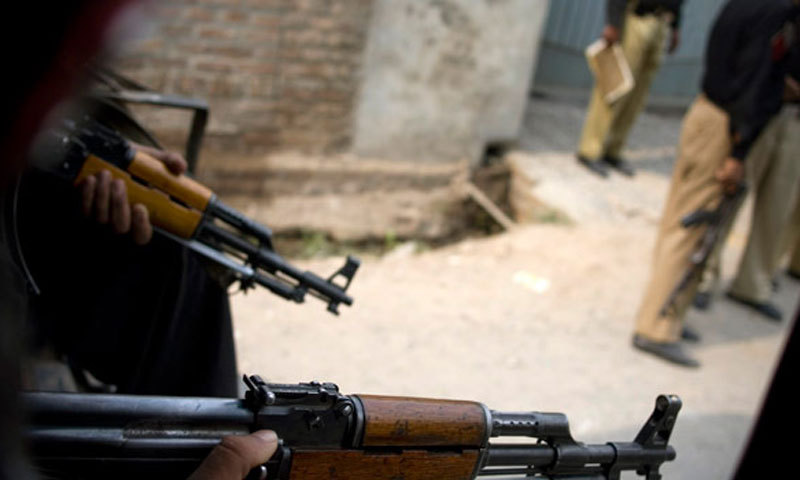
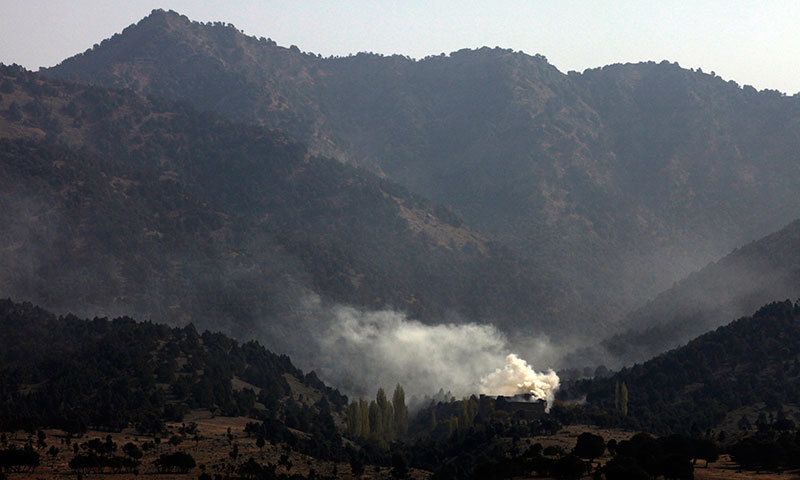
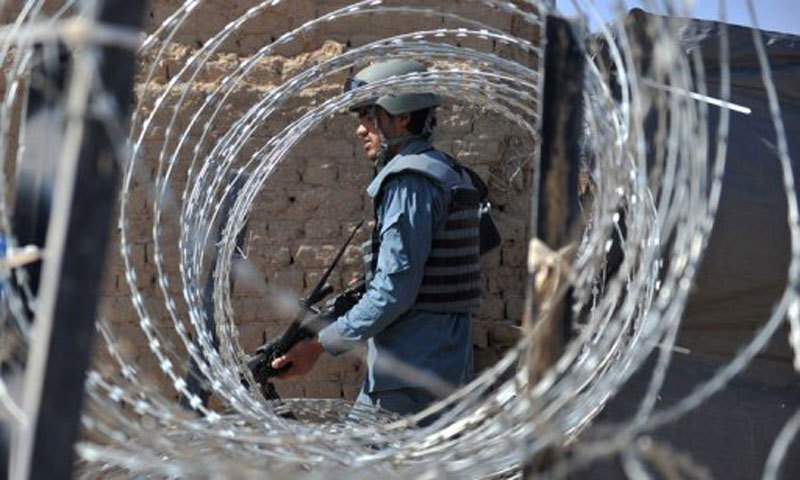
PESHAWAR: At least three soldiers were killed and two others were injured on Thursday in two improvised explosive device (IED) blasts in the country's northwest, sources in the Inter-Services Public Relations (ISPR) told Dawn. The devices were planted along a roadside and targeted a team of soldiers patrolling on foot and inspecting the area near Nosher Fort bordering North Waziristan. A statement issued by the military spokesman said: “Two soldiers embraced martyrdom and three were injured early in morning in two IED blasts planted by terrorists on a roadside near Nosher Fort, bordering North Waziristan." Another issued a short time later added one of the wounded subsequently died. Other reports claimed that it was a landmine blast. Police personnel and rescue teams reached the site of the attack and shifted the bodies and the injured to a nearby hospital. AFP adds: “A patrolling team was inspecting the Bannu-Miramsah road to build a military check post when they stepped on an IED,”a senior security official based in Peshawar said. He said the incident occurred around 16 miles east of Miramshah. “It's a standard operating procedure that a patrolling team on foot inspects the area before setting up a temporary checkpoint,” he said.

Bombs kill one Afghan policeman; Nato soldier dies

KANDAHAR: Two roadside bombings, minutes apart, killed an Afghan policeman and wounded four others in the southern city of Kandahar on Thursday, an Afghan officer said. Officer Shamsullha, who like many Afghans goes by only one name, said the first explosion struck a police car as it drove down a street in Kandahar city in the morning hours, killing one officer and wounding two. As other policemen who were nearby rushed to the site of the blast, a second explosion went off, wounding two policemen, said Shamsullha. No one immediately claimed responsibility for the attack. The Taliban have launched their annual spring offensive, promising to step up attacks against Afghan security forces in a bid to undermine the Western-backed government as foreign combat troops prepare to withdraw from the country by the end of the year. Also on Thursday, the international coalition said one of its service members died in a helicopter crash in southern Afghanistan the day before. The cause of Wednesday's crash was not immediately known and the Nato statement did not provide other details. Coalition policy is for home countries to identify their military dead. But an Afghan police officer, Atta Mohammad, said the crash occurred in Kandahar province's Maruf district around midnight on Wednesday. Along with the Nato soldier killed, 15 coalition service members were also hurt in the crash, he added. Mohammad said the helicopter accidentally struck the district's communication antenna, which caused the crash.

Indian cousins found hanging from tree after gang-rape: police

LUCKNOW: Two teenage girls have been found hanging from a tree in a northern Indian village after they were gang-raped by five men, police said Thursday. A post-mortem report indicated that the cousins from the low-caste Dalit community, aged 14 and 15, hanged themselves late Tuesday after being attacked in a village in the Budaun district of Uttar Pradesh state. “The report suggests ante-mortem hanging, which means the girls probably committed suicide. But we will take into account all aspects before coming to a conclusion,” Atul Saxena, Budaun police chief, told AFP. The prime accused Pappu, who goes by one name, was arrested after an initial police complaint was registered by the girls' relatives against five men for gang-rape, murder and child sexual abuse, Saxena said. “A team of around 50 police officers is on the lookout for the absconding accused,” he added. Saxena could not confirm the exact ages of the accused, but said they were in their “late teens”. The incident sparked protests by the victims' families and villagers, who accused the police of apathy early on Wednesday when the bodies were discovered. The attack is the latest to highlight India's dismal record on preventing sexual violence, despite tougher laws and efforts to change attitudes towards women after the fatal gang-rape of a student in New Delhi in December 2012 shook the nation's conscience. Earlier this year, a young girl was gang-raped in a remote village in West Bengal state on orders from tribal village elders who objected to her relationship with a Muslim man.

Malik Ishaq acquitted in three cases over insufficient evidence

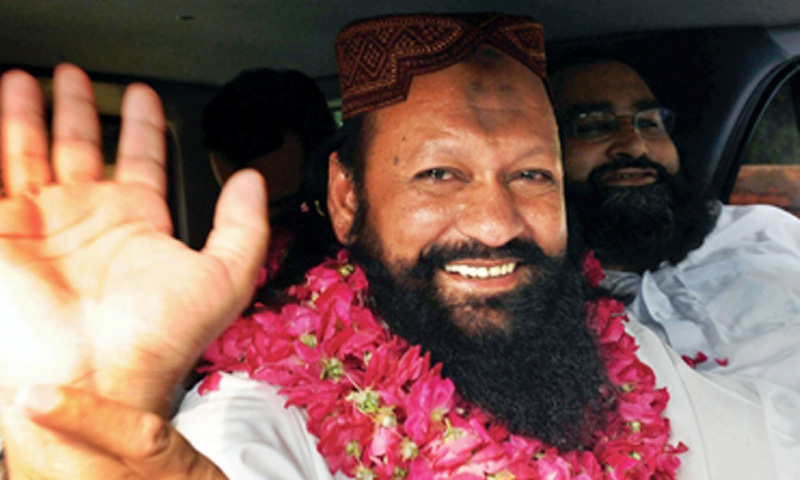
RAWALPINDI: A Rawalpindi anti-terrorist court on Thursday acquitted Malik Ishaq, chief of proscribed Lashkar-i-Jhangvi (LJ) militant group, in three cases relating to terrorism, DawnNews reported. Judge Rana Masood Akhtar issued acquittal orders for Ishaq in the cases, saying the evidence against Ishaq was not sufficient for further proceedings. The had been registered against Ishaq at police stations in Attock, Hazro and Talagang and he was also previously arrested over charges relating hate-speech and inciting violence. Having faced charges relating to killing of more than 100 people, most of them Shia Muslims, and the attack on the Sri Lankan cricket team in March 2009, Ishaq has spent around 15 years in Pakistani jails. He was initially a member of Sipah-i-Sahaba Pakistan (SSP), a banned Sunni extremist group but later dissociated himself from it for his alleged ‘violent policies’ and formed his own outfit. The LJ was proscribed by the Pakistan government as a terror group soon after its inception in early 1990s. After reaching an agreement with Ahle Sunnat Wal Jamaat (ASWJ) chief Ahmed Ludhianvi, Ishaq joined as second-in-command of the former SSP in 2012. In Feb 2014, the United States added Ishaq to its list of most wanted international terrorists along with keeping the LJ on a list of international terrorist organisations.

SHC reserves ruling on plea seeking removal of Musharraf's name from ECL

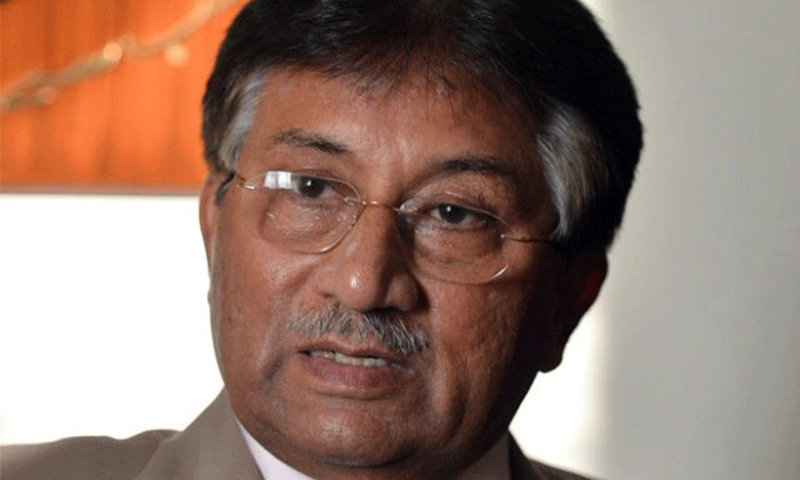
KARACHI: The Sindh High Court (SHC) on Thursday reserved its ruling on a petition calling for the removal of the name of former military ruler Gen (retd) Pervez Musharraf from the exit control list, DawnNews reported. A two-judge bench of the SHC, headed by Justice Muhammad Ali Mazhar, heard the petition. The ruling was reserved after Musharraf's counsel Barrister Farogh Naseem and Attorney General Pakistan Salman Aslam Butt concluded their arguments on the matter. Naseem stated in his arguments that Musharraf's name should be removed from the ECL as his backbone had a fracture and the requisite treatment was not possible in Pakistan. He added that the case against Musharraf did not involve charges of treason but of abrogating the country's constitution. Naseem further said that Musharraf was being victimised and that his trial was being pursued for political reasons and not to ensure the administration of justice. Speaking to media representatives, Butt said that if Musharraf managed to leave the country, he would not return. He added that Musharraf did not trust the judicial process to work in his favour, adding that the cases against the former army strongman were of a grave nature. The attorney general insisted that Musharraf was faced with treason charges, adding that deciding on whether or not to remove his name from the ECL did not fall within the remit of the SHC.

Woman stoned to death in Lahore: PM directs Punjab to submit report

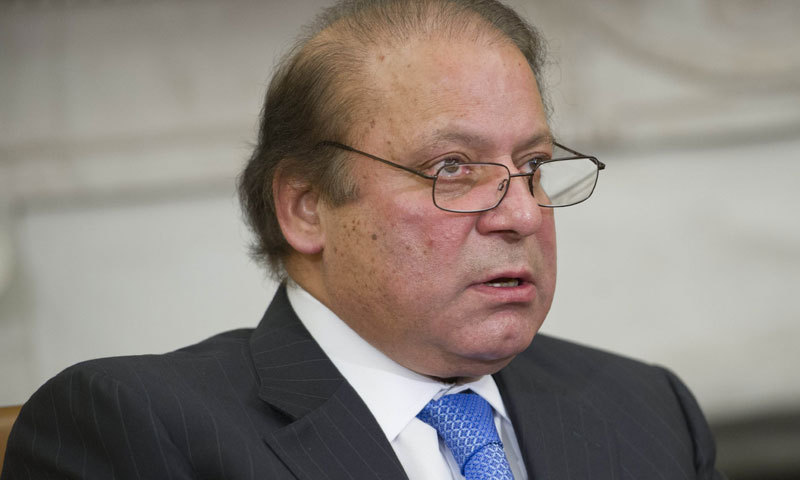
ISLAMABAD: Prime Minister Nawaz Sharif has taken notice of the murder of 25-year-old pregnant woman Farzana Parveen who was stoned to death near the Lahore High Court on Tuesday morning by members of her family allegedly for marrying a man of her choice, DawnNews reported. The premier on Thursday directed Punjab Chief Minister Shahbaz Sharif to submit a report on the incident by the evening. The prime minister has said that those involved in the murder which took place in broad daylight in Punjab’s provincial capital of Lahore should be brought to book. Moreover, on Wednesday, police teams raided a number of residences and other places to arrest those suspected of involvement in the brutal killing. Farzana was attacked with bricks when the attackers intercepted on her way to the LHC. Police booked her father Azeem, brothers Zahid and Ghulam Ali, cousins and some other relatives. The brutal act took place on Fane Road, one of the busiest roads in Lahore, when Farzana, of Nankana Sahib, her husband Mohammad Iqbal and in-laws, left the office of her counsel for going to the court. Her father and brothers had got an abduction case registered against her husband and she had filed a petition in the LHC to get the case quashed. She was to appear before the court on Tuesday to record her statement in favour of her husband.

Interview: ‘US drones are better than PAF jets’

THE US drones were better weapons to use against militants as compared to Pakistan Air Force jets, believes Rustam Shah Mohmand, a Pakistan Tehreek-i-Insaf-appointed member of the government committee to negotiate with the Tehreek-i-Taliban Pakistan (TTP). “Drones are more precise in targeting militants than the jets the air force is using, which cause heavy collateral damage,” he told Dawn. “The government should have formed a strategy in collaboration with the US to carry out strikes using drones.” Last year, the Pakistan Tehreek-i-Insaf (PTI) organised sit-ins over several months to force the US government to bring drone strikes to an end, and the Obama administration practically halted these operations. However, Mr Mohmand, whom PTI chief Imran Khan declared the party’s point man on the TTP and militancy, now thinks Pakistan should have utilised the accuracy of drones. “Pakistan should have had acquired drones from the US and operated them for the North Waziristan strikes, or it should have had collaborated with the US over authentic information about ground targets to reduce collateral damage,” he said. The former bureaucrat who has served as Pakistan’s ambassador to Afghanistan, federal interior secretary, and political agent in Khyber and South Waziristan Agencies added that collateral damage caused by PAF jets in North Waziristan has forced several families to migrate to Afghanistan. “Many civilians have been killed in the recent air strikes,” he commented. “Many markets, bazaars, shops and houses have been destroyed. This has forced hundreds of families to migrate to the Afghanistan province of Khost despite the fact that American forces bombard those areas. They are so frustrated that they prefer Khost over Bannu despite the unrest in Afghanistan.” North Waziristan Agency is now the focus of the government given that most of the militants have reportedly moved here from South Waziristan. “All of the leadership is in North Waziristan,” said Mr Mohmand. “Almost 80 per cent of the Mehsud tribes have left South Waziristan.” Peace talks In Mr Mohmand’s view, the strikes will also have an impact on peace talks with the TTP. “As far as the peace talks are concerned, the Mohmand and Bajaur factions of the TTP have already announced that negotiations can’t go ahead in the shadow of the air strikes,” he explained. “The North Waziristan militants are on the run and are involved in infighting so they are unable to decide anything.” According to Mr Mohmand, “contact was made between Maulana Yousaf Shah and Qari Shakeel-ur-Rehman of the TTP shura two weeks ago. The Taliban conveyed the message that they are waiting for a second meeting with the government committee but then the air strikes spoiled the environment. We are now unaware about the Taliban’s mood, but I think that the government has to go back to talks even if it is after two months.” However, Mr Mohmand believes there were other reasons, too, that held back the peace process. “There was a lukewarm response from both sides,” he explained. “The government should have released at least eight to ten non-combatant prisoners to help the negotiators convince the TTP to release Professor Ajmal Khan, the sons of Salmaan Taseer and Yousaf Raza Gilani, and several other people kidnapped by them. But this never happened. Then, certain TTP leaders think that they won’t be getting amnesty, so the process could not work.” According to Mr Mohmand, “the militants asked for a safe place to hold talks with the government, in the Shaktoi area of South Waziristan, because of the lower presence of the army there and because they would have been able to sneak back into North Waziristan in case of an attack by the Americans. But the government refused to meet that demand, too.” Nevertheless, he says, “I believe that talks are the only way forward.” At the same time, he believes that the TTP is losing its strength. “They have differences and clashes among themselves,” he explained. “Then, there is the dearth of resources and volunteers, while the fighters are fatigued. The local population wants peace, so I don’t think they can continue longer in this situation. A low-key insurgency can prevail for the next 10 or 20 years, but it has become quite difficult for them to keep the full-scale insurgency going across the country.” Mr Mohmand also said that the number of foreign militants has also been reduced to a few hundred. “Up to 300 or 400 foreign militants remain in Pakistan,” he explained. “They are Uzbek, Chechen, Turkmen and Arabs.” He admits that the army has its justifications for the strikes after nine soldiers were killed in an attack on the forces, but opposes the widespread action. “It was wrong to expand the area of operation,” he asserted. “The strikes should have been confined to recognised targets only.” Asked about the possible result of the ongoing strikes and peace efforts, Mr Mohmand said that the government may be able to sign an accord with a faction of the TTP but several splinter groups would defy it. “For a permanent solution, you will have to involve local tribesmen and disarm the militants through talks,” he said. “Then you can give them amnesty and include them in the mainstream on the assurance of the tribal elders.” Published in Dawn, May 29th, 2014

Poet, author Maya Angelou dies at 86

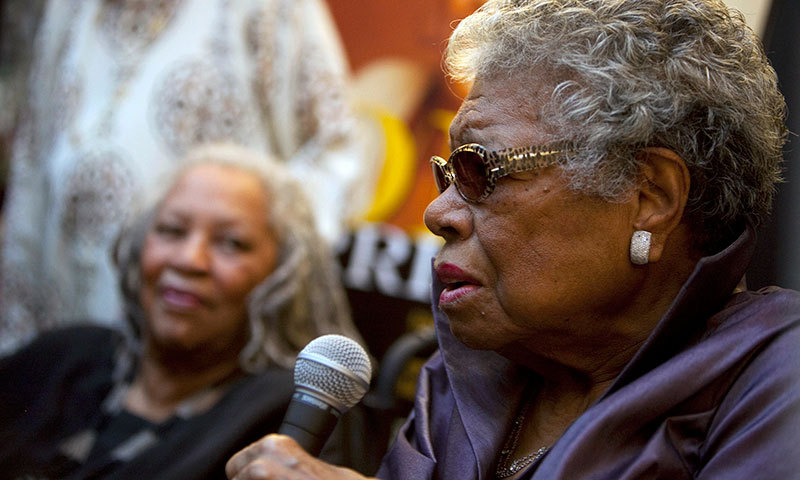
NEW YORK: Maya Angelou, a modern Renaissance woman who survived the harshest of childhoods to become a force on stage, screen, the printed page and the inaugural dais, died Wednesday, her son said. She was 86. Angelou's son, Guy B. Johnson, said the writer died at her home in Winston-Salem, North Carolina, where she had been a professor of American studies at Wake Forest University since 1982. Tall and regal, with a deep, majestic voice, Angelou defied all probability and category, becoming one of the first black women to enjoy mainstream success as an author and thriving in virtually every artistic medium. The young single mother who worked at strip clubs to earn a living later wrote and recited the most popular presidential inaugural poem in history. The childhood victim of rape wrote a million-selling memoir, befriended Malcolm X, Nelson Mandela and the Rev. Martin Luther King Jr., and performed on stages around the world. An actress, singer and dancer in the 1950s and 1960s, she broke through as an author in 1969 with “I Know Why the Caged Bird Sings,” which became standard (and occasionally censored) reading, and was the first of a multipart autobiography that continued through the decades. In 1993, she was a sensation reading her cautiously hopeful “On the Pulse of the Morning” at President Bill Clinton's first inauguration. Her confident performance openly delighted Clinton and made the poem a best-seller, if not a critical favourite. For President George W. Bush, she read another poem, “Amazing Peace,” at the 2005 Christmas tree lighting ceremony at the White House. She was a mentor to Oprah Winfrey, whom she befriended when Winfrey was still a local television reporter, and often appeared on her friend's talk show program. She mastered several languages and published not just poetry, but advice books, cookbooks and children's stories. She wrote music, plays and screenplays, received an Emmy nomination for her acting in the 1977 miniseries “Roots,” and never lost her passion for dance, the art she considered closest to poetry. Her very name as an adult was a reinvention. Angelou was born Marguerite Johnson in St. Louis and raised in Stamps, Arkansas, and San Francisco, moving back and forth between her parents and her grandmother. She was smart and fresh to the point of danger, packed off by her family to California after sassing a white store clerk in Arkansas. Other times, she didn't speak at all. At age 7, she was raped by her mother's boyfriend and didn't speak for years. She learned by reading, and listening. At age 9, she was writing poetry. By 17, she was a single mother. In her early 20s, she danced at a strip joint, ran a brothel, was married (to Enistasious Tosh Angelos, her first of three husbands) and then divorced. By her mid-20s, she was performing at the Purple Onion in San Francisco, where she shared billing with another future star, Phyllis Diller. Angelou was little known outside the theatrical community until “I Know Why the Caged Bird Sings,” a book occasionally attacked for its content. In a 1999 essay in Harper's, author Francine Prose criticized “Caged Bird” as “manipulative” melodrama. Meanwhile, Angelou's passages about her rape and teen pregnancy have made it a perennial on the American Library Association's list of works that draw complaints from parents and educators. “I thought that it was a mild book. There's no profanity,” Angelou told The Associated Press. “It speaks about surviving, and it really doesn't make ogres of many people. I was shocked to find there were people who really wanted it banned. I still believe people who are against the book have never read the book.”

Non-bailable arrest warrants issued against Gilani, Amin Faheem

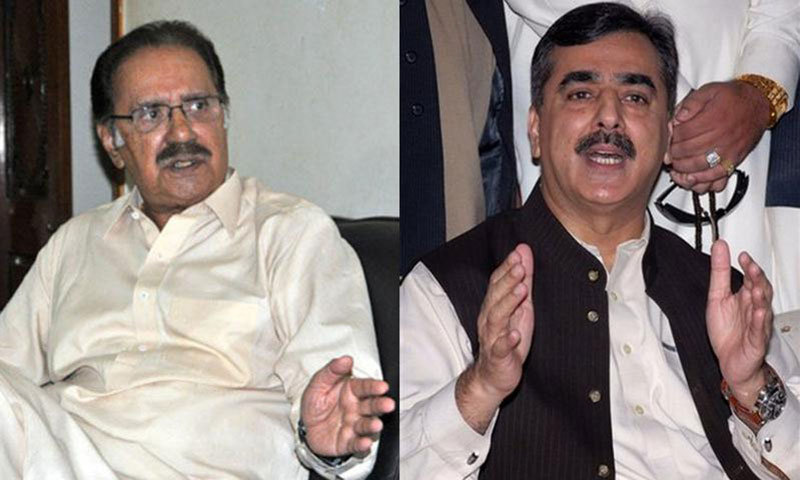
KARACHI: An anti-corruption court in Karachi on Thursday issued non-bailable arrest warrants for former prime minister Yousuf Raza Gilani and senior Pakistan Peoples Party (PPP) leader Makhdoom Amin Faheem, DawnNews reported. The warrants against the two were issued in a case relating to financial irregularities in the Trade Development Authority of Pakistan (TDAP). Subsequently, the court adjourned the hearing to June 17. The case in this regard had been registered by the Federal Investigation Agency (FIA) when Faheem was the commerce minister. Also, the court had previously issued three notices to Gilani and Faheem, requiring them to appear before it. The notices went ignored after which a bailable arrest warrants was issued against both leaders. Today, however, the court issued non-bailable warrants and adjourned the hearing to June 17.

Kashmir’s special status to go, says Modi’s minister

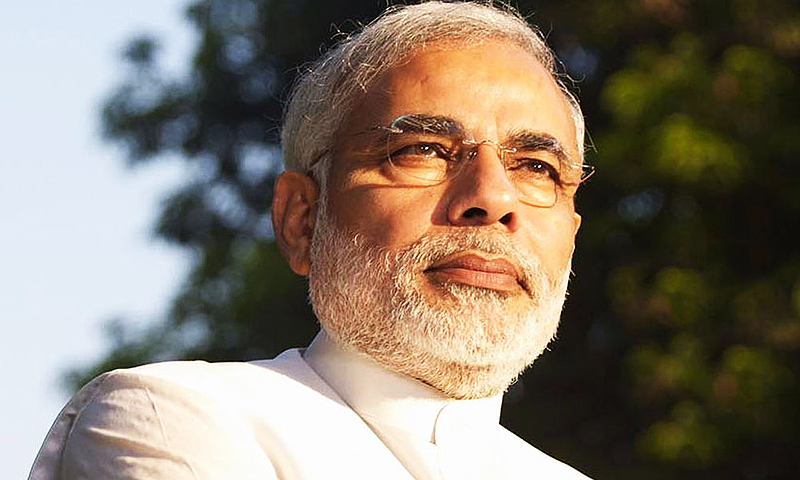
NEW DELHI: Indian Prime Minister Narendra Modi has begun the process to abrogate Article 370 that is said to legally bind the disputed Himalayan state with India, a key minister said on Tuesday. Within minutes of taking charge as the Minister of State in the Prime Minister’s Office, Mr Jitendra Singh triggered a controversy. He said the process of abrogating Article 370 that grants special autonomous status to Jammu and Kashmir had already begun and that they had started discussing the issue with several stakeholders in the state. In a series of tweets, J&K Chief Minister Omar Abdullah said “Article 370 is the only constitutional link between J&K & rest of India” and “Talk of revocation is not just ill-informed it’s irresponsible”. Mr Abdullah also said: “Long after Modi Govt is a distant memory either J&K won’t be part of India or Art 370 will still exist”. The Indian Express said Mr Jitendra Singh’s inclusion in the Modi government was a surprise given that he joined the BJP just two years ago. He called Article 370 a “psychological barrier”. Abrogation of Article 370 is an old demand of the Bharatiya Janata Party. Published in Dawn, May 28th, 2014

Nigeria’s ex-president holds talks to free girls

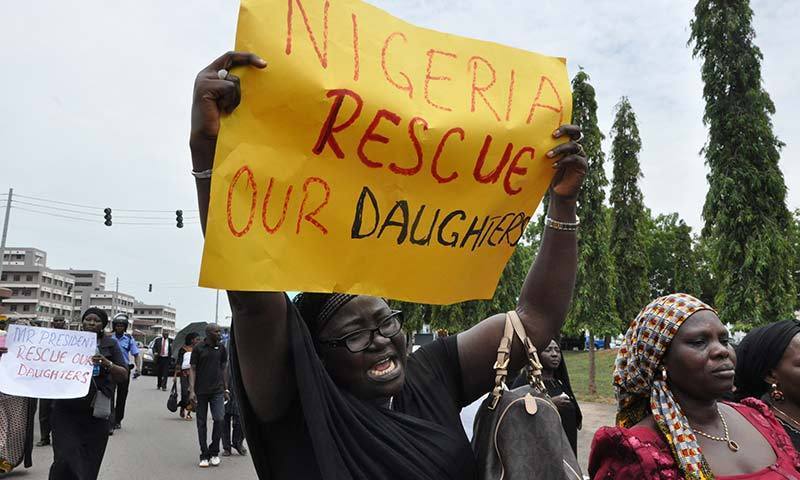
LAGOS: Nigeria’s former president Olusegun Obasanjo has met people close to the extremist group Boko Haram in an attempt to broker the release of more than 200 kidnapped schoolgirls, a source told AFP on Tuesday. Reports of the talks emerged as Boko Haram was blamed for fresh attacks on the security forces, public buildings and a school in its stronghold. Cameroon also said it had begun deploying 3,000 extra troops to buttress its border with Nigeria against the threat posed by marauding militants. On Monday evening, Nigeria’s Chief of Defence Staff, Air Chief Marshal Alex Badeh said the 223 girls still missing had been located but cast doubt on the prospect of any rescue by force. The talks last weekend at Obasanjo’s farm in Ogun state included relatives of senior fighters, intermediaries and the former president, the source said. Published in Dawn, May 28th, 2014

The coronation of the emperor

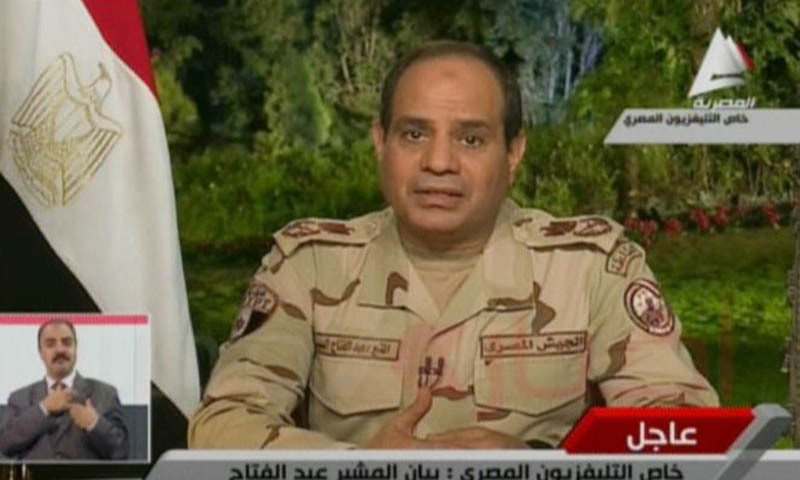
The coronation of the emperor By Robert Fisk Published about 19 hours ago An image grab taken from Egyptian state television Al-Masriya on March 26, 2014 shows Egypt An image grab taken from Egyptian state television Al-Masriya on March 26, 2014 shows Egypt's Defence Minister and armed forces chief General Abdul Fatah Al-Sissi announcing his resignation from his military position to stand in the upcoming Egyptian presidential elections during a televised address in Cairo. Sisi, faces no serious competition in the upcoming election, likely to be held before June, and is expected to easily win the poll riding on a wave of popularity. **************************************************************** NAPOLEON will be crowned. And after the revolution - after its terrors and deaths and instability and its Islamist Directory - who would begrudge the Emperor his coronation? Why, even the election posters for Field Marshal (retired) Abdel Fattah al-Sisi call him “President of Egypt”, and the only thing you notice, looking into his profoundly chubby, cheerful - might one say dull? - face is that he is in a suit and tie and, in one picture, reclining in a fine old armchair. This is no Emperor without clothes. And now here’s the shock for me. If I were an Egyptian, I’d have voted for Mr Sisi yesterday. Not that he’s inspiring. Anyone who tells his people that democracy may be 10 - or 20! - years away, is not going to go down in the history books as the Great Liberator. Daniel O’Connell he is not. But Mr Sisi has three things on his side: he is offering to free Egyptians from the past three years of pseudo-democracy under Mohamed Morsi; he has most of the Croesus-Gulf states - minus Qatar, of course - on his side to rescue Egypt from bankruptcy. And the Americans - rabbit on though they will about Egyptian human rights - will keep their mouths shut and their treasury open to the Egyptian army providing Mr Sisi guarantees the safety of Israel. And of course, Mr Sisi has offered what all folk want in hard times, especially Westerners and Israelis supposedly confronting the danger of Islamist terror in the Middle East: stability, stability, stability. Come to think of it - and speak not thus of our favourite Field Marshal - that’s what dictators always offer. But it’s easy for a foreign reporter to be patronising in Cairo these days, a Western liberal tut-tutting away at the re-infantilisation of a nation, a people who have fought and died for their dignity at the hands of Mubarak’s thugs and have then relapsed into a second political childhood, demanding the return of a dictator, another Nasser, another Sadat, another Mubarak - for he, too, remember, was a very senior member of the armed forces, the commander of the Egyptian air force, no less. Who cares now for the 1,500 Muslim Brotherhood civilians who died under the guns of the security forces last year? They featured in no one’s election campaign. But they were Egyptians, citizens of their country every bit as much as Mr Sisi. The reality, however, is that Mr Sisi is undoubtedly the man most Egyptians want. Who are we to deny his election if it produced the man Egyptians voted for? And that, as an Egyptian friend asked me yesterday, is democracy, isn’t it? Well yes, I tried to explain, but with the Muslim Brotherhood banned as “terrorists” and their supporters - surely several million are still left - with no one to vote for, what does this election mean? Surely the bland Nasserist Hamdeen Sabahi with 40 years of political huckstering (and poetry!) behind him - and he’s been the only opposing candidate to the Field Marshal - never believed that he represented the beating heart of Egypt? The problem for Mr Sisi - and he has many more to come, not least the economic collapse of his country - is what kind of mandate he can really claim to have. A tour of polling stations in central Cairo yesterday did not suggest that the masses were turning out in the numbers he wanted. I found one off July 26 Street without a soul on the premises save for policemen and soldiers. Ala’a, a friend of mine for 10 years, went to vote in a Giza schoolhouse on Monday evening - and was the only voter there. Heba Sharf, branch manager of a Cairo bookshop spent just one minute at her Heliopolis polling station on Monday because there were only two other voters present. A Sabahi voter, I must add, told me there were at least 300 people at his polling station yesterday morning. I wonder. Unsurprisingly, there were reports of government employees threatened with the loss of $100 from their pay packets if they did not prove they had voted. Journalists loyal to Mr Sisi - which, alas, means almost every television presenter and mainstream scribe in Cairo - were tweeting the news that Mr Sisi might withdraw from the polls if insufficient Egyptians exercised their democratic rights. Too many people, in short, have seen too few people voting. So what does it mean if Mr Sisi can claim 82 per cent of the vote – my favourite at the moment, for he has to do better than the 81.5 per cent that the old wheelchair President of Algeria claimed a few weeks ago - if the turnout, for example, was only 20 per cent? Certainly, it has got to be far smaller than the figures for the 2012 elections when liberty was as fresh as the flaming “tree of life” acacias now blooming across Cairo. Journalists outside Egypt have caustically suggested that Mr Sisi is neither Nasser nor Sadat, but “Mubarak in all his splendour” - this from Wael Qandil in the inevitably Qatari-backed Al-Arabi al-Jadid. Al-Musri al-Youm, published in Cairo, recalled, of course, the happiness of Egyptians when Mr Sisi announced that there were “no more Muslim Brothers”. There would be no more “religious officials”, the great man said. “The only man in charge of what goes on in the country ... is the head of state. I am presenting myself before the people, and I am telling them: I am the man in charge of values, of principles, morals and religion.” Is this really the stuff of Egyptian dreams? Heba Sharf, the bookshop manager, talked of the growing disappointment of Egyptians after Mubarak’s overthrow and the failure of the 2011 revolution to produce mature leaders - indeed, any leaders at all. This, of course, is to Mr Sisi’s advantage. If the revolution was hijacked by Islamists - a popular narrative in the Western press - then the Field Marshal was the only man standing, untramelled by scandal (let us here forget the Egyptian army’s vast ownership of real estate, factories, etc) or impropriety. All we must forget is that leaders of that self-same 2011 revolution - no Islamists they - have themselves now been banged up in jail. Where the catch comes in all this is that neither Mr Sisi nor Sabahi – who spent a couple of weeks in jail under Mubarak - have explained their campaign policies. Both promised detailed plans for the future economy but Mr Sisi’s spokesman announced, incredibly, that if the Field Marshal published his proposals, he would be forced to waste too much time replying to questions from the electorate. No one, however, questions Mr Sisi’s irritation with the United States nor his new-found relationship with the Russians. Vladimir Putin is the taleb to Egyptians - the fox - an animal much admired when cunning rather than courage is a necessary commodity for survival. The backcloth to all this history-making is that Egypt, with its 94 million people - a population now growing by one million a year - has little influence in the Arab world, let alone outside, and is propped up only by Saudi cash and US grants. But if Egyptians were freed from fear by their revolution in 2011 - and again in 2012, if Morsi’s overthrow is to be regarded as a counter- revolution rather than a military coup - then they will return to the streets again if they are sufficiently humiliated or abused. One of Mr Sisi’s posters yesterday lauded the Field Marshal’s presidency as “the way to regain the Egyptian state”. This was pretty much Napoleon’s tune after 1789 and its subsequent bloodbath. But Napoleon, as we all know, met his Waterloo. By arrangement with The Independent Published in Dawn, May 28th, 2014

Private guards’ strength is more than double of police in Karachi

KARACHI: As the city police operational strength of less than 27,000 officials has remained stagnant over the past five years, the number of private security guards in the city has crossed the 55,000 mark amid a growing security threat, it emerged on Tuesday. The situation has proved a boon for the private security industry in the metropolis where a single policeman protects the lives, property and legitimate interests of 1,524 people on average. Data shared by the police shows that Karachi enjoys the services of total 26,847 personnel for active policing, while over 125 companies are offering services of some 55,000 private security guards to individuals and organisations according to the figures compiled by the All Pakistan Security Agencies Association (APSAA). “There are some 55,000 private security guards registered with our companies operating in Karachi,” said Nisar Sarwar, chairman of the APSAA. Police rules fix the minimum ratio as one constable to 450 people He added: “In the south zone [comprising Sindh-Balochistan region with Karachi as its hub], we have some 143 registered members and nearly all of them are based in Karachi and doing their duty here. “As the demand has been increasing gradually, the number of security guards following this trend has definitely risen over the years.” On the one hand the rising trend of hiring private guards has brought more and more business opportunities for private companies, but on the other, it reflects the vulnerable security scene of the port city that has the lowest average of policemen per citizen in the region despite generating more than half of the national revenue. A recent study carried out by the Karachi police and shared with the media indicated that the available strength of 26,847 law enforcers for the city is much below the requirement and a policy in this regard is required to be reviewed for the vibrant city of 22 million people. “Of the 26,847 policemen, 8,541 are deployed for security purpose [protecting individuals and sensitive installations] and 3,102 personnel are deputed for investigation,” stated the police study. “Only 14,433 policemen are there to maintain law and order and protect the lives and properties of 22 million people of Karachi. The 14,433 officials work on two shifts of 12 hours each, indicating an average of one policeman for the protection of 1,524 people.” According to the Police Rules Chapter-2, it said, the total strength of police for watch and ward should not ordinarily exceed the ratio of one constable to 450 people. A senior official believes it’s not only the ‘alarmingly low’ number of sanctioned police force for Karachi that has affected the overall performance of the department, the lethargic process of fresh recruitments has also been a hurdle towards better policing. “There is hardly a police station in the city that functions with its sanctioned strength,” said a senior officer. He added that 8,541 policemen from the available strength had been performing security duties of individuals, including politicians, legislators, high officials, businessmen, social figures and religious personalities. “Some major cities of the world having similarities with Karachi in living conditions and crime culture are also far ahead in terms of police resources. In London, one policeman is responsible to serve 152 people, in New Delhi, 291 citizens are protected by a policeman and in New York, a police official serves 237 people. Even in Lahore, one policeman is dedicated for every 337 people.” Published in Dawn, May 28th, 2014

Fazlur Rehman ‘endeavours’ to forge alliance

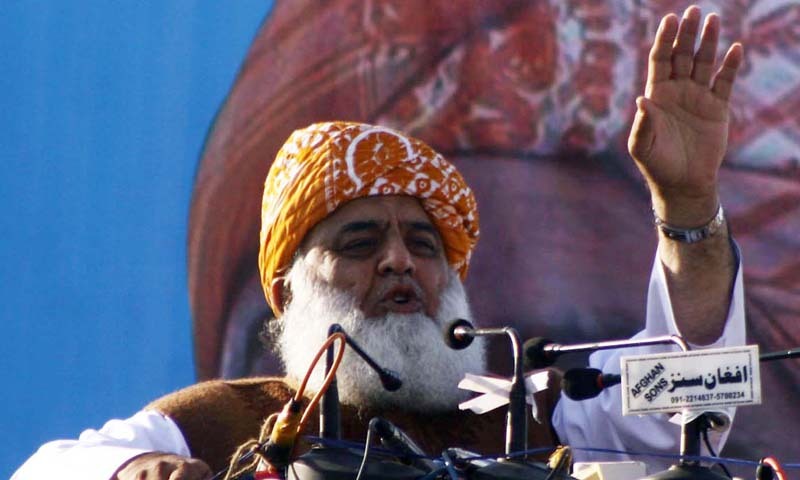
LAHORE: In continuity of his efforts to cobble together religious parties in an alliance, Jamiat Ulema-i-Islam (Fazal) chief Maulana Fazlur Rehman on Tuesday visited JUP President Pir Ijaz Hashmi and other leaders here. The Maulana had called on Jamaat-i-Islami emir Sirajul Haq on Monday. Talking to reporters after his meeting with Mr Hashmi, he reiterated his desire to set up a platform of Islamist parties to counter the ‘conspiracies being hatched to secularise the country’. Says contacting religious leaders to resolve their mutual differences Terming (PTI chairman) Imran Khan and (Pakistan Awami Tehreek leader) Tahirul Qadri the representatives of ‘western secular ideology’, he said to block them was the utmost responsibility of religious parties of the country. He said religious parties had been cornered and were under pressure for being blamed for extremism in the country. A joint strategy was need of the hour to cope with the situation, he added. The JUI-F chief said he was contacting religious leaders to resolve their mutual differences and create an atmosphere conducive to forging national unity and solidarity. He said the prevailing political and security situation also figured in his talks with the JUP leadership. Fazlur Rehman said peace negotiations with the Taliban had come to an end as a fierce military operation had been launched in North Waziristan in which scores of innocent people, including women and children, had been killed, while their houses, crops and cattle destroyed. Saying that without the establishment’s nod no political government could hold peace talks with the Taliban, he added that so far the powers that be did not seem to be in a mood to engage the militants in talks. Mr Hashmi regretted that successive governments frustrated the people by not enforcing Sharia and the Constitution, and adopting ad hoc policies for their own interests. He said Nawaz’s visit to India would remain unsuccessful unless the core issue of Kashmir was resolved. He said the present media crisis was the product of non-journalist anchors, who were alien to the norms of the profession. jamaat: The Jamaat-i-Islami has demanded recovery of Pakistan’s money stashed in foreign banks and fixing Rs15,000 as minimum wages for workers. At a press conference on Tuesday, Punjab JI chief and MPA Dr Waseem Akhtar demanded the government bring back more than $200 billion plundered from the country by corrupt politicians and bureaucrats and deposited in Swiss banks. He also demanded raising the minimum wages to Rs15,000 and 50pc raise in salaries and pensions of government employees. Seeking a change in taxation policy, the Jamaat leader suggested fixing 75 and 25 as the ratio of direct and indirect taxes, respectively. All kinds of income, including from farms, which was above Rs600,000 should be brought into the tax net while doing away with sales tax on agriculture inputs, he said. Dr Akhtar sought interest-free loans up to Rs500,000 for unemployed youth and payment of Rs3,000 and Rs5,000 per month as unemployment allowance to graduates and postgraduates until they secured a job. Meanwhile, Jamaat-i-Islami Secretary-General Liaquat Baloch criticised Prime Minister Nawaz Sharif’s visit to India, saying it proved counter-productive “as expected” and created more problems for the country. Published in Dawn, May 28th, 2014

Students in eight colleges forced to drink ‘sewer water’

RAWALPINDI: College students in the garrison city are being forced to drink water tainted with sewage, contaminated due to a faulty sewerage system which has been mixing effluent with the water supply lines in at least eight colleges of Rawalpindi. A letter available with Dawn reveals that the education department has asked the provincial building department to look into the matter. Meanwhile, an official of the education department said that the principals of the colleges in question had been complaining about the faults in the sewerage system. The official added that an inspection team from the National Institute of Health (NIH) found the presence of bacteria in a tubewell installed at Vaqarun Nisa College. On the directions of the provincial education department, the principal decided to close the well last month. He added that there are also apprehensions that the water in Government Degree College for Boys Satellite Town, Muslim Town Girls College, Degree College for Women Dhoke Kala Khan, Degree College Dhoke Elahi Bux and Degree College Zafarul Haq Road was also contaminated due to damaged sewerage system. NIH team finds bacteria in samples from one college; red-tape delaying action On May 21, the directorate of colleges wrote to the building department of Rawalpindi, requesting it to check the problem and prepare rough cost estimates so money for its repair could be included in the next Annual Development Programme (ADP). The letter, a copy of which is available with Dawn, outlined the problem being faced by the colleges, all of which are located in NA-56. Director Colleges Rawalpindi Division Prof Humayun Iqbal said that the college principals met Pakistan Muslim League-Nawaz (PML-N) leader Mohammad Hanif Abbasi last month to discuss the missing facilities in the colleges. They also raised the issue regarding the contamination of drinking water in the colleges, due to old and dilapidated sewerage system. “It does not mean that all the students, who are pursuing their education in NA-56 colleges, are drinking contaminated water. All the colleges have multiple sources of drinking water,” he said. The director colleges further said that after the meeting, Hanif Abbasi directed his office to fix the problems. Talking about the letter written by his office to the provincial building department, Mr Iqbal said: “We wrote the letter on the directions of Hanif Abbasi to check the problem and prepare cost estimates for the inclusion in the next ADP for the upgradation of the sewerage system, which could pollute the clean drinking water,” he said. Pakistan Tehrik-i-Insaf Chairman Imran Khan is the member of the National Assembly representing NA-56 in parliament. Published in Dawn, May 28th, 2014

Pakistan fully capable of defending itself, PM Nawaz

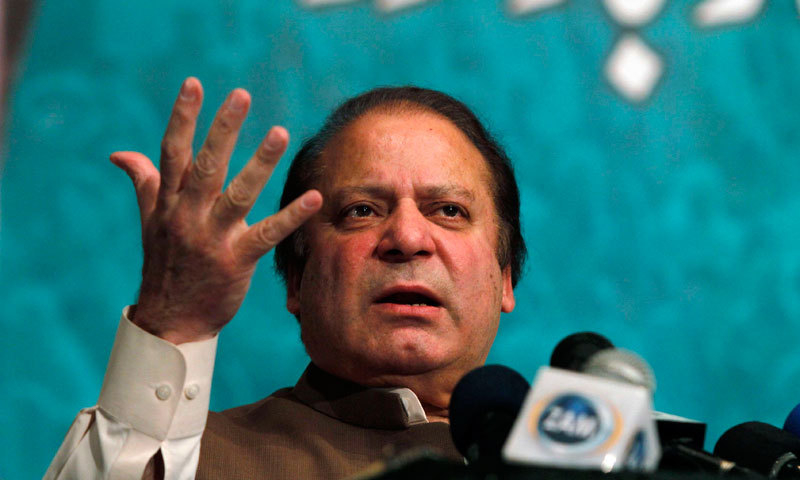
LAHORE: Prime Minister Nawaz Sharif on Wednesday gave an address on the occasion of Youm-i-Takbeer and said that Pakistan is fully capable of defending itself against any possible aggressive designs, DawnNews reported. The premier congratulated the nation on the event and said that the country’s nuclear assets were in safe hands, adding that it was for peaceful purposes. On the subject of his recent visit to India, the prime minister said that the visit was a success and we want cordial relations with our neighbours. Nawaz also said that a Karachi mass transit plan would be initiated soon and it would be a priority of the government to complete all the projects within its stay. Sharif had visited India for two days to attend the inauguration ceremony of India's newly elected prime minister, Narendra Modi, with whom he said, he had a “warm and cordial” bilateral meeting too.

Zardari acquitted in polo ground case

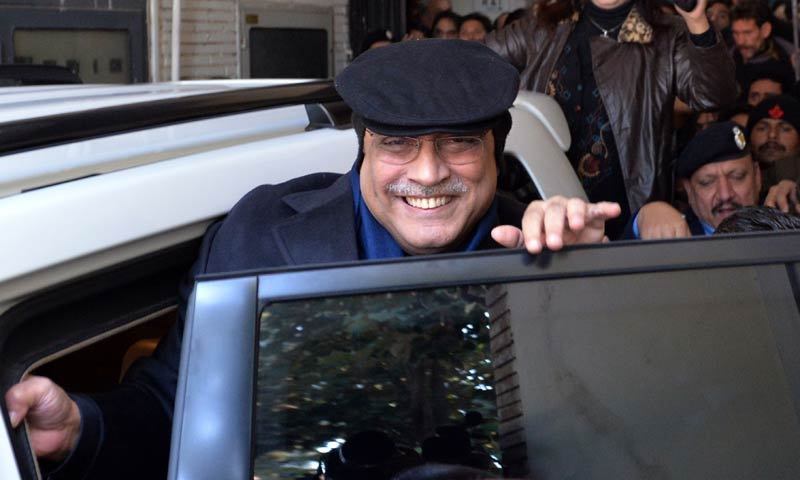
ISLAMABAD: An accountability court on Wednesday acquitted former president Asif Ali Zardari in the polo ground corruption reference, DawnNews reported. The court announced the verdict saying the accused had not been proven guilty so far. It further stated that evidence against the former president was not sufficient for further proceedings. This reference builds upon the construction of a polo ground along with ancillary works at the Prime Minister House, which NAB says are illegal and in violation of the rights and privileges that were afforded to Zardari. In February, the court had reserved its judgment on the application of the former president seeking acquittal in the corruption reference. The reference filed in 2000 alleged that the polo ground at the Prime Minister House was constructed during the second tenure of former prime minister Benazir Bhutto on the verbal orders of her husband Asif Ali Zardari to CDA chairmen Saeed Mehdi and Shafi Sehwani at an estimated cost of Rs52.29 million. The NAB in the reference nominated the two former CDA chairmen as the principal accused. It was alleged that both the former CDA chiefs got sheds constructed and carried out landscaping in a portion of the Prime Minister House and converted it into a polo ground. The other references filed against Zardari are: SGS: This corruption case is the continuance of a reference filed in 1997 that accused the late Benazir Bhutto and her spouse Zardari to have gained off a contract between the SGS and the government. ARY: This reference revolves around granting of trade licenses to ARY Traders for importing gold and silver which NAB says has caused losses to the treasury. Ursus tractors: This reference deals with alleged corruption during the import of Russian and Polish tractors. Cotecna: This case is about the award of a contract to the Swiss company after allegedly receiving six per cent bribe on the revenue proceeds.

Taliban condemn US exit strategy from Afghanistan

KABUL: Taliban insurgents Wednesday denounced US plans to keep troops in Afghanistan until the end of 2016, threatening to wage war against the “occupation” until the very last foreign soldier pulls out. Outlining the US strategy to end America's longest war, 15 years after the September 11 attacks, President Barack Obama confirmed Tuesday that the 32,000-strong US deployment in Afghanistan would be scaled back to around 9,800 by the start of 2015. Those forces would be halved by the end of 2015 before eventually being reduced to a normal embassy presence with a security assistance component by the end of 2016. But underscoring the instability still roiling Afghanistan, two Americans were slightly wounded in an attack on a US consulate vehicle in Afghanistan's western city of Herat on Wednesday. An unidentified gunman on a motorcycle fired a rocket-propelled grenade at the US vehicle in Herat, five days after insurgents attacked an Indian diplomatic mission in the same city near the border with Iran. Taliban insurgents responded to Obama's announcement by ruling out an end to fighting until a complete withdrawal of US forces had taken place — a grim indicator that Afghanistan's long, bloody war is far from over. “Now that Obama has announced that he will keep around 10,000 troops until the end of 2016 and continue their occupation, Afghanistan Islamic Emirate condemns it and considers it a violation of sovereignty, religion and human rights,” said a Taliban statement. The statement, which used the insurgents' name for the country, appeared to inflate the number of troops scheduled to remain under Obama's plan. “The American leaders should do now what they plan to do two years later. Even if one American soldier is in Afghanistan, it is not acceptable to our nation and jihad (holy war) will continue against them.” 'Afghanistan is not ready' The threats reaffirmed the fears raised by some observers in Afghanistan that a complete withdrawal of US-led international troops would send the nation spiralling into chaos. Fawzia Koofi, a female member of Afghanistan's parliament, posted on Twitter: “We are proud of the moral/self-esteem of our security forces, however, I had expected more than ten thousand troops to continue post 2014.” Others warned that the lingering militant threat could lead Afghanistan down the path of Iraq, where violence is at its highest level since 2008. “Afghanistan is not ready,” said security analyst Mia Gul Wasiq. “If they withdraw irresponsibly, Afghanistan will become like Iraq. “We have not been able to establish a strong government... the US has not done its job, that was to root out terrorism from Afghanistan. The war and terrorism is still there, their job is not done. So their plan and timetable on paper is not practical.” There was no immediate comment on Obama's announcement from outgoing Afghan President Hamid Karzai. The US drawdown relies on Afghanistan signing a long-delayed Bilateral Security Agreement laying out the terms and conditions of the US military presence in the country after this year. Karzai has refused to sign the agreement, but both candidates vying to be his successor in next month's presidential election run-off — Ashraf Ghani and Abdullah Abdullah — have said they will sign the deal. “I'm hopeful we can get this done,” Obama said, as he outlined the end of US involvement in a conflict which began when American-led forces invaded Afghanistan to oust the Taliban and hunt Al Qaeda leader Osama bin Laden after the 2001 attacks on New York and Washington. “We're finishing the job we started,” he said. US combat operations would draw to a close at the end of 2014, meaning US troops would no longer patrol Afghan cities, towns or valleys from next year, Obama said, underlining that future security would hinge on the Afghans themselves. US troops remaining in Afghanistan after 2014 would be available to train Afghan forces while supporting counter-terrorism operations against Al Qaeda remnants, Obama said, saying the withdrawal would herald a “new chapter in American foreign policy”. Obama made an unannounced visit to US forces in Afghanistan on Sunday, spending four hours at Bagram, one of the secure bases that will house support troops after their combat mission ends.

Sultan Azlan Shah dies at 86

The Sultan of Perak, Sultan Azlan Shah, passed away on Wednesday at the age of 86, Malaysia’s state-run BERNAMA news agency reported. Sultan Azlan Shah, who reigned over the Malay state of Perak for three decades, was an avid fan of field hockey and was known for the Azlan Shah Cup annual hockey tournament, which was named after him. In 1997, Sultan Azlan Shah was elected the President of the Asian Hockey Federation, a position he held until his demise. He also served as the President of the Malaysian Hockey Federation until 2005. Azlan will be laid to rest Thursday afternoon at the royal mausoleum in Kuala Kangsar. He leaves behind his wife, a son, and three daughters.

Aziz dispels notion of ‘charge-sheet’ given by Modi

ISLAMABAD: Advisor to the Prime Minister on National Security and Foreign Affairs, Sartaj Aziz on Wednesday rejected the notion that Indian Prime Minister Narendra Modi gave a charge sheet to his Pakistani counter-part Nawaz Sharif during their meeting in New Delhi yesterday. “There was no charge sheet given by Indian Prime Minister rather both the sides expressed their views on all issues of common concern,” Aziz told a news briefing here at the Foreign Office. “We opted for dignified rather than aggressive diplomacy,” the top Pakistani diplomat added. “There was a clear recognition of each other’s concerns and the need for mechanisms to address them.” “During the meeting it was clear that both sides were of the view that confrontation should be converted into meaningful cooperation,” said Aziz. “The issue of terrorism also came up to discussion,” said Aziz, adding that Prime Minister Sharif informed his Indian counterpart that terrorism was a mutual concern and Pakistan had suffered enormously due to this menace. “The people and government of Pakistan are serious and committed to fighting terrorism in their own national interest,” Aziz quoted the premier as saying. Answering questions whether Mumbai trial, Samjhota Express and other terrorist attacks were discussed in the meeting, he said, “As you all are aware, all aspects of terrorism have been discussed at different levels in our region. We believe that such issues can be handled only through constant interaction between the concerned authorities of the two countries.” “The prime minister undertook this visit with a clear vision in mind, based on strategic calculation and not just for a photo-op. In order to make this vision a reality, the starting point was for economic revival and development. Without economic revival we cannot fight poverty and unemployment or protect sovereignty of Pakistan,” he remarked. The advisor asserted that a robust economic agenda, which is the priority of the both governments, cannot be advanced without peace in the region. “Both the leaders agreed that they had the mandate and their respective tenures ahead of them to meet the hope and aspirations of one and half billion people of the two countries,” Sartaj Aziz claimed. He said although the visit was essentially a ceremonial occasion, where Pakistan together with other SAARC countries participated in the spirit of the South Asian fraternity, “the actual result and outcome was much better than we expected.” Sartaj Aziz asserted that although the government was only one day old, the Indian prime minister recognised the need for a dialogue process to address all bilateral issues that stand in the way of better relations between the two countries. “Both the premiers felt the need to turn a new page in our ties,” he remarked. When asked why PM Sharif did not meet Kashmiri leadership during his visit and whether this was a compromise on Kashmir dispute, Aziz said meeting Kashmiri leadership was not on agenda, however, issue was raised during meeting with Indian premier. The senior diplomat said that both leaders agreed to intensify their efforts to resolve all issues including Kashmir. The meeting also called on the two governments to refrain from intervening in each other’s internal affairs. When asked about discussion on trade, the advisor said brief discussion also took place on the issue including other confidence building measures. It was also agreed in the meeting that the two Foreign Secretaries would meet soon on mutually convenient dates to discuss the way forward, the advisor remarked.

Anglican leader says Pakistan's minorities should have equal rights

LAHORE: The Archbishop of Canterbury on Wednesday called for Pakistan to safeguard the rights of its religious minorities and afford them equal treatment under the law. Justin Welby, the leader of the world’s Anglicans, was on a two-day visit to the eastern city of Lahore where he met with church leaders, government officials and members of the minority Christian community. “Christians, historically, have given tremendous services to this country and I hope they can be given the scale of freedom and equal rights under the law,” he told AFP. He added his message to the people and government of this country was to respect and safeguard the rights of all minorities. Talking to media, he said he met many Muslim religious leaders and government fumitories including Punjab governor Muhammad Sarwar. “Everybody is concerned about the private use of blasphemy laws, which is a sensitive matter in Pakistan,” he said. “However, they don’t suggest a way forward and mechanism how to stop it.” Most of Pakistan's Christians are poor and working in menial jobs. They have suffered attacks and riots in recent years, most notoriously last September when a double suicide attack at a church in the northwestern city of Peshawar killed 82 people.

Five Hindu children abducted in Balochistan

QUETTA: Armed men kidnapped five children belonging to minority Hindu community from Balochistan's volatile Jaffarabad district on Wednesday, senior officials said. Syed Zafar Ali Shah, the Deputy Commissioner Jaffarabad told Dawn.com that the children were going to school when abducted by the armed men near Dera Allah Yar. He, however, added that four accused belonging to a local tribe were arrested in connection with the kidnapping. “The ages of children are between five to 10,” Syed Ashfaq Ahmed, the District Police Officer Jaffarabad said. He said one of the local journalists was also arrested during police raid with regard to the incident. The deputy commissioner stated that the kidnappers had shifted all five children to Rato Dero area of Sindh. “Very soon, we will recover the children unharmed,” vowed Shah. The children belong to an ancient Hindu community living in Dera Allah Yar area of Balochistan and they are daughters and sons of well-known Hindu trader and newspaper agent Saith Bhojraj. The deputy commissioner stated that the children were coming back from school when abducted by the armed men. Balochistan Police also approached Rato Dero Police for the recovery of kidnapped children. It is, however, yet to be confirmed that whether it was a family dispute or the children were kidnapped for ransom, police said. There was no immediate claim of responsibility for the kidnapping. Jaffarabad is considered to be one of the most sensitive districts of Balochistan. Kidnapping for ransom in the area remained rampant. Besides this, the area is also considered to be one of the hubs of militants targeting vital national installations and the security forces.

Nawaz orders probe into desecration of religious sites

ISLAMABAD: Prime Minister Nawaz Sharif on Wednesday expressed serious concerns over acts of vandalism at religious sites belonging to different faiths in Sindh and directed concerned authorities to hold inquiry into the matter. Speaking to Parliamentarians from Sindh at the Prime Minister House, he said that the federal government would undertake rehabilitation of religious sites that were damaged. The notice was taken after dozens of protesters from the Sikh community pushed past the front gate and entered the grounds of the Parliament building in Islamabad last week, protesting attacks on their houses of worship. Earlier this week, the Pakistan Sikh Council had warned the government that the community will launch a countrywide protest movement if all the culprits who had desecrated their holy book, Guru Granth Sahib, are not arrested by May 31. The prime minister, during today’s meeting, also directed to establish a dedicated cell at the Prime Minister Office for Sindh affairs. He also said that the position of provincial party leader and other vacant provincial party posts would be filled soon. “Our party is engaged in politics of reconciliation and strengthening democracy, said Sharif. Chief Minister Punjab Shahbaz Sharif, Federal Interior Minister Chaudhry Nisar Ali Khan, Minister for Railways Khawaja Saad Rafiq, Minister of State for Railways Abdul Hakeem Baloch and Senator Mushahidullah Khan were also present in the meeting. The Parliamentarians apprised the premier about development issues of their respective constituencies and lauded the progress in Karachi operation. They also felicitated him on his successful visit to India. “We have always respected mandate of other parties and expect the same from them,” said the prime minister. He said that it was his commitment to the people of Sindh that law and order situation would improve. “Bringing back normalcy in Karachi is my priority as it is the economic hub of Pakistan,” said Prime Minister Sharif. He further said that majority of mega-development projects like Karachi-Lahore Motorway, Thar Coal Power Project, Jamshoro Power Plant, Gaddani Power Park, Port Qasim Power Plant and Karachi Circular Railway would not only be a source of economic prosperity, but would also create millions of employment opportunities for locals. The delegation included, Amir Bakhsh Bhutto, Marvi Memon, Shah Muhammad Shah, Ismail Rahu, Imdad Hussain Chandio, Zain Magsi, Dr Rahila Gul Magsi, Saleem Zia, Syed Zafar Ali Shah, Aslam Abro, Ghulam Mustafa, Munawar Raza, Haji Hanif Memon, Asghar Rind, Ayaz Ali Sheerazi, Dr Darshan Panchi, Bhawan Das, Dr Ramesh Lal, Irfanullah Khan Marwat, Humayoun Khan, Haji Shafi Jamoot, Mrs Soreth Thebo, Shah Hussain Shah Sherazi, Ejaz Shah Sherazi, Ameer Haider Sherazi, Aqil Jatoi, Masroor Jatoi and Dr Arbab Ghulam Rahim.

Monday, May 26, 2014

Know about possible experts to be associated with ministries in Modi government

New Delhi: The thinking process about who all will be included in Narendra Modi government is still going on. For the cooperation with cabinet ministers, many state ministers will be helping the team of Modi. Also, one expert for every ministry will be appointed by the government. According to sources, Modi may appoint approximately 28 experts for various ministries which may include Metro man E Sreedharan, HDFC chief Deepak Parikh and Jagdish Bhagwati. We bring you the possible experts which may be included in the government.
Ajit Dobhal Ajit Dobhal has worked as the director of Indian Intelligence Bureau. He had led the unit for more than a decade. Dobhal was the top IPS of Kerala cadre batch 1968. He is the first officer of the country who has been awarded the Kirti Chakra. He recently met the PM designate Narendra Modi to make him aware about the challenges and threat the country has been facing. He is considered to be in the race for National Security Adviser in Modi government.
Deepak Parikh Hailing from Maharashtra, Deepak Parikh has been awarded with Padma Bhushan award for his remarkable work in industries and trading sector. Non-Executive chairman of Housing Development Finance Corporation (HDFC), Deepak Parikh, is one of the popular persons of Indian Economics. When asked about his views on Modi government coming to power in Lok Sabha Elections, he had said "I will be good news for the country but bad for Gujarat. Also, a different picture of the country is likely to prevail in next 5 years. Parikh is likely to be chosen for the Finance Ministry Adviser.
E Sreedharan E Sreedharan is the well known civil engineer of the country. He has been the director of Delhi Metro between 1995 and 2012. He is also known as the Metro man of the country. Sreedharan was awarded Padma Bhushan by the President in the year 2008. Under Modi government, there are chances that infrastructure sector will pace-up. Several schemes and projects of railways and infrastructure worth Rs. 83000 crore has been hanging mid way in the UPA government. Now there are hopes that those will be completed as Modi takes charge. No steps have been taken on expressway projects or on high speed rail or world class stations. According to speculations, E Sreedharan may be appointed as Railways Minister or Transport Adviser in PMO.
Jagdish Bhagwati Jagdish Natwarla Bhagwati is an economist of the country. He is a professor of economics and Law at the Colombia University. He is known for his research work in the international business. He is also a supporter of free trade. Bhagwati was awarded the Padma Bhushan in 2000. He has already advised the PM designate Narendra Modi that Raghuram Rajan should continue as the governor of RBI. He also advised Modi that every year a conference should be held where the agenda of the government should be made clear to the ministers. In the assembly elections, he came in to controversy for his comment that he is neither attached with Modi nor Rahul Gandhi. On being asked about what if he is offered a part in Modi government, he said "I see myself as the adviser to Prime Minister. I will be happy if I am offered any such designation."

Blog Archive