Monday, August 4, 2014

Iraq's Yazidi minority flees militant threat

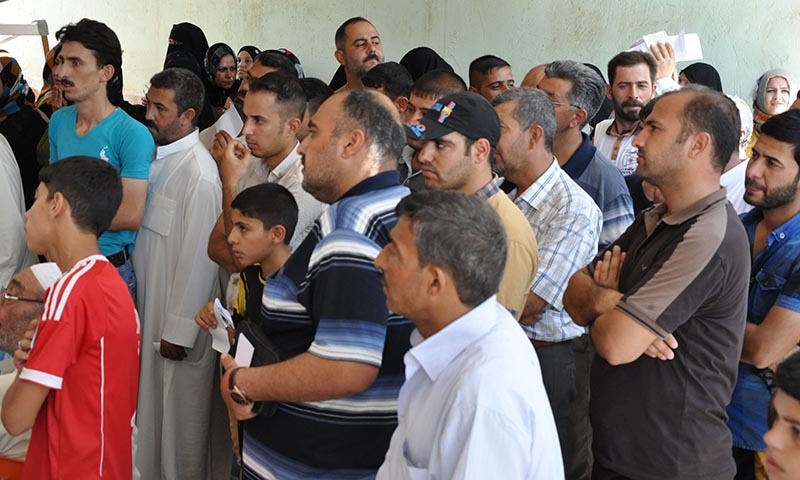
DAHUK: Tens of thousands from Iraq's minority Yazidi community have fled their homes after Sunni militants captured their towns in the latest offensive to expand the territory of their self-styled caliphate. As Kurdish fighters struggled to hold back the onslaught of the Islamic State militants on Iraq's north, some 40,000 Yazidis, a minority religious sect, fled the northern towns of Sinjar and Zumar, said Jawhar Ali Begg, a spokesman for the community. “Thousands of Yazidi people have been killed,” he said. The militant group gave the Yazidis, who follow an ancient religion with links to Zoroastrianism, an ultimatum to convert to Islam, pay a tax or face death, Begg added. Iraq is facing its worst crisis since the 2006 civil war when the Islamic State group, an al Qaeda breakaway faction with a strong presence in Syria, captured large swaths of land in the country's west and north in a lightning offensive earlier this year. The United Nations said last month that more than 500,000 people have been displaced by the violence since June, bringing the total this year to 1.4 million, including more than 230,000 Syrian refugees. The group drove ethnic and religious minorities out of Iraq's second-largest city, Mosul, and attacked mosques and shrines, claiming they contradicted strict Islamic teachings. Kurdish forces, known as the peshmerga, have been battling with the militants for control of several towns stretching between the province of Nineveh and the Kurdish Iraqi province of Dahuk. At least 25 Kurdish fighters were killed in clashes with the militants on Sunday, and another 120 were wounded, according to Muhssin Mohamed, a Dahuk-based doctor. A statement Monday by the Islamic State said it had captured dozens of Kurdish prisoners during the clashes and seized “large number” of weapons. The authenticity of the statement could not be verified, but it was posted on a website used by the group.

School principal killed in Karachi firing

KARACHI: A school principal was killed Monday in a firing incident in Karachi’s Baldia Town, DawnNews reported. Haji Ishaq, the principal of a Christian school, was on his way to school when he was targeted in Baldia Town Sector 4/D. Karachi, the largest metropolitan city of Pakistan, is riddled with targeted killings, gang wars, kidnappings for ransom, extortion and terrorism. Targeted operations led by Rangers’ forces with the support of police are ongoing in the city under a directive issued by the federal government against criminals already identified by federal, military and civilian agencies.

SC rejects former CJ's request for Imran’s contempt case records
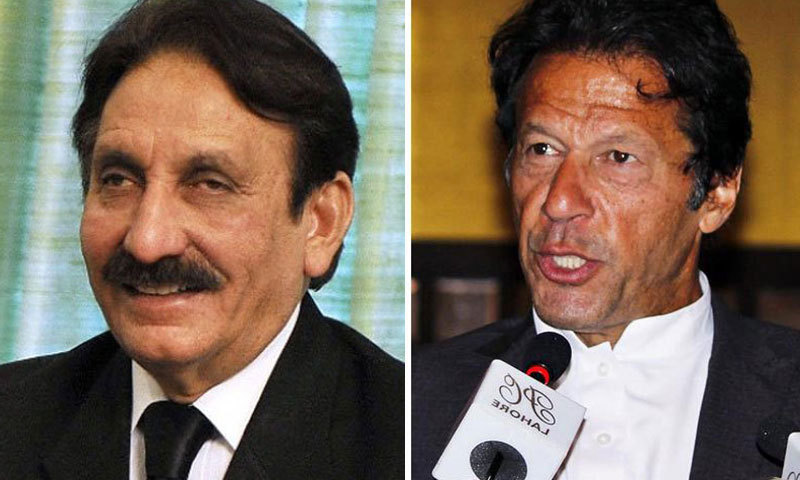
ISLAMABAD: The Supreme Court on Monday rejected a request by former Chief Justice Iftikhar Chaudhry to obtain an official and attested copy of Pakistan Tehreek-i-Insaf (PTI) chairman Imran Khan’s reply submitted before the court in a contempt case. The former top judge had sought the copy to support defamation charges he had filed against the PTI chief. The contents of the statement have been mentioned by the former chief justice in the defamation notice served on Imran. According to Advocate Sheikh Ahsann-ud-Din, a lawyer close to the former chief justice, the printing branch of the apex court rejected the request today, saying Chaudhry was not an aggrieved party in the case and is therefore not permitted by Supreme Court rules by to obtain the documents. The Supreme Court rules state that “a party to any cause, matter or appeal, who has appeared shall be allowed to search, inspect or get copies of all pleadings and other documents or records in the case”. Court sources also confirmed that the printing branch had denied the request on the stated grounds. The Supreme Court had on July 31 summoned Imran to face contempt charges after he made derogatory remarks against the judiciary. Imran had criticised the judiciary and the Election Commission of Pakistan by describing their role as ‘sharmnak’ (shameful) in the alleged rigging in the general elections last year.

Justice (r) Sair Ali named acting PCB chairman

Pakistan's Prime Minister Nawaz Sharif on Monday appointed a retired judge to hold elections for the country's cricket chief within a month, hoping to draw a line under a long-running crisis. The post of Pakistan Cricket Board (PCB) chairman has been held by rivals Zaka Ashraf and Najam Sethi five times each since May last year, leading to widespread ridicule at home and abroad. Ashraf was first suspended by Islamabad high court over dubious elections. Sharif appointed Sethi, a journalist and former newspaper editor, to the post after he was elected prime minister last year. The Ministry of Inter-Provincial Coordination (IPC) which handles sport said judge Sair Ali would oversee the process. “Justice Sair is appointed election commissioner with immediate effect as per requirements laid down in the new PCB constitution and will hold elections of PCB chairman within the next 30 days,” said a statement. Ali was one of the several judges who refused to provide legal cover for former military ruler Pervez Musharraf's 2007 imposition of emergency rule. Under the PCB's recently reformed constitution, the chairman will be elected for a three-year tenure but can be voted out by the 10 member board of governors. Former chairman and diplomat Shaharyar Khan, who held the post from 2003 to 2006, is seen as a favourite in the election. The leadership crisis had raised the prospect of Pakistan being suspended by the International Cricket Council (ICC). Two years ago the ICC had warned its member countries to chose their heads in a democratic manner without any government influence but since then they backed down after protests from Pakistan, Bangladesh and Sri Lanka.

Nisar fails to convince Imran to call off PTI long march
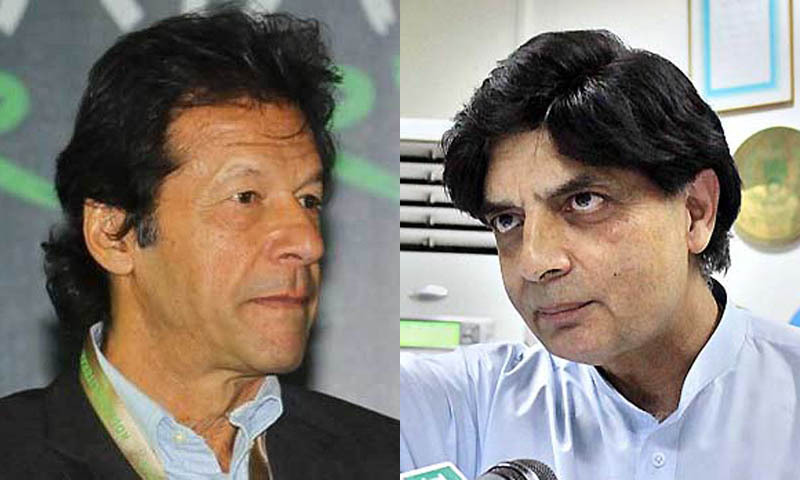
ISLAMABAD: Interior Minister Chaudhry Nisar Ali Khan established telephonic contact with Pakistan Tehreek-i-Insaf (PTI) chief Imran Khan to convince him to call off his million man long march on Islamabad but the latter refused, highly placed sources told Dawn. Interior Ministry sources said that three to four days ago, Nisar had spoken to the PTI chief and invited him for a meeting in order to listen to his demands. However, Khan refused to meet the interior minister and said his "Azaadi March" was final and would not be called off at any cost. The interior minister is likely to establish contact with like-minded PTI politicians after his unfruitful attempt with Khan. PTI's central media cell confirmed that the two political leaders had spoken via telephone. Earlier, reports quoting both PML-N and PTI sources had said that Nisar and Imran had met at the latter's Bani Gala residence to discuss various alternatives to the Independence Day long march for electoral reforms. However, Nisar had later denied that the meeting had taken place whereas there was no direct denial from Imran on this matter.

No threat from PTI's 'million' march, says Nawaz
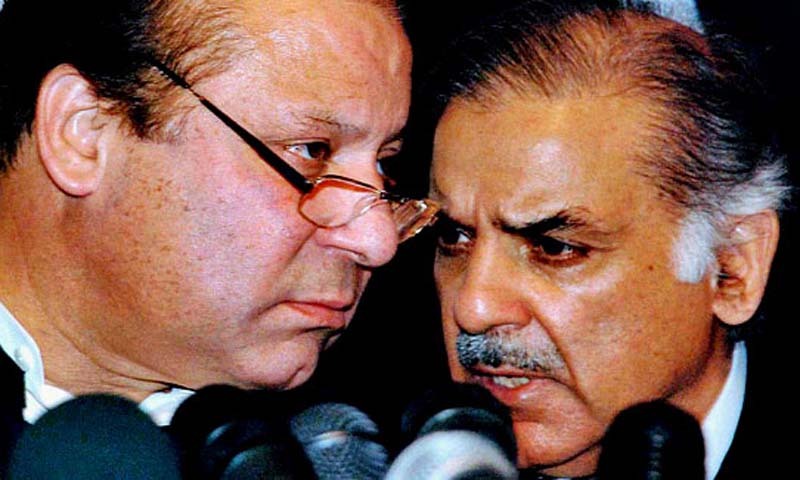
ISLAMABAD: Prime Minister Nawaz Sharif said Monday that his government faced no threat from the Pakistan Tehreek-i-Insaf's (PTI) planned 'Azadi' march on August 14 in Islamabad. Presiding over a consultative meeting of the Pakistan Muslim League - Nawaz (PML-N), Nawaz claimed that his government was not one to fear any form of protest, and said that political problems should only be resolved politically. According to DawnNews, the meeting discussed strategies to deal with PTI's planned ‘million’ march, as well as the opposition in the National Assembly session scheduled to begin later today. The meeting was attended by top leaders, including the Khyber Pakhtunkhwa Governor Sardar Mahtab Ahmad Khan, Punjab Governor Muhammad Sarwar, Chief Minister Punjab Shahbaz Sharif, Ishaq Dar, Pervez Rashid, Chaudhary Nisar, Ahsan Iqbal, Abdul Qadir Baloch, Irfan Siddiqui, Hamza Shahbaz, Rana Sanaullah, Rana Mashhood, Shahid Khaqan Abbasi, and Rana Maqbool.

Two soldiers, seven Uzbek terrorists killed in N Waziristan: ISPR

ISLAMABAD: Seven Uzbek terrorists and two army soldiers were killed during the clearance of the Miramshah to Datta Khel road, a military spokesperson said on Monday. However, this information could not be independently verified as journalists have limited access to North Waziristan. While the clearance was in progress, army troops carried out a snap operation on Uzbek terrorist hideouts in Datta Khel Bazar. A spokesman for ISPR stated that Naib Subedar Mashkoor and Lance Naik Zaheer were also killed in the ambush. According to the spokesman, towns including Miranshah, Mirali, Boya and Degan, extending to Datta Khel have been cleared. However, the operation is currently in progress as there are pockets of resistance between Miranshah-Mirali, villages of Momin Gul Ziarat, Darpakhel, Tappi, Spalga and the south of Tochi river. Furthermore, he said that a large number of IEDs and suicide jackets were recovered in the surrounding areas of Mirali in Shahbaz Khel, along with 75 Rockets, chemicals and propaganda literature. In Umer Ki Kalli, an additional IED factory was also discovered. The military launched an operation in the restive tribal agency on June 15 in the aftermath of a deadly attack on the Karachi airport that left over 30 people dead. The military has said that foreign and local militants, including Tehreek-i-Taliban, Islamic Movement of Uzbekistan and Haqqani network members will be targeted in the offensive.

Four missing persons recovered in July, says commission report

ISLAMABAD: The Supreme Court-appointed Commission of Inquiry on Enforced Disappearances (CIED) claimed in a report on Monday that it had traced seven missing persons during the month of July. The commission, comprising former Supreme Court judge Justice Javed Iqbal and retired police officer Mohammad Sharif Virk, has submitted its report to the National Crisis Management Cell (NCMC), which works under the Ministry of Interior. An official of the NCMC told Dawn.com that out of the seven traced people, four missing persons had reached their homes. The remaining three persons are still detained at different internment centres in Khyber Pakhtunkhwa, he said. The official said that according to the report, the commission has succeeded in recovering four persons including Mohammad Yaseen son of Hussain Badshah, Noor Hayat son of Khayal Muhammad, Muhammad Lucqman son of Spain Gul and Sahfiullah son of Aziz Muhammad. All four were residents of district Hangu and have been reported missing since September 29, 2013. He added that the commission has succeeded in tracing three additional persons, including Abdul Jaleel son of Yasmeen-Ul-Haq and Atta-ur-Rehman son of Said-Ur-Rehman, who both have been reported missing from Kohat since May 7, 2012. “They are confined in internment center of Kohat at present,” the official added. The NCMC official said that Kaleem Ahmed son of Parveen Ahmed – a resident of tehsil Kabal of district Swat who had gone missing on October 9, 2012 – is currently in the internment center of Swat. When contacted, Khayal Muhammad, the father of Noor Hayat, claimed that the security agencies had kidnapped five persons of his town including his son on September 29, 2013. Khayal said that the four people including his son returned home recently but the fifth person – Tehseenullah son of Aziz Muhammad – was still in the custody of the security agencies. “My son and his friends were studying at different colleges and universities of Peshawar and they were not involved in any kind of terrorist activities,” he said. “It is difficult (for them) to even walk now due to the physical tortured they endured at the hands of the security officials,” he claimed. On Jan 1, 2011, 138 cases of missing persons were pending before the commission. During the period of 1st Jan, 2011 to 31st July, 2014, 2036 new cases were received by the commission, raising the total number of cases to 2,174. Over 750 cases have been disposed of by the commission while more than 1,400 cases are still pending before it.

Discos overcharge consumers, Rs15bn collected

ISLAMABAD: Though National Electric Power Regulatory Authority (Nepra) had approved a surprising cut of Rs1.67 per unit in base tariff of power distributing companies (Discos) more than three months ago, the Federal Ministry of Water and Power did not issue notification to this effect, as a result of which discos, during this period, collected additional amount of around Rs15billion from the consumers. Documents available with Dawn disclosed that the national electric power regulatory authority during the month of April had approved Rs1.67/unit reduction in the basic power tariff.But, power ministry despite the passage of three months did not issue notification in this regard. As a result, discos successfully collected additional Rs15billion from power consumers only due to absence of issuance of notification. As per rules, the government (power ministry) is bound to issue notification within 15 days, documents added. Sources said finance and power ministries are using delaying tactics while the discos are fleecing the already burdened consumers with skyrocketing power tariff. They added top brass of the Ministry of Water and Power are found busy in meetings to find an amicable solution to so far unsolved power crisis of the country. Details of the documents also made it clear that power sector regulatory authority on 28th April completed the process of determination for the base power tariff of the discos for financial year 2013-14. And, with effect to the decision of decrease in the tariff which was made by the authority, Rs1.09/unit decrease in the price of power was made for the consumers using 100unit/month, while Rs1.67/unit cut for consumers category use 101 to 200unit/month, Rs0.24/unit for consumers use 201 to 300unit/month, Rs1/unit for 301 to 700unit/month while Rs0.50/unit reduction in power tariff for the power consumer’s category who uses above 700units in a month. Similarly, Rs1 per unit decrease in the power tariff for commercial, industrial and agricultural consumers. "Nepra Act section 31(4)Provided that the Federal Government may, as soon as may be, but not later than fifteen days of receipt of the Authority’s intimation, require the Authority to reconsider its determination of such tariff, rates, charges and other terms and conditions. Whereupon the Authority shall, within fifteen days, determine these anew after reconsideration and intimate the same to the Federal Government, “document said. When contacted with a spokesman of Nepra, he said the authority had dispatched its decision to water & power ministry on 28th April, 2014. “The need is to notify the decision as early as possible,” he said. He also said that after issuing of decision by the regulatory authority, Nepra Tariff Rules made the regulatory bound to forward the decision within 72 hours to the ministry of water and power for the notification. A spokesperson of power ministry also said that finance ministry is mulling to revise the subsidy of the tariff for FY 2013-14 and several meetings have been held in finance ministry in this very regard. “As soon as finance ministry would approve the subsidy, water and power ministry will issue power tariff notification and the Nepra would also be informed,” he said.

Pakistan making arrangements to evacuate citizens from turmoil hit Libya

ISLAMABAD: Pakistan's embassy in Tunisia is making arrangements for Pakistanis trapped in Libya to evacuate the turmoil-hit country through the Tunisian border, the foreign office said Monday. "The Pakistani Embassy has already registered a large number of Pakistanis and referred their documents to Tunisian authorities for visa on arrival," the statement read. Since no Libyan airport is functioning due to the ongoing strife, the Pakistani embassy in Tunis has been assigned to facilitate visa on arrival at the Tunisian border from where the Pakistani nationals will be able to fly home. The Pakistani Embassy in Tripoli has indications that the number of Pakistanis who may have to be evacuated is between 3,000 to 6,000, said the foreign office statement. The foreign office and the Pakistani embassy in Tripoli have directed Pakistani nationals to contact embassy personnel for further assistance.

Zimbabwe recalls player who set fire to cricket HQ

HARARE: Zimbabwe has recalled batsman Mark Vermeulen to its cricket squad six years after he was cleared of arson on psychiatric grounds after setting fire to the national union's headquarters and an academy building. Vermeulen was cleared in a court in 2008 despite admitting setting fire two years earlier to the union offices at Harare Sports Club and an academy pavilion at another location. He was cleared after arguing he was suffering from problems related to epilepsy caused by being hit on the head by a ball during a game. The 35-year-old Vermeulen's recall Monday came after he recently made a century for Zimbabwe A against Afghanistan. He was part of a 25-man squad named by new coach Stephen Mangongo for tours by South Africa and Australia this month.

Achakzai vows to defend constitution

ISLAMABAD: In a fiery speech in the National Assembly on Monday, leader of the government-allied Pakhtunkhwa Milli Awami Party Mahmood Khan Achakzai vowed to defend democracy and the constitution of Pakistan against all odds. “Those who do not believe in the supremacy of the constitution should set themselves aside from those who do. We will revolt against those who betray the constitution,” said the seasoned politician. Achakzai urged leaders to unite and form ‘a front’ to safeguard democracy. Speaking after Sartaj Aziz tabled a resolution against Israeli atrocities in Gaza, he said: “In many ways, our country has also turned into Gaza. There should be another resolution — a resolution promising that we will defend the constitution.” “Betraying the constitution is akin to treason, and we will respect and defend it against all odds,” he said.

PIA air hostesses allege harrasment

KARACHI: Air hostesses of Pakistan's national airline have filed sexual harassment complaints against a senior Pakistan International Airlines (PIA) male staff member. Responding to the allegations, PIA spokesperson Mashood Tajwar told Dawn that the air hostesses alleging harassment were "venting grievances" after having been declared "unfit" by a suitability committee. It was however not clear whether the air hostesses were declared 'unfit' before or after they alleged harassment. Tajwar said that a suitability committee of PIA conducts grooming and fitness tests every six months to ascertain performance suitability of the cabin crew. He added that two air hostesses had filed written complaints with PIA's Committee for Protection of Women at Workplace, only after they were declared unfit by the committee and had no issues prior to the tests. The spokesperson said that the complaints were disregarded after a probe was conducted into the allegations.

Wedding speculation: 'Imran focused on politics'

ISLAMABAD: A Pakistan Tehreek-i-Insaf (PTI) representative on Monday said reports that Chairman Imran Khan’s family is putting pressure on him to marry someone from within the family are “not true”. In response to an article published in The Express Tribune, founding member of PTI Naeem-ul-Haque in a telephone conversation with Dawn said, “Yes, his sisters have been asking him for five years now to get married, but there is no one in sight and no specific person in mind." The Tribune article quoted a family source as saying that Imran’s sisters were eager for him to wed in order to avoid “personal attacks” and had allegedly selected a girl from within the family. "There are thousands of women young and old who would wish to marry him!" Haque exclaimed, "but he is focused on something else [changing the system]. This time is crucial for him politically." The cricketer-turned-politician was previously married to English journalist and activist Jemima Goldsmith for nine years. The marriage ended amicably in 2004 with Goldsmith stating that she was unable to adapt to life in Pakistan. She has campaigned against drone strikes in Pakistan, as well as against the wars in Iraq and Afghanistan.

PTI says police now threatening its leaders

ISLAMABAD: After shadowing and harassing Pakistan Tehrik-i-Insaf workers, the capital police have started issuing threats to PTI leaders to pre-empt their Azadi March planned for August 14, the party said on Sunday. “I received a call this morning from the Special Branch (of police) asking me to shift my family from my house by 5pm for I could be put under house arrest anytime,” Shireen Mazari, senior leader and information secretary of the PTI, told a press conference here. She said someone introducing himself as Saqlain Bajwa delivered the threat to her. “How can I push out my family from my house, and why should I,” she asked, adding, “I am not the only one who received the call. Naeemul Haq, staff officer to PTI Chief Imran Khan, also received a similar call.” Senior Superintendent of Police Mohammad Ali Nekokara had denied to Dawn on Saturday that the police had been visiting the homes of PTI activists and menacingly demanding information about the party workers mobilising support for the march. But SSP Nekokara meaningfully added that the police had “only been collecting contact numbers” of the party workers, in accordance with the Standard Operating Procedure, for conveying them government’s messages in case of an emergency. In reply to a question, Ms Mazari said the PTI has decided not to seek permission from the Ministry of Interior or the District Administration for holding its Azadi March. “We know about the threats to Imran Khan but he has never tried to hide behind bulletproof shields. There will be same security for workers and leaders,” she said. LG system and Tenancy Law PTI MNA from Islamabad Asad Umar, sitting by her side at the same press conference, said the PML-N government was not serious in resolving the problems and issues of the federal capital. “The Tenancy Law is not being introduced in the federal capital. As far as the local government system (LGS) is concerned, the draft law shows that there will be no role for the residents of Islamabad in the governance,” he said. Local leader of PTI Shahzad Wasim said that Article 37(1) of the Constitution says there should be decentralisation of powers in the country but the government was not willing to introduce true LGS in Islamabad. “Even if the LGS is introduced in Islamabad, a retired bureaucrat will take most of the decisions,” he said. Published in Dawn, Aug 4th, 2014

Assembly dissolution debate starts as ‘Azadi March’ nears

As the “Azadi March” of Pakistan Tehreek-i-Insaf is scheduled to be held on Aug 14, PTI chairman Imran Khan and several of its leaders have stated on different occasions that they might also dissolve the Khyber Pakhtunkhwa Assembly for putting pressure on the federal government for the acceptance of their demands. Furthermore, they stated that one of the options with them was to tender resignations from the National Assembly as well as provincial assemblies. The PTI’s Core Committee had on June 25 empowered Imran Khan to direct the chief minister of Khyber Pakhtunkhwa to dissolve the Khyber Pakhtunkhwa Assembly if the federal government did not accept its demands. Prior to that Imran Khan had given a statement that the assembly would be dissolved if his demands were not met. That statement had drawn criticism from the opposition parties in Khyber Pakhtunkhwa Assembly. Similarly, Chief Minister Pervez Khattak has also endorsed the views of his party chief on different occasions. The threat of dissolving the assembly has even forced the Jamaat-i-Islami and Awami Jamhoori Ittehad Pakistan (AJIP), the two coalition partners of PTI, to publicly oppose the assembly dissolution at a joint press conference on Sunday. JI chief Sirajul Haq and provincial senior minister Shahram Tarakai of AJIP stated that they were opposed to any move of dissolving the assembly, however adding that PTI had the right to quit the government. Legal experts believe that if PTI is serious about dissolving the assembly the option available with other parties averse to that move would be to submit a notice for moving a resolution for a vote of no-confidence against the chief minister. The chief minister could advise the provincial governor to dissolve the assembly under Article 112. Sub-article 1 of Article 112 states: “The governor shall dissolve the provincial assembly if so advised by the chief minister; and the provincial assembly shall, unless sooner dissolved, stand dissolved at the expiration of 48 hours after the chief minister has so advised.” An explanation to the said sub-article states: “Reference in this Article to ‘chief minister’ shall not be construed to include reference to a chief minister against whom a notice of a resolution for a vote of no-confidence has been given in the provincial assembly but has not been voted upon or against whom a resolution for a vote of no-confidence has been passed.” Another mechanism for the dissolution of assembly is available in sub-article 2 of Article 112 under which the governor may dissolve an assembly when no member of the provincial assembly commands confidence of majority of the members of the assembly. That sub-section states: “The governor may also dissolve the provincial assembly in his discretion, but subject to the previous approval of the President, where a vote of no-confidence having been passed against the chief minister, no other member of the provincial assembly commands the confidence of the majority of the members of the provincial assembly…” Article 136 of the Constitution provides for the mechanism for a no-confidence against a chief minister. Article 136 (1) states: “A resolution for a vote of no-confidence moved by not less than twenty per centum of the total membership of the provincial Assembly may be passed against the chief minister by the provincial assembly.” Clause 2 of the same Article provides that a resolution referred to in Clause 1 shall not be voted upon before the expiration of three days, or later than seven days, from the day on which such a resolution is moved in the provincial assembly. If the resolution is passed by a majority of the total membership of the provincial assembly, the chief minister shall cease to hold office. The most famous example of premature dissolution of the Khyber Pakhtunkhwa Assembly on the advise of the chief minister was in 1993 when then governor Amir Gulistan Janjua ordered the dissolution of KP (then NWFP) Assembly on the advice of then chief minister Mir Afzal Khan. That dissolution of the assembly was challenged before the Peshawar High Court by then ANP leader Begum Naseem Wali, a leader of PML Nawabzada Mohsin Ali Khan and then Speaker of the assembly Habibullah Khan Tareen. They alleged that Mir Afzal had lost confidence of the majority of the members and the majority members had submitted a notice for a vote of no-confidence at the residence of an additional secretary of the assembly. However, the high court bench, headed by then chief justice Abdul Kareem Kundi, dismissed those petitions and upheld the assembly dissolution. Similarly, in Oct 2007, then chief minister Akram Khan Durrani advised the governor to dissolve the assembly. The assembly had to complete its tenure in Nov 2007. Subsequently, the governor dissolved the assembly on Oct 10, 2007. Experts believe that in case PTI does not opt for dissolution of the provincial assembly and instead its MPAs resign then it would be binding on the Election Commission of Pakistan under Article 224 to conduct by-elections in those constituencies within 60 days of the occurrence of those vacancies. However, that would be possible only if after resignation of all the 55 MPAs of PTI any of the remaining members in the assembly enjoy confidence of the majority of the total membership of the assembly. Published in Dawn, Aug 4th, 2014

Return of the gamekeeper By Babar Sattar

In the run-up to Aug 14 what is happening and why it is happening is as clear as why it ought not to be happening. Ayaz Amir is on the mark that the soft coup has already succeeded and khakis now have Nawaz Sharif on a tight leash for which the government itself deserves all the credit. Notwithstanding that civil-military imbalance is the bane of constitutionalism and democracy, one must give the khakis their due: with their unflinching focus on defining and controlling the rules, they are simply better at this game. The khakis have been able to dominate our polity because they are the only ones in our polity able to distinguish between individual and institution and never allow the interests of the former to trump those of the latter. Nawaz Sharif has proven himself incapable of such distinction. The Sharif camp argues that it is on one page with the khakis. The crucial flaw here might be mistaking warm personal relations between the prime minister and the army chief for a relationship of mutual trust and respect between the civilian and military parts of the state. Can personal rapport between the two Sharifs override the military’s institutional interests? The problem with the politics of survival is that it sounds the death knell of governance and reform. Sharif has traditionally been an embodiment of the status quo. Whatever illusions he might have conjured up about reforming institutional structures or his own style of governance during his years in exile now seem to have vanished. Calling the military in aid of civil power in Islamabad under Article 245 ahead of Imran Khan’s march on Islamabad is a clear message that the rest of his term in office will be about nothing but survival. The problem with the politics of survival is that it sounds the death knell of governance and reform. What will become of Sharif’s proactive India policy? Who will determine Pakistan’s foreign policy towards Afghanistan in wake of US troop withdrawal? What about the national internal security policy or Nacta or intelligence reform or a new anti-terror force? The distribution of power among various actors has quickly changed over the last few months. Sharif, the most powerful and dominant actor six months back, has now been sized up and boxed. Have we returned to the ’90s? The judiciary (reeling from loss of credibility due to former chief justice Iftikhar Chaudhry’s controversial tenure and Khan’s broadside against its alleged partisanship) is no longer being perceived as a neutral arbiter. With Geo neutered and its competitors enjoying the spoils of war, the media’s ability to shape narratives or act as a check on the abuse of power by the government or the khakis has largely dissipated. Rival political parties are once again at each other’s throats. And the military, as gamekeeper, reigns supreme behind the curtains. In Pakistan all politics is personal. Whether it is Khan’s march on Islamabad or Sharif invoking Article 245, this battle is for control over Punjab. To say that Khan has been propped up by the khakis might sound derogatory on TV talk shows. But no one understands Punjab’s proclivity to stay on the right side of power better than Sharif. In the ’90s, Punjab understood that no government was ever removed under Article 258(2b) to be brought right back. Likewise the guessing game today is only this: will the khakis go all the way to support Khan? Sharif has elected to call the khakis to his aid in Islamabad not because he wishes Khan’s supporters to get into an altercation with the army or because the army might engage in Model Town-style maintenance of order. The invocation of Article 245 is only meant to send the message across Punjab: Sharif has khaki-patronage for now. The march on Islamabad by the PTI could never go anywhere unless the khakis elected to act in aid of the marchers. If the khakis act as arbiters and not as a dislodging force, the deal will be about reform and not re-election. So why are the khakis saving Sharif? They are not. They are just getting back in control. As Ejaz Haider concluded in his recent analysis of Article 245 in the backdrop of the Islamabad march: “The army will come out as the rose between two thorns.” The army has finally recovered the social and political space it lost under Musharraf’s unpopular years, which it couldn’t recover under Kayani. Here is a wartime army protecting Pakistan against the existential threat of terror, without political ownership, but with massive public support. The role of the judiciary and the media as popular countervailing forces stands diminished. With the crash entry of the PTI in the political space, the compact of not seeking mid-term removal of governments (a lesson the PML-N and PPP learnt from their destructive politics of the ’90s) is dead in the water. And while playing favourites in Punjab had become harder even in the ’90s (with the PPP’s declining support base), the PTI’s emergence as a credible and impatient rival to PML-N has now created viable political options for the kingmaker. It appears that Sharif’s politics will continue to be defined by his fear of Khan, as manifested in his equivocal policy on terror and foot-dragging on electoral reforms. Faced with Khan on one side and the khakis on the other, Sharif seems to have concluded that sleeping with the enemy to acquire power might be bad, but not so much to preserve it. Khan’s politics now seems equally personal, whether reflected in his singular focus on Sharif’s ouster or his striking belief that Iftikhar Chaudhry single-handedly stole the 2013 election from him. Politics is dirty business. But it is about to get dirtier. The Islamabad march is round one. It won’t be a knockout round. It will leave both antagonists beat up and the gamekeeper looking strong. It is unlikely to end in a settlement, leaving room for further rounds and the continuing need for a gamekeeper. Lost in this infighting and politicking will be the agenda of institutional, governance or policy reform, as well as the demand for constitutionalism, democracy and civil-military balance. The writer is a lawyer. sattar@post.harvard.edu

Sattar raises doubts over Rangers claim of detained 'target killer'

KARACHI: A man arrested by rangers from Karachi's Pir Elahi Bakhsh (PIB) Colony area early on Monday confessed during initial interrogation to 12 murders, including those of three policemen, a press release issued by Sindh Rangers said. Muttahida Qaumi Movement (MQM) leader Farooq Sattar, however, has raised questions about the authenticity of this claim. The MQM staged a walk-out from National Assembly over the alleged raid on Farooq Sattar's residence. Moreover, party workers and leaders also staged protests outside Karachi Press Club. The statement identifies the man as Shamshad Ali and maintains that the man is linked to a political party as a ‘right-hand’ man of a party leader. It accuses him of leading a target killing ring that has killed 35 people on his orders. The statement says that the scope of the investigation would be expanded to include leaders of political parties, who have allegedly received proceeds from extortion and other illegal activities carried out by Shamshad. Shamshad was arrested along with two others by Rangers personnel from the PIB Colony. The arrests were made near the residence of Farooq Sattar, who said that the law enforcement agency had carried out a raid in his neighbourhood and removed his security detail. He had earlier identified the man as Rao Shamshad, and described him as an active member of the party. Speaking to Dawn today, Sattar said that the Rangers’ statement on Shamshad’s confession seems to be a move to demonise him. “The ‘confession’ of 12 murders within 12 hours of interrogation raises questions. Why have they [Rangers] issued a statement about this confession? Could they not have stated instead that an investigation is underway? This is an attempt to make him look like a demon,” he said in a telephone interview. He added that if any individual has to be investigated, the probe should be carried out in a clear manner instead of harassing residents and guards. “They are just trying to justify an illegal measure,” Sattar said. He reiterated his earlier agitation of his security camp being removed and ransacked by the Rangers, a move the paramilitary force is yet to confirm. “What did Shamshad’s arrest have to do with my security guards?” he asked. The senior MQM leader said that if the raid was conducted on the basis of the Pakistan Protection Act (PPA) then the arrested suspects should be declared as terrorists or enemy aliens. He also questioned as to why the security forces went to different houses even after Shamshad’s arrest. Rangers deny raid at Farooq Sattar residence Earlier, Major Sibtain Rizvi had refuted Farooq Sattar’s claim that a raid had been conducted at his residence, adding that Rangers were in the area to apprehend target killers and extortionists. Rizvi said Rangers had arrested two alleged target killers and an extortionist during the raid which was carried out two streets down from the residence of Sattar who is MQM's deputy convener and MNA. The street on which Sattar lives was cordoned off in the process and Rangers took over security of the area in order to ensure arrests of the suspects, he said.

Sunday, August 3, 2014

‘Mid-term polls only possible if govt wants them’

Following reports that Pakistan Tehrik-i-Insaf (PTI) Chairman Imran Khan asked party lawmakers to have their resignations ready, it is becoming clear that PTI is mulling the demand for mid-term elections quite seriously. Dawn spoke to leading constitutional expert and senior lawyer, S.M. Zafar and asked him whether the Constitution allows for mid-term polls in the aftermath of the 18th Ammendment. Q: Does the Constitution, in its current shape, allow for mid term elections? A: Mid-term elections cannot be held without the express advice of the prime minister as envisioned in Article 58 of the Constitution. They can only be held if the PM dissolves the National Assembly. In such a situation, the prime minister and those members of his cabinet who do not intend to contest election would continue until the formation of a new government. Before the 18th Ammendment, the president could, under the old Article 58-2/B, dissolve the National Assembly. But this power was stripped from the president by the 18th Ammendment. Q: Is there any other way for a political party to force the government’s hand and push for mid-term polls? A: According to the current Article 58-2, “the President may also dissolve the National Assembly in his discretion where, a vote of no-confidence having been passed against the Prime Minister, no other member of the National Assembly commands the confidence of the majority of the members of the National Assembly in accordance with the provisions of the Constitution”. For a vote of no-confidence to be passed, two-thirds of the 342 members of the lower house would have to endorse it, which seems unlikely given the current scenario. Q: Will en masse resignations of opposition lawmakers have any impact? A: If more than half the members of the National Assembly resign, then under the Representation of Peoples Act 1976, mid-term elections could be held. But this is highly unlikely and unprecedented, as no one has ever been able to convince parliamentarians to resign in such great numbers in the past. Published in Dawn, Aug 3rd, 2014

Nawaz rules out PTI’s ‘Azadi march’ a threat to govt

ISLAMABAD: Reiterating his stance of resolving issues through talks, Prime Minister Nawaz Sharif on Sunday night ruled out that his government is under threat by the Pakistan Tehreek-i-Insaf’s (PTI) ‘million march’ on the federal capital scheduled for August 14. According to DawnNews, he observed during an interview that political problems were always resolved through dialogue and understanding and not through protests and marches, however, he said the people were fully aware of such designs and would not let them succeed. Sharif vowed to remove all reservations shown by the PTI and its chief Imran Khan. “Grievances will be addressed through talks whether prior to or after the long march,” he said. The prime minister said the judiciary and other institutions have been working independently to address complaints of the opposition and they should be trusted. He said the nation was going through a tough phase with military operation Zarb-i-Azb in progress in North Waziristan Agency to eliminate terrorism from the country. While the entire nation was fully backing the operation, the opposition parties must also lend their support to the armed forces and internally displaced persons (IDPs), said the PM. “Opposition should back Pakistani armed forces,” said the premier, adding that the NWA military operation has entered into the decisive stage. Sharif also called upon the opposition to play a positive and constructive role in the larger interest of the country. To a question, the prime minister said that the government was taking steps to enhance power generation and expressed his resolve to tackle the issue. The statement comes on the same day when PTI chief Khan vowed to end what he termed is the 'Sharif family monarchy’ in the country through his party’s ‘Azadi march'. Speaking to his party workers in Lahore, the PTI chief had said that the sit-in in Islamabad will not end until a ‘new Pakistan’ is made. The ruling Pakistan Muslim League – Nawaz (PML-N) has reportedly been approaching the PTI for a negotiation prior to their scheduled 'million-man' march to the federal capital on August 14. Interior Minister Chaudhry Nisar Ali Khan has denied any meeting with Imran, while the PTI chief has said there is "no room" for any agreement with the government. Imran Khan had called his supporters to march to Islamabad in protests of the government's alleged rigging of four key constituencies that the PTI chief says were won fraudulently by the PML-N.

Complaints filed against Aamir Khan for 'obscene' PK poster

Soon after the release of the first look of Aamir Khan’s upcoming film PK, a complaint was filed against the Bollywood superstar in an Indian court over the ‘obscene poster’. According to a report in the Times of India, first year LLB student Abhishek Bhargava filed a complaint in an Indore court against Aamir’s first look poster for the Rajkumar Hirani film PK. "In the poster of the film PK, which is slated for release on December 19, actor Aamir Khan has posed nude, which will promote obscenity in the society. Therefore, I have requested the court to register a case in the matter under relevant sections," the student told reporters In another report in Hindustan Times, advocate Manoj Kumar also filed a case in a Kanpur court against the promoters of the film, Aamir Khan, producer Vidhu Vinod Chopra and Rajkumar Hirani. Claiming that the poster was obscene, the advocate said it had hurt his sentiments. “When I received a copy of the newspaper I was shocked with the poster. [The] newspaper reaches crores of people including children and the elderly.”

Ex brother-in-law ‘assaults’ woman cricketer

GUJRANWALA: Women’s cricket team all-rounder Nida Dar was allegedly beaten up and injured by her former brother-in-law over a family dispute on Saturday following which she got a first information report registered against him. Nida told police her sister had got divorce from Junaid Dar who was threatening her and her family with dire consequences and demanding extortion. She said she had asked him not to come to their house ever, which enraged him. On Saturday, he went over to their house along with his accomplices and assaulted Nida and threatened her with dire consequences. He later fled from the scene when she raised an alarm. Nida told the media she went to the police station for action against Junaid, but police did not pay heed and instead harassed her. She then narrated the entire incident to the media after which an FIR was registered against the suspects. She demanded police arrest Junaid and his accomplices as he was still issuing death threats to her and her family. Jinnah Road police said raiding teams had been constituted to arrest the suspect. COMPENSATION: Chief Minister Shahbaz Sharif on Saturday accorded approval to compensation for the family of the three children who were electrocuted in Khiali two days ago. Commissioner Shamail Ahmad Khwaja along with Gepco Chief Executive Muneer Ahmad and other senior officers went to the residence of the deceased children in Shadman Town and presented a cheque for Rs1.5 million to their father, Zaheer, on behalf of the chief minister. They also offered condolences over the deaths. The Gepco chief executive said Water and Power Secretary Nargis Sethi also offered condolences to the bereaved family. He claimed all electricity poles in the six districts of the division had been checked to avoid such incidents in future. He ordered to provide electricity connection immediately at the residence of the deceased children. CRACKDOWN: A meeting of the administration and police decided to launch a crackdown on shopkeepers and kite flyers on Saturday. All DCOs and DPOs of the division were directed to ensure safety of citizens’ lives. The meeting was presided over by Commissioner Shamail Ahmad Khwaja while DCO Azmat Mahmood, CPO Waqas Nazir, Additional Commissioner Khalid Nazir and Assistant DIG Iftikhar Ahmad attended it. The meeting expressed concern over several incidents of kite string injuries and deaths in and around the city and directed all police officials and the administration to take stern action against shopkeepers and kite flyers and arrest them instantly. Published in Dawn, Aug 3rd, 2014

Varsities restricting access to social media sites

ISLAMABAD: At least four major public sector universities in the twin cities do not allow students to access social media websites on campus Internet and Wi-Fi networks. Fatima Jinnah Women University (FJWU), the International Islamic University (IIU), the Pir Mehr Ali Shah University of Arid Agriculture and the Comsats Institute of Information Technology – one of the country’s leading institutes for IT – are among those who have blocked access to the social networking sites Facebook and Twitter. A Dawn survey has revealed that both sites have been blocked at FJWU since at least 2011, while IIU implemented the ban three months ago. Arid University introduced the measure in June while Comsats, the latest entrant to this club, blocked access in July. Officials from all the institutions claim that the sites were blocked after the administration received complaints from both students and teachers. Curbs on Facebook, Twitter prompted by teachers who complain students don’t pay attention in class IIU Deputy Director IT Shakeel Shah told Dawn: “We blocked access to social media websites a few months ago because teachers came to us and complained that students were too preoccupied surfing the web and did not take adequate interest in lectures. “They use Twitter and Facebook during university hours, which disrupts the classroom environment,” he said. A member of the Comsats faculty told Dawn the institute had restricted access to social networking sites in view of complaints by young women. “They complained of harassment by young men and fellow students and accused of posting insulting comments,” the faculty member said. Comsats spokesperson Shahbaz Ahmed said the varsity had implemented the ban in early July “due to various reasons”. However, he said, the ban may be lifted very soon. A representative for FJWU told Dawn the university had restricted access to social media sites on campus servers for some years now. This decision, they said, was taken in the students’ own interest to provide them with a “safe and secure environment”. But the official admitted that despite the ban, several students continued to access Facebook and Twitter via proxy websites or on their own mobile devices. Failed experiment Blocking access to social media in a bid to decrease distractions and get students to concentrate on academics is the method of choice for several public and private educational institutes in the country. However, this is a failed experiment, as was proven by the Harrisburg University of Science and Technology in Pennsylvania. The US college, in a bid to empirically measure the impact of banning social media on students’ performance, completely blocked access to social media and instant messaging platforms for one week in 2010. However, before the week was up, observers declared the experiment a failure, as some students “went to great lengths to foil the university's attempts to block them from accessing the sites on campus”. Regressive attitude Students at the universities in question, also complain that their administrations are adopting a regressive approach. “I would use Facebook to keep in touch with classmates online and we had Facebook groups of old students, where everyone shared notes, study tips and other useful resources,” a girl from IIU told Dawn. Bilal, from the same university, said: “This is tantamount to denial from access to information and students are being deprived of a valuable knowledge-sharing resource”. Those who have their own mobile devices can still access Facebook, Twitter and other instant messaging and social networking sites. Other, more resourceful students, especially at the IT-centric Comsats, have worked out how to bypass the bloackade. Hasees Ahmed, an undergraduate student at the institute, told Dawn that the more tech-savvy students had no problems getting around the filtering and can easily log onto social media, even on campus Internet. This regressive attitude is also embarrassing for students. “When we tell our friends from other institutions that Facebook is blocked on our campus, they ask us what kind of IT university is this,” a young woman studying computer science told Dawn. An FJWU student said that proxy websites were a staple among the students. “Even if they block one proxy site, we can find ten others,” she said. “I don’t know why they did it. I heard that a certain retired brigadier took the decision,” the student said. Published in Dawn, Aug 3rd, 2014

Govt official booked for ‘sexual harassment’

MULTAN: Bhakkar police have registered a case against a former district government official for subjecting one of his female subordinates to ‘sexual harassment’. According to the FIR (No 215/14) registered under Section 354 of the Pakistan Penal Code (PPC) by Bhakkar city police station on the complaint of the ‘victim’, the official summoned her to his office on May 23 and asked her for sexual favour. On her refusal, she alleged, he hurled threats of dire consequences including transferring her to some remote place. She said when she reported the matter to higher authorities through various applications, the suspect not only misbehaved with her during a training session at the district headquarters hospital in front of a number of people but also slapped her on May 26 to punish her for making complaints. The woman’s husband told Dawn a two-member committee constituted by the departmental secretary to probe the matter had declared the official guilty. He said the suspect was made an officer on special duty (OSD) by the secretary concerned while mentioning in his transfer order that he was being transferred from his post for his misbehaviour with female staff which is tantamount to misconduct. He lamented that despite such a clear verdict against him, the suspect had been again posted as a tehsil officer. He said a complaint was also submitted to the city police but the investigation officer wrongly declared the suspect ‘innocent’. He said another complaint was submitted to the district police officer (DPO), who appointed Sadar DSP Asmatullah Khan as inquiry officer. The case was lodged after the DSP declared the suspect guilty. He said many other female employees of the department, appearing before the inquiry committee, endorsed the allegations, besides producing evidences to police. Published in Dawn, Aug 3rd, 2014

Analysis: Pakistan's Facebook Dilemma

As of August 2014, there are 15.4 million Pakistanis on Facebook, representing approximately 8.5 per cent of the country’s total population; a virtual city set to rival Karachi in terms of sheer numbers. Without a doubt, Facebook is Pakistan’s largest social network, and — unlike when it was banned over ‘Draw Prophet Muhammad Day’ in 2010 — few would now argue that the site is simply ‘a waste of time’ or only for the ‘elite’ in society. The Pakistan Tehreek-i-Insaaf (PTI) proved the political value of Facebook in the May 2013 general elections; many entrepreneurs, businesses, entire industries big and small are dependent on social media for daily work; the audience ranges across all social strata, from urban populations to rural, all communicating, sharing, mobilising, forming relationships, and yes, seeking pure entertainment. With the help of ultra-cheap smartphones flooding the markets coupled with the launch of 3G, telcos are pouring millions into advertising Facebook and Twitter access — often free access — to customers, and Facebook itself ensured its pre-eminent status in December 2013 by adding Urdu into its officially supported languages for the platform. Hate speech is a familiar sight on Facebook, and given that a large amount of such speech is in Urdu script or Roman Urdu, reporting it to Facebook using the mechanisms in place is largely futile. The value that Facebook is bringing to Pakistani society is undeniable, and given that 2013 estimates put the social network’s expanding reach at a rate of one local user every 12 seconds, Mark Zuckerberg’s giant is going to be a permanent fixture in Pakistan for a long time. The future looks ever bright. That is if we do not see a sudden, permanent ban on the platform, courtesy the powers that be. Facebook is not without its flaws, and some very serious issues have emerged that raise questions about how the government, and society, need to tackle the misuse of the network. Violence against women on Facebook in the form of threats, blackmail and harassment through misuse of personal information via hacking — and often otherwise — is becoming more common, resulting in dangerous real-world consequences. Local case: ‘Facebook fiend’ walks free after terrorising former fiancée Hate speech is a familiar sight on Facebook, and given that a large amount of such speech is in Urdu script or Roman Urdu, reporting it to Facebook using the mechanisms in place is largely futile. Editorial: Hate speech gains acceptance Blasphemy accusations over material that is shared, liked or just appearing in an individual’s newsfeed have occurred, resulting in arrests, as in the case of Junaid Hafeez, a visiting lecturer at Bahauddin Zakariya University, Multan. Allegations of blasphemy on Facebook also triggered the recent riots in Gujranwala leading to the deaths of three female members of the Ahmadi community, two of whom were minors. Finally, the issue of proscribed outfits ranging from the Sipah-i-Sahaba Pakistan to the Tehreek-i-Taliban Pakistan using Facebook to communicate, organise and recruit is a very real threat. The knee-jerk reaction to such growing problems, as in the case of the blanket ban on YouTube, is what human rights activists and internet stakeholders fear. Given that there are currently no cybercrime laws beyond the outdated and largely inapplicable Electronic Transactions Ordinance (ETO), 2002, there is very little law enforcers can do to address criminal activities carried out on Facebook. A new Prevention of Electronic Crimes Bill has been waiting to be passed by the assemblies for over a year now, with next to no attention paid to the issue. Legislation alone, however, is hardly going to solve the Facebook dilemma. How will such laws be used (or misused)? Who will they benefit and who will remain vulnerable, given that so far only left-leaning, secular groups, religious minorities, homosexuals and those critical of the state have faced blocks and bans online? What mechanisms will be in place for an investigation involving Facebook? How will those empowered by the state build a working relationship with the social network, given the mess we have seen in the ongoing YouTube ban? What about the ever-present threat of blasphemy accusations on social media? On blasphemy: The murder of reason Facebook is here, complete with the values that govern the social network — values such as open access to information, speed of information flow, a focus on creating social impact with empowered individuals built into its very structure. While millions have embraced the platform, many of these values have unexpected consequences, or even come into direct conflict with those governing Pakistani society, with freedom of religious thought and expression being the most prominent case in point. There is little basic understanding of the platform, especially in relation to privacy and security. Unless the dilemmas Facebook poses are raised and addressed at every level, in every institution, from classrooms to parliament, from the workplace to courts, to the nuclear family and beyond, the massive gains the social network is giving the nation will likely be lost. This loss will either come in the form of draconian laws set up and exercised out of ignorance and personal gain, or worse, a national-level incident involving Facebook that is dealt with a blanket ban of the network. The negative impact of such a ban could only be measurable against the level of ineptitude that would allow this to occur. Published in Dawn, Aug 3rd, 2014

'Million-man' march: PPP asks Imran to shun confrontation

PESHAWAR: The Pakistan People’s Party on Saturday criticised the federal government for deploying the army in Islamabad for security under Article 245 of the Constitution and declared the move unwise on part of the Pakistan Muslim League-Nawaz leadership. During a meeting of his party workers, PPP Khyber Pakhtunkhwa president Khanzada Khan said the Pakistan Tehreek-i-Insaf’s August 14 march had baffled the PML-N leadership so much that it invoked Article 245 of the Constitution and thus, endangering democratic system in the country. “It’s the duty of the government to take parliament into confidence before taking such steps as it is not a minor issue for the country’s future and political system,” he said. He said the federal government itself had invited the military and in case of any harm to democracy, the entire responsibility would rest with the PML-N leadership because it had failed to tackle such a minor issue. “Prime Minister Nawaz Sharif doesn’t need to fear because Imran Khan is unable to topple the government through its protest marches but the rulers should show courage and face the challenge,” he said. Says PML-N to be blamed in case of any harm to democracy The PPP provincial president said the politics of confrontation had always harmed the country and therefore, PTI should avoid it. He said the PTI chairman was taking very childish steps and in case he continued with his wrong policies, the democratic system would not put up with conspiracies. Khanzada Khan, however, said the PPP on its part would try to foil attempts against democracy because it had always rendered matchless sacrifices against dictatorship in the country. He later went to the house of provincial general secretary of Qaumi Watan Party Bakht Baidar Khan in Chakdara and condoled the death of his brother in a firing incident. The PPP leader condemned the killing and said it was a complete failure of the provincial government to maintain law and order. He said the people of Khyber Pakhtunkhwa had voted the PTI to power but it failed to honour the people’s mandate as the government failed to initiate a single developmental project during the last one year. Khanzada Khan said the PTI leadership had nothing to do with the development of the province and the people’s welfare and that it had focused on protests, sit-ins and demonstrations, which didn’t serve the purpose of the poor people. During the visit, the PPP leader was accompanied by provincial general secretary Mohammad Hamayun Khan, Senator Ahmad Hassan Khan, former federal minister Malik Azmat Khan, former district president Khurshid Ali Khan, former provincial minister Malik Mehmood Zeb Khan and PSF leader Alamzeb Khan. Meanwhile, former provincial president of PPP women’s wing Asma Alamgir on Saturday criticised the federal government for invoking Article 245 of the Constitution and said it was the duty of the federal government to take political parties on board before taking such a step as it could endanger democracy in the country. “It is the basic right of every citizen and every political party to take out processions, hold rallies, public meetings and marches in any part of the country but it doesn’t mean that the government will call in the military for suppressing protests,” she told party workers at her house here. Asma Alamgir said political parties should realise the significance of democracy and avoid taking steps to create problems for democratic system. She advised the PTI leadership to avoid taking steps that could lead to the derailing of the system, saying dictatorship served the purpose of none. Published in Dawn, Aug 3rd, 2014

Imran Khan will be responsible if 'Azadi march' targeted: Pervaiz Rashid

ISLAMABAD: Federal Minister for Information and Broadcasting Pervaiz Rashid said on Sunday that Imran Khan will be responsible in the event of an incident of terrorism on August 14 — the day of the Pakistan Tehreek-i-Insaf's scheduled 'Azadi march'. Speaking to media in Rawalpindi, Rashid said Imran Khan will have to give assurance that the rally will be a peaceful one. He said that Imran's reported call for the resignations of PTI MNAs will lead to a mutiny within his party. He also said that leaders of Muslim League did not resort to a 'long march' to create Pakistan but instead pursued a democratic struggle. "Why didn't Imran Khan stage a march during Musharraf's regime?" he asked, claiming that those standing up against the government are supporters of General (retd) Pervez Musharraf. The information minister's statement comes at a time when the ruling Pakistan Muslim League Nawaz (PML-N) is reportedly approaching the PTI for a negotiation prior to Imran Khan's scheduled 'million-man' march to the capital on August 14. Interior Minister Chaudhry Nisar Ali Khan has denied any meeting with Imran, while the PTI chief has said there is "no room" for any agreement with the government. Imran called on country-wide supporters to march to Islamabad in protests of the government's alleged rigging of four key constituencies that the PTI chief says were won fraudulently by the PML-N. Abid Sher Ali accuses Imran of cooperating with Taliban At a media briefing on Sunday, Federal State Minister for Water and Power Abid Sher Ali accused Imran Khan of collaborating with the Taliban and said he is dividing the nation. "It is the Taliban who is organising the long March and Imran Khan is speaking their language," Sher Ali told reporters. Abid further said that the PML-N stands by the Pakistan military.

At least 10 killed in strike on UN school in Gaza: medics

GAZA CITY: At least 10 people were killed Sunday in a fresh strike on a UN school in southern Gaza which was sheltering Palestinians displaced by an Israeli military offensive, medics said. Gaza emergency services spokesman Ashraf al-Qudra said dozens of people were wounded in the attack which took place in the southern city of Rafah, which straddles the border with Egypt. Chris Gunness, spokesman for the UN agency for Palestinian refugees (UNRWA), said the school had been housing thousands of internally displaced people (IDPs) who had been forced to flee their homes by the ongoing violence in Gaza. “Shelling incident in vicinity of UNRWA school in Rafah sheltering almost 3,000 IDP. Initial reports say multiple deaths and injury,” he wrote on his Twitter feed. Witnesses said the attack happened while people were waiting in line for food supplies. It was not immediately clear whether the strike was the result of Israeli or Palestinian fire. The Israeli military had no immediate comment and the UN said it was not immediately clear where the strike originated It was the third time in 10 days that a UN school had been hit and came four days after Israeli tank shells slammed into a school in the northern town of Jabaliya, killing 16 in an attack furiously denounced by UN chief Ban Ki-moon as “reprehensible”. Earlier Israel's military had begun redeploying along its border with Gaza after the government signaled it would reassess its operations. A number of tanks and other vehicles were seen leaving Gaza on Sunday. In a televised address late Saturday, Prime Minister Benjamin Netanyahu suggested troops would reassess the operation after completing the demolition of Hamas military tunnels under the border. Security officials said the tunnel mission was winding down. At the same time, Netanyahu warned Hamas would pay an “intolerable price” if it continued to fire rockets at Israel and that all options remain on the table. Israel carried out airstrikes in southern Gaza Sunday even as it signaled it may be scaling back its 27-day-old offensive in Gaza. Gaza health officials said nine Palestinians were killed in the strike. On Saturday, the Israeli army gave a first indication it was ending operations in parts of Gaza, while continuing to bombard other areas ahead of fresh truce talks in Cairo. As a Palestinian delegation flew to Egypt in search of a ceasefire, the Israeli army conveyed a message to residents of part of northern Gaza that it was “safe” to return home. “They have been informed it is safe for civilians to return to Beit Lahiya and Al-Atatra,” a spokeswoman told AFP, in what was understood to be a confirmation that troops had stopped operating there. Witnesses in the north confirmed seeing troops leaving the area as others seen leaving another flashpoint area in southern Gaza. It was the first time troops had been seen pulling back since the start of Israel's devastating 26-day operation, which has so far claimed more than 1,660 Palestinian lives and forced up to a quarter of the territory's population into exile. The move came after an army spokesman told AFP Israel was “quite close to completing” the destruction of tunnels used for infiltrating southern Israel, the main objective of the ground operation. Despite the partial withdrawal, Israel's security cabinet decided against sending a delegation to ceasefire talks with the Palestinian delegation in Cairo. Hunt goes on Israel said it was focusing its search for Goldin on the outskirts of sprawling Rafah, where some 210,00 Palestinians live. Israel considers the capture of its soldiers a casus belli. In 2006, Gaza militants captured conscript Gilad Shalit and held him for five years before freeing him in exchange for more than 1,000 Palestinian prisoners. Weeks after Shalit's capture, Israel launched a 34-day war on the Hezbollah militia in Lebanon after it seized two soldiers, whose remains were later returned in another swap deal. US President Barack Obama “unequivocally condemned” Friday's killing of two soldiers and the lieutenant's alleged capture, saying that if those responsible wanted an end to the bloodshed, Goldin would need to be “unconditionally released, as soon as possible”. Meanwhile, air strikes and tank fire pounding huge areas of Gaza into rubble, killing four members of the same family in the central area of Deir al-Balah and another eight, from two separate families, in Rafah, medics said. Israeli's army also said it intercepted two rockets from Gaza on Saturday. UN figures show that up to 25 per cent of Gaza's population of 1.8 million may have been forcibly displaced, with more than a quarter of a million now seeking safety in shelters belonging to UNRWA, the UN agency for Palestinian refugees. Egypt's President Abdel Fattah al-Sisi said Saturday a Cairo truce plan can offer a solution to the spiralling violence. The Palestinian delegation going to Cairo includes intelligence chief Majid Faraj, senior Hamas official Mussa Abu Marzuq, and Ziad al-Nakhale, a leader of Islamic Jihad. Ahead of the meeting, Sisi said Egypt's Gaza truce proposal offered a “real chance to find a solution to the crisis” but that it must be implemented quickly to stop the bloodshed.

Police probe into Karachi beach deaths holds city administration responsible

KARACHI: A police probe into the recent deaths of 34 swimmers at Karachi beaches pinned the responsibility of the incident on the city administration, DawnNews quoted sources as saying on Sunday. A report presented by Additional Inspector General (AIG) Karachi police Ghulam Qadir Thebo to Inspector General (IG) Ghulam Hyder Jamali said the city administration had not imposed Section 144 when bathers had flocked to the sea, but had done so after reports of the deaths surfaced. For this reason, the police was not authorised to prevent people from going to the beach. Sources quoting the report said that Section 144 — which bans the a gathering of more than four people at one place — had expired, whereas the city administration issues the notification for Section 144 when the tide is high. The report also states that only three out of the 34 swimmers drowned at Hawkesbay beach, while the rest had drowned from a portion of Clifton beach situated behind Dolmen Mall, Clifton. The police report suggests that experts should investigate the nature of underwater trenches at Clifton beach to determine whether they were natural or man-made. The IG of Sindh police will present the report during a session of the central committee today. Eid celebrations in Karachi were marred by the deaths of 31 bathers who drowned while bathing in the sea at different points of Clifton and Hawksbay beaches. Pakistan Navy helicopters were also used in the rescue operation. IG Jamali had constituted an investigative committee which included Karachi's police chief, to probe the incident. Earlier experts had claimed that the high number of deaths by drowning may have occurred due to dredging activities carried out in the vicinity for the extension of port operations.

JI chief terms PTI long march 'justified'

PESHAWAR: Jamaat-e-Islami (JI) chief Sirajul Haq on Sunday said the Pakistan Tehreek-e-Insaaf's (PTI) call for a long march was "justified" DawnNews reported. He however added that the JI would not support any move to dissolve the Khyber-Pakhtunkhwa assembly. Distancing himself from recent reports that suggest PTI leaders may hand in their resignations from the National Assembly, Haq said, "If the PTI chooses to step down from power it would be entirely their own choice." On Saturday, Haq had clarified that the JI would not be supporting any "unconstitutional step" taken by the PTI. “The people have given us the mandate and we will not breach their trust,” he had said while addressing his party workers at Fazal Qadir Shaheed Park. Earlier in July, it was reported that the JI had opted not to join the PTI long march because the party had not been consulted on the proposed protest plan. The PTI is expecting close to a million people to take part in the march on the federal capital. The party had called for a 'million march' on Aug 14 to register its protest against alleged widespread rigging in the 2013 general elections. PTI leaders have been working to forge alliances to ensure the "final push" to Islamabad will be a success. While the JI appears unwilling to participate directly, Pakistan Awami Tehreek (PAT) chief Dr Tahirul Qadri's own march to Islamabad may join with the PTI. PML-Q's Chaudhry Shujaat is reported to have advised the PTI leadership not to go for a solo flight because he thinks the PTI workers cannot make a long stay in Islamabad.

Tahirul Qadri announces 'Martyrs Day' for Aug 10

LAHORE: Pakistan Awami Tehreek (PAT) chief Dr Tahirul Qadri on Sunday announced that his party will observe a 'Day of Martyrs' on August 10, to commemorate the lives lost in violent clashes that broke in Lahore's Model Town on June 17. In press conference held outside the Minhajul Quran secretariat, Dr Qadri said that before staging a 'Revolution March' — a date for which has not yet been announced — those responsible for the loss of lives on June 17 must be brought to justice. He said that if the government tried to present obstacles in the way of the 'Martyrs Day' call, it would result in the dissolution of the government within the month of August. Dr Qadri held the Punjab government completely responsible for the Model Town tragedy and said, "Nawaz Sharif should decide whether he will leave office first or his brother." The PAT chief said that 14 people were killed and 90 wounded due to direct gun fire. He added that a total of 469 rounds had been fired during the clashes on June 17. He alleged that police had subjected women and the elderly to torture and violence and warned that police would be meted with the same treatment it gave to PAT activists.

India landslide death toll climbs to 92

NEW DELHI: Rescue workers Sunday discovered more bodies in the mud and debris of a devastating landslide in western India, taking the confirmed death toll to 92, an official said. With dozens more villagers still missing, rescue workers kept up their grim search for victims of the landslide which destroyed a remote village in Maharashtra state on July 30. “So far we have found 92 bodies and eight survivors. But we expect to find 68 more bodies,” Alok Awasthi, commandant of the National Disaster Response Force (NDRF), told AFP. “About 60 percent of the area has been cleared and more than 50 percent of the rescue effort is done,” he said. Rescue workers using diggers and other heavy machinery continued to be hampered by heavy rain, which is thought to have triggered the landslide, he said. The “weather continues to be a big problem, it's slowing us down”, he said of the 378-member rescue force. Around 160 people were believed to be have been living in Malin village, most of which was destroyed when the hill behind it gave way, sending down tonnes of earth and trees. Grieving relatives have been identifying bodies and attending mass cremations at their village after losing whole families. State home minister RR Patil promised that affected families would receive proper rehabilitation, when he visited the village late Saturday. Disaster experts and Maharashtra Chief Minister Prithviraj Chavan have blamed the landslide on deforestation and construction work on the hills. While India's annual rains are a lifeline for the economy, flooding and building collapses are frequent during the monsoon season. The northern state of Uttarakhand was hit by a landslide and flooding disaster last year that is thought to have killed nearly 6,000 pilgrims, tourists and others. A separate landslide struck a village in neighbouring northeastern Nepal on Saturday killing at least eight people and leaving dozens missing.

'No chance' of finding 159 Nepal landslide victims: official

KATMANDU: There is no chance of finding any of the more than 150 people who are believed to have been buried by a massive landslide in northern Nepal, an official said Sunday, as rescuers struggled to dig through piles of rock, mud and trees. Rescuers have so far recovered only eight bodies since the landslide early Saturday blocked a mountain river, causing the water to form a lake that was threatening to burst and sweep several villages. Fresh rainfall on Sunday hampered search attempts. “We have no chance of finding any of the missing people alive under this pile of debris,” said Yadav Prasad Koirala, who heads the government's Department of Natural Disaster Management. “We have names of 159 people who are believed to be missing and buried, but there could be even more people. “ Koirala said it was even difficult for bulldozers and heavy equipment to move the debris that crushed dozens of houses in the village of Mankha, about 120 kilometers east of Katmandu, Nepal's capital. Gopal Parajuli, the chief government administrator in the area, said the water level and mud was making the rescue work very difficult, and that army troops used explosives to try to alleviate a dangerous buildup of water. The controlled explosions managed to knock down part of an earth wall that had blocked a river and created a temporary dam, allowing some water to flow out, but much of it still remained trapped, posing an immediate threat to downstream villages as far away as India, Parajuli said. He said the amount of water flowing out of the dam and pouring in was almost the same Sunday morning as the previous day, keeping the water level stable. A Mankha resident who was among the dozens of people injured by the landslide said he feared his entire village had been wiped out. “There are nearly 100 people in the 60 houses in my village and 20 more people in the neighboring village who were buried by the landslide. All of them are likely dead,” Durga Lal Shrestha said Saturday from his hospital bed in Katmandu, where he was flown by helicopter. Shrestha, who suffered bruises on his face and arms, said he and his family heard a rumbling sound and the ground shook like an earthquake. “The walls in my house caved in, but the roof was fine and that is how we were able to survive,” he said. “When we came out, it was dark and muddy. Everyone was screaming and it was a chaotic situation. “ About 40 people were injured. Besides Shrestha, 10 others were flown to Katmandu for hospital treatment, including a Belgian man. The Arniko highway, which connects Nepal to Tibet, remained closed on Sunday. In neighboring India's Bihar state, authorities evacuated thousands of villagers after flood warnings were issued in eight districts at risk of flash floods. Indian army soldiers and air force helicopters and jets were being readied to launch relief and rescue operations, said Anirudh Prasad, a top official in Patna, Bihar's capital. Landslides are common in mostly mountainous Nepal during the rainy season, which runs from June through September. A landslide in May 2012 killed at least 26 people when an avalanche blocked the Seti river in northwestern Nepal. The walls burst, causing a flash flood that swept several downstream villages.

At least 150 killed as 6.1 quake strikes China

BEIJING: At least 150 people have died after an earthquake struck a remote part of southwestern China on Sunday, state news agency Xinhua reported The US Geological Survey said the quake registered at a shallow depth of less than 1 mile. The US Geological Survey said the magnitude-6.1 quake hit Yunnan province at 4:30 pm at a depth of 10 kilometers. State television said on its microblog that the epicentre was in Yunnan's Ludian county, where the initial deaths were reported. Communications have been seriously affected and rescuers are rushing to the scene, the report said. Pictures posted online by state media showed troops stretchering people away, and bricks which had fallen off buildings damaging cars. China is frequently struck by quakes in this part of the country. A quake in Sichuan in 2008 killed almost 70,000 people. The quake was also felt in the neighbouring provinces of Guizhou and Sichuan, state media added.

CGames: Indian officials reportedly arrested for assault

NEW DELHI: Scottish police have arrested two Indian officials who were in Glasgow for the Commonwealth Games for alleged assault, according to Indian media reports on Sunday. Indian Olympic Association (IOA) secretary general Rajeev Mehta was arrested over an alleged incident in Glasgow on Saturday, the Times Now network reported. Wrestling referee Virender Malik was also detained elsewhere in the Scottish city on Saturday for a separate case of assault, according to the network. A Glasgow police spokeswoman told the network that a 45-year-old man and a 49-year-old man had been arrested but declined to name the pair or give details of the alleged incidents. “It is expected both men will appear in Glasgow Sheriff Court tomorrow, Monday, the 4th of August,” the spokeswoman said. The arrests are the latest embarrassment for the IOA some of whose elected officials were accused of corruption related to the chaotic 2010 Commonwealth Games in New Delhi. The International Olympic Committee froze India's membership in December 2012 over the graft charges meaning Indian athletes could not compete under the national flag at the Sochi Winter Games earlier this year. The 14-month ban was finally lifted in February after the IOA agreed to revise its constitution, keep tainted officials out, and hold fresh elections.

Two marches, and unending speculation

Are the Chaudhry brothers and Tahirul Qadri 'saviours of the nation'? Will Imran Khan and other Pakistan Tehreek-i-Insaf leaders be arrested? As the government mulls how to deal with the PTI and PAT, political stakeholders on Twitter share their two cents about the much-touted August 14 ‘Azadi March’. ********************************************************************************************** Khurram Dastgir Khan cannot hold back the sarcasm:

PM holds out olive branch to PTI chief

MURREE: Prime Minister Nawaz Sharif on Saturday asked Interior Minister Nisar Ali Khan to convey to Pakistan Tehrik-i-Insaf Chairman Imran Khan that the government was ready to accept his demands in accordance with the Constitution. Seemingly awed by Imran Khan’s Azadi March on August 14, Prime Minister Nawaz Sharif convened a meeting of his close aides to discuss options to deal with the situation. Sources privy to the meeting said Interior Minister Nisar Ali Khan briefed the prime minister about his recent contacts with the PTI chairman. Besides the interior minister, the meeting was attended by Khyber-Pakhtunkhwa Governor Sardar Mehtab Abbasi, Punjab Chief Minister Shahbaz Sharif, Minister for Railways Khawaja Saad Rafiq and Minister for Finance Ishaq Dar. The sources said the meeting also discussed other political issues, alluding to the threat of holding a march by Pakistan Awami Tehrik Chairman Tahirul Qadri. The sources said the prime minister sought proposals from the cabinet members on how to handle the situation. The Punjab chief minister and the interior minister have been in Murree for the last two days in connection with Eid celebrations. Earlier, the chief minister hosted a dinner for the prime minister at Shangla. Published in Dawn, Aug 3rd, 2014

Sattar urges for LG system to strengthen democracy

KARACHI: Muttahida Qaumi Movement (MQM) leader Dr Farooq Sattar on Sunday said basic issues should be resolved for political stability in Pakistan, for that he demanded establishment of an effective, powerful and independent local government system in the country, DawnNews reported. Speaking at a press conference here, he said the country was being pushed towards turmoil as differences were widening between the political forces, emphasising on more public participation in the democratic process. The MQM leader termed the sea view tragedy as a question mark on competency of policy makers, saying the people were being left alone by the authorities in the incident. Dozens of bathers had died at Sea View and Hawkes bay beaches during the Eid holidays earlier in the week. Sattar urged for a probe into the tragedy to ascertain real reasons that caused it, adding that an institution must take responsibility for the incident. The MQM leader also lashed out at the concerned authorities on the prevailing water shortages in Karachi. He expressed his concerns that the issue may lead to ethnic riots within in a year.

PAT's Rawalpindi district officebearers resign from posts

RAWALPINDI: Addressing a press conference in Rawalpindi district office-bearers of the Pakistan Awami Tehreek (PAT) tendered their resignations alleging that party chief Dr Tahirul Qadri had incited people to violence. They added that call for slaughtering and physical engagement with policemen was within the domains of decency. The district post-bearers also claimed that they were not consulted over Dr Tahirul Qadri's press conference in Lahore today adding that the party chief took decisions without taking any one else into confidence. The resigning officers said that calling for a head for a head never brought revolutions adding that they were not in favour of taking the law into their own hands. Talking about the resignation of its party-bearers, PAT's Punjab president Basharat Jaspal said that 'PML-N's planted individuals left the revolutionary party on their own.' He added that those in favour of violent rulers did not like the peaceful platform of the PAT. Earlier during the day, Pakistan Awami Tehreek (PAT) chief Dr Tahirul Qadri announced that his party will observe a 'Day of Martyrs' on August 10, to commemorate the lives lost in violent clashes that broke in Lahore's Model Town on June 17.

Aamer hopes for earlier return to cricket

KARACHI: Banned Pakistan paceman Mohammad Aamer Sunday said he hoped to return to the game before a five-year ban ends next year if the world cricket body amends its anti-corruption code. Aamer's spot-fixing ban ends in September 2015, but Pakistani cricket officials have applied for it to be relaxed, with the matter likely to be finalised in October. “It's a frustratingly lengthy wait and I am counting every day with my fingers crossed,” 22-year-old Aamer told AFP. He was found guilty of spot-fixing during a Test at Lord's in 2010 with two team-mates, spent three months in a British jail and was banned in 2011 from the game by the International Cricket Council (ICC). “I can't say anything before October, whether I am able to return to international cricket or be able to play in domestic matches, its all up to the ICC,” said Aamer. Aamer said the Pakistan Cricket Board's taking up his case with the ICC had raised his spirits. “I am thankful to the PCB for taking up my case with the ICC and that has raised my spirits,” said Aamer. “Whether I am able to play the World Cup (2015) or not it's not in my hands but even without me Pakistan is a strong team and have the prayers and good wishes of all the fans in the country,” he added. The cricket board last year requested the ICC relax some of the conditions of Aamer's ban to allow him to take part in domestic matches. That prompted the ICC to form a committee to look into the matter as it agreed to review its anti-corruption code which carries a minimum five-year ban for offenders. “I have never lost hope, that's always with me,” Aamer said. “I train hard and will resume training in the next few days after the Ramadan break, so from my side I will be ready whenever the go-ahead comes.” The left-armed paceman became the youngest player ever to take 50 Test wickets and guided Pakistan to a 1-1 series draw against Australia when the two teams played in England in June 2010.

Imran vows to end ‘Sharif monarchy’ through Aug 14 march

LAHORE: Pakistan Tehreek-i-Insaf (PTI) chief Imran Khan on Sunday vowed to end what he termed is the 'Sharif family monarchy’ in the country through his party’s ‘Azadi march’ scheduled for August 14. Speaking at a PTI workers convention here, he said the sit-in will not end until a ‘new Pakistan’ is made. Khan said there was no real democracy in Pakistan but a monarchy of Prime Minister Nawaz Sharif. He asked the difference between monarchy and democracy and answered himself that in democracy, the head of state is accountable to the people, there is merit in democratic system and taxpayers’ money is not used by the rulers. "Now you tell me, can the Pakistani nation hold Sharif brothers accountable?" questioned the PTI chief, adding that, “What kind of democracy is this? I challenge you to bring forward any individual I have appointed in Khyber Pakhtunkhwa government from my family.” “Till the leaders in this country are not elected democratically, till they don’t spend taxpayers’ money on the citizens of the state, no change will come,” he said. “The time for this fake government is over, we will not rest until re-elections take place,” said Khan to a charged audience. The statement comes at a time when the ruling Pakistan Muslim League – Nawaz (PML-N) is reportedly approaching the PTI for a negotiation prior to Imran Khan's scheduled 'million-man' march to the federal capital on August 14. Interior Minister Chaudhry Nisar Ali Khan has denied any meeting with Imran, while the PTI chief has said there is "no room" for any agreement with the government. Imran called on country-wide supporters to march to Islamabad in protests of the government's alleged rigging of four key constituencies that the PTI chief says were won fraudulently by the PML-N. The PTI chief alleged that the Sharif family was involved in corruption and blamed them for stealing taxpayers’ money. “Hyde Park flat of Nawaz Sharif’s son is worth Rs7 billion while Mayfair apartment is of Rs5 billion … where did you get this money from, Mian sahib?” he questioned. “I am a taxpayer, I am asking you 20 years ago you had nothing. Where did all this money and property come from?”

Blog Archive