Friday, April 25, 2014

Gurgaon: High-profile sex racket busted, 5 including a minor arrested from paying guest hostel

Gurgaon: A high-profile sex racket was busted on Saturday at Chakkarpur that comes under the jurisdiction of Sector 29 police station. The police have arrested five persons in this regard. "After a tip-off, we conducted a raid at a rented house in Chakkarpur and arrested five persons, including four women and a pimp," Gurgaon Police Commissioner Alok Mittal told Daily Bhaskar. He said the racket was being operated from a paying guest hostel in the area. "Two of the arrested women are from Nepal. One among them is minor," he said. The police have lodged a case and initiated a hunt to nab the other members of the racket, Mittal added.

5 cups of coffee a day can lead to obesity!

A first-of-its-kind study has warned that drinking five cups of coffee a day may lead to obesity and chronic disease. The study found that five coffees doubled the fat around the organs in the abdomen which could lead to deadly conditions. Chlorogenic Acid (CGA) present in coffee was thought to have health benefits but the study found that too much of it may build up fat and cause other health problems. Researchers from the Western Australian Institute for Medical Research (WAIMR) and the University of Western Australia discovered that the beverage can worsen obesity. Mice which were given a dose of five cups of coffee developed twice the amount of visceral fat. This fat is the most dangerous form of fat that collects around the organs in the abdomen. In a report by news.com.au, University of WA professor Kevin Croft said that previous studies had only tested small amounts of coffee equivalent to one cup of coffee a day. “Studies have shown that coffee consumption lowers the risk of developing Type 2 diabetes. With this in mind, we studied the effects of CGAs, which are very rich in coffee but also found in tea and some fruits including plums,” Croft said. “The CGAs were previously known for their health benefits -- increasing insulin sensitivity and reducing blood pressure and body fat accumulation,” he said.

Is sleep disorder linked to Parkinson’s, Alzheimer’s?

A sleep disorder that causes people to act out their dreams is a predictor of brain diseases like Alzheimer's and Parkinson's, a new research has found. "Rapid-eye-movement sleep behaviour disorder (RBD) is not just a precursor but also a critical warning sign of neurodegeneration that can lead to brain disease," said associate professor and lead author Dr John Peever from the University of Toronto in Canada. "In fact, as many as 80 to 90 per cent of people with RBD will develop a brain disease," said Peever. The disturbance occurs during the rapid-eye-movement (REM) stage of sleep and causes people to act out their dreams, often resulting in injury to themselves and/or bed partner, researchers said. In healthy brains, muscles are temporarily paralysed during sleep to prevent this from happening. "It's important for clinicians to recognise RBD as a potential indication of brain disease in order to diagnose patients at an earlier stage," said Peever. "This is important because drugs that reduce neurodegeneration could be used in RBD patients to prevent (or protect) them from developing more severe degenerative disorders," Peever said. His research examines the idea that neurodegeneration might first affect areas of the brain that control sleep before attacking brain areas that cause more common brain diseases like Alzheimer's. Peever said he hopes the results of his study lead to earlier and more effective treatment of neurodegenerative diseases.

Fad, Truth and Theory: Skipping dinner will not help you lose weight!

A common fad has impregnated the minds of diligent dieters, that skipping dinner will make them lose weight. Ladies, we are sorry to burst the bubble, but this is definitely not the truth! Read on to find out the theory and truth behind this common myth. Theory To lose weight, eat most of your calories in the morning and early afternoon, because food eaten at night has a higher chance of being converted into fat. Truth Calories will do what they are meant to do irrespective of the time of their intake. Cutting down on your meals at night will affect your sleep. It’s a known fact that sleeping on an empty stomach is complicated. Try Eat the majority of your daily calories, between dinner and late-night snacks. As carbs cause serotonin release, which make you content and induces sleep. If you wish to cut down on your calories intake try eating healthy (fruits, proteins) during the day, and save the big starchy meal for the night.

Beware: 5 vegetables and fruits that can kill you!

Yes! You read right. Many fruits and vegetables that you are eating on a daily basis are actually poisonous. Little is known about the hidden dangers of these otherwise healthy foods. These fruits have the ability to make you sick, paralyse you or even kill you. Sometimes a few parts of fruits are inedible and other times, the whole fruit. Read on to know more about lethal poisons that these fruits carry. Potatoes- Very similar to tomatoes, potatoes have poisonous stems and leaves. When potatoes turn green, it is an indication that they have a high concentration of glycoalkaloid poison. Eating green potatoes can lead to weakness, confusion and eventually even a coma. Rhubarb- A wonder plant, it can be grown at home and is used to make excellent puddings. The leaves contain an unknown poison along with corrosive acid. Mixing the leaves with water and soda makes it even lethal. Tomatoes- Technically tomato is an ovary. A chemical ‘Glycoalkaloid’ exists is the leaves and stems of the tomato plant that can stomach problems and extreme nervousness. They must be removed before eating a tomato. Apples- Seeds of Apple contain cyanide in small doses. If you chew a lot of apple seeds, it can end up making you sick. Dying is possible if you eat enough apple seeds in a go. Cherries- The juicy and sweet fruit has a ‘not-so-sweet’ dark side -- seeds of cherries, on being crushed or chewed release prussic acid (hydrogen cyanide) that could be dangerous.

Sex racket busted at popular Gurgaon mall on MG Road, six arrested

Gurgaon: The Gurgaon police have busted a sex racket operating out of a spa and massage parlour at a popular mall on M G Road in Gurgaon, and arrested five women and a man. Assistant Commissioner of Police (DLF) Rao Dalbeer Singh said following a tip-off a police team raided the spa and massage parlour at DT City Centre mall Tuesday evening. Five women in the age group of 20 to 30 years and a man, who is believed to be a client, were arrested. Before the raid, police had sent a dummy customer there to ascertain the activities. As the dummy customer gave a go-ahead signal, the police team raided the parlour and arrested the accused, Mr Singh said. The arrested women belong to north eastern states of the country, while the man hails from Gurgaon. The owner of the parlour is avoiding arrest, Mr Singh

SHOCKER: MBBS student beaten to death by eight students in Muzaffarnagar

Muzaffarnagar: A shocking incident of the death of a final year MBBS student in Muzaffarnagar reminds of Aman Satya Kachroo case. Gurgaon resident Kachroo, a first-year MBBS student at Dr Rajendra Prasad Medical College, Tanda, was ragged to death by four senior students on March 8, 2009. Now a final-year MBBS student at the Muzaffarnagar Medical College was allegedly beaten to death by fellow students, police said on Friday. Manoj Malik was allegedly thrashed by eight students, studying in different classes, in the college premises yesterday, they said. A case has been registered against Himanshu Saini, Praveen, Monu, Bijender, Amit, Wasina, Asad and Akram at the Mansurpur police station. The body has been sent for postmortem. The reason behind the attack is yet to be ascertained, police said

Salman Khan's close friend actor Inder Kumar arrested for rape

Actor Inder Kumar, who is said to be a close confidante of Salman Khan, is said to have been arrested by the Versova Police, Mumbai, following allegations of rape. Initial reports suggest that Inder apparently convinced a model, aged 22, of acquiring roles in Bollywood and kept her in his house where he allegedly developed physical relationship with her. This seems to be a case of casting couch, says a police official on the basis of anonymity. When Daily Bhaskar spkoe to the victim, she revealed, "On the pretext of work, he exploited me." Right now, the victim is sent for medical tests at the Cooper Hospital, while Inder Kumar has been sent to the police station where the procedure of an arrest is on." Inder has been seen in over a dozen of films with Salman Khan like Kahi Pyaar Na Ho Jaye, Wanted, et al. Inder is said to be a close buddy of Salman.

Virgin Blue passenger plane hijacked, forced to land at Bali airport

Bali: According to media reports, a Virgin Blue passenger plane has been hijacked on the way to Bali. Reportedly, the hijacked plane was forced to land in Bali.

PTI wins provincial assembly seat vacated by PML-N

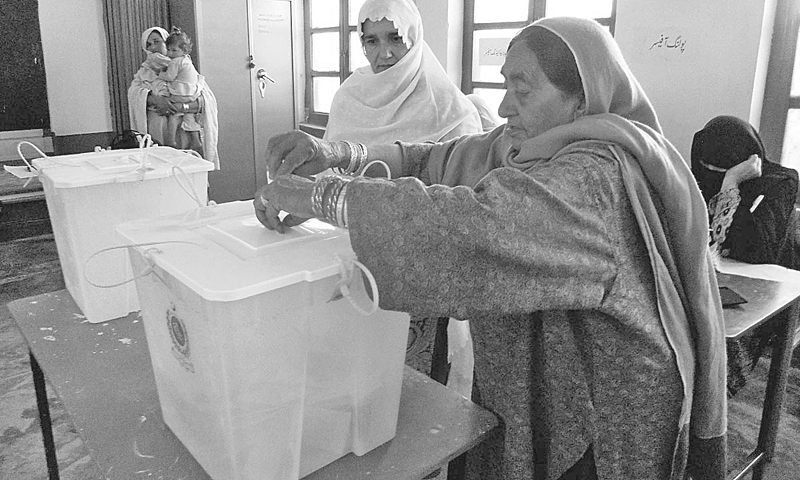
MINGORA: The Pakistan Tehreek-i-Insaf won the PK-86, Swat-VII provincial assembly seat in by-election on Thursday. The seat fell vacant after an election tribunal disqualified Pakistan Muslim League-Nawaz MPA Qaimoos Khan over fake degree. According to unofficial results, PTI candidate Dr Haider Ali Khan won the by-election by securing 17,420 votes at all the 85 polling stations in the constituency. Sardar Khan of PML-N stood second by bagging 16,346 votes, while JUI-F candidate Ali Shah secured third position by getting 10,072. The overall turnout was 40 per cent. The constituency has 134,614 registered voters for whom 85 polling stations were set up, including 29 for men, 29 for women and 27 for both. The administration had declared 42 polling stations the most sensitive, 36 sensitive and seven normal. Polling the seat took place peacefully between 8am and 5pm without break. The Khwazakhela police briefly arrested two women for polling bogus votes. The two, including Muskan and Rukhsan, both residents of Peshawar, were later freed. The local administration had put in place tight security checks at polling stations. After the announcement of the unofficial results, the PTI activists and sympathisers in different parts of the district came onto the streets to celebrate the party’s victory in the by-election. CM CONGRATULATES THE WINNER: Provincial Chief Minister Pervez Khattak has congratulated Dr Haider Ali for winning the PK-86, Swat by-election and attributed his victory to the PTI’s growing popularity in the province and the people’s confidence in the policies of the party’s provincial government. The chief minister the tsunami of change, which began its journey under the leadership of PTI chairman Imran Khan, had not subsided and instead was moving ahead with more strength and vigour. He said the PTI tsunami would sweep the entire country with the people’s support. In a message of congratulation to the party candidate, Mr Khattak said the people were sick of the decades long exploitative and anti-people policies of the traditional hereditary politicians, so they wanted practical change and PTI had provided them with a ray of hope. “The brave and politically aware people of Khyber Pakhtunkhwa had accorded support to that voice to begin the journey towards massive change in the province. Now, this change will happen in the whole country,” he said. The chief minister expressed the hope that the newly-elected MPA would work for the progress and development of the area, resolve the local residents’ grievances, play an effective role for effective legislation in the province and make sincere efforts for strengthening the party,” he said. Mr Khattak said he expected that the MPA-elect would play a pivotal role in the elimination of corruption and nepotism from the public sector organisations to make them reflective of the people’s expectations. Also, provincial information minister Shah Farman congratulated the MPA-elect and said the PTI-led government’s revolutionary steps in education, health and other sectors were appreciated by the people. He said the public support of the provincial government was fast increasing and that was why a number of political figures were joining PTI.

Malaysia vows MH370 transparency as families vent anger

KUALA LUMPUR: Malaysia's premier pledged to release a report on flight MH370's disappearance as passengers' families protested Friday outside the country's embassy in Beijing, venting anger at the agonising information vacuum surrounding the plane. Prime Minister Najib Razak, whose government has faced wide questioning over its transparency on MH370, promised that a preliminary report submitted to the UN's aviation body would be released publicly. “In the name of transparency, we will release the report next week,” he told CNN in an interview aired late Thursday. That wasn't soon enough for dozens of Chinese relatives who held an overnight protest outside the Malaysian embassy in Beijing, according to a spokesman for relatives. Many family members, especially those in China — two-thirds of the 239 people aboard the Malaysia Airlines plane were Chinese — have for weeks bitterly accused Malaysia of a secretive and incompetent MH370 response. Tensions boiled over at a briefing Thursday at a hotel where relatives are staying, after airline representatives said a Malaysian embassy official would not arrive to answer their often extremely combative questions. “We want somebody from the embassy to come out and tell us why they didn't come,” said relative Steven Wang. He said about 100 people had waited outside the mission overnight. Police fanned out around the embassy Friday morning. Dozens of relatives had staged a noisy protest last month at the embassy — apparently sanctioned by Chinese authorities, who cleared streets for their approach — decrying Malaysian authorities and the national airline as “murderers”. The Boeing 777 vanished on March 8 en route from Kuala Lumpur to Beijing and is now believed to have crashed in the southern Indian Ocean, where an Australian-led search is under way. But a difficult underwater search of the suspected crash site, using an unmanned mini-submarine equipped with a sonar device, was nearing completion with no trace of the plane found. Search 95 per cent complete “Bluefin-21 has now completed approximately 95 per cent of the focused underwater search area. No contacts of interest have been found to date,” said a statement from the search headquarters in Perth. The UN's International Civil Aviation Organisation (ICAO) requires countries to submit within 30 days a factual account of what is known so far in any air crash. A Malaysian official had said Wednesday it was uncertain whether the government would release the report. But Najib confirmed Malaysia would release it publicly after an “internal investigation team” examined it. Asked on CNN whether that indicated it contained embarrassing revelations, Najib replied, “No, I don't think so.” Anthony Brickhouse, a member of the International Society of Air Safety Investigators, said the report was unlikely to contain anything startling. “This preliminary report is really just a run-down of what you know so far. And in this case, not much is known anyway,” he said. Malaysia has pledged that any data eventually recovered from the plane's “black box” will be publicly released. It has said it is assembling what officials insist will be an independent international team operating under ICAO guidelines to conduct a comprehensive probe. Australian and Malaysia authorities are mulling what to do next in the ocean search if the Bluefin-21 fails to find wreckage. But they insist the search — estimated to have cost at least $100 million and counting — will go on, possibly using other assets including more powerful sonar devices. Najib stressed that his government was not yet prepared to declare MH370's passengers dead, while saying, “it is hard to imagine otherwise.” A relatives' organisation this week denounced a Malaysian official's suggestion that death certificates could soon be issued. The outraged families said that would be premature in the absence of any proof of what happened.

Special court reserves judgment over FIA’s investigation report‏

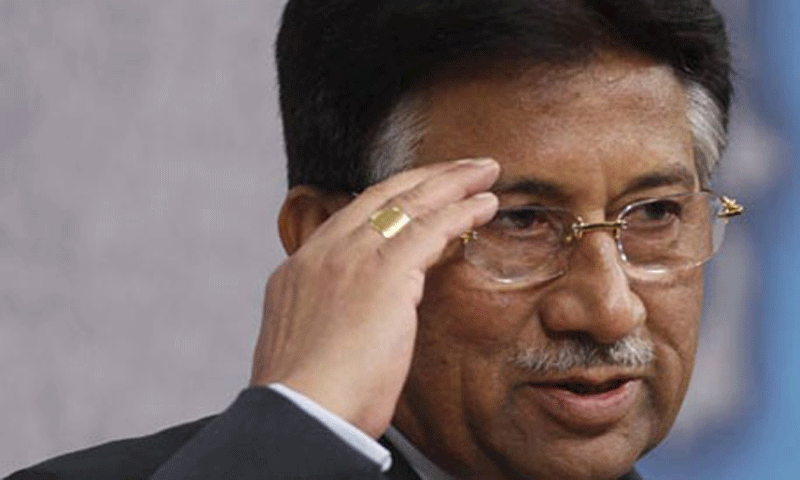
ISLAMABAD: The special court on Thursday in treason case against the former military ruler Gen (retd) Pervez Musharraf reserved its judgment related to the handing over of Federal Investigation Agency’s (FIA) investigation report to the defence lawyers while adjourning the hearing until April 28, DawnNews reported. The three-judge court, headed by Justice Faisal Arab of the Sindh High Court, heard the case pertaining to treason charges against the former president. During the hearing, lawyer of the defence team Barrister Farogh Nasim said that the trial should be fair otherwise it should not take place at all. Nasim in continuation of his arguments demanded that along with the investigation report revealing the outcome of the investigation process, all the documents pertaining to the case should be also provided. The defence lawyer said that a secret act existed in the country but the investigation report did not fall under the domain of the official act to justify the report’s classification. Justice Arab replied that if it were a case of classification then the media would not have broadcast the report. Nasim said that he had given references of the court orders and today would provide their summary. He also questioned the initiation of the trial under Article 6 of the Constitution and said that the process would be challenged. The defence counsel sought not only the investigations report but all documents pertaining to the case. Addressing the court, Nasim also expressed his reservations regarding the safety and preservation of the documents saying that it was common knowledge as to how records were maintained in Pakistan. The court subsequently adjourned the hearing of the case until April 28 while reserving its judgment related to the handing over of the FIA report. Nasim had earlier leveled allegation that the non-provision of the FIA report by the federal government was based on 'malintention.

Google social networking boss Gundotra leaving company

SAN FRANCISCO: Google Inc's head of social networking services, Vic Gundotra, is leaving the Internet search company, he said on Thursday, three years after overseeing the launch of the Google+ social network. Gundotra, who has worked at Google for eight years, announced the move in a Google+ post. He did not give a reason or say where he was going, but related a story about a sudden death in his extended family which made him rethink life's priorities. "We pour our heart and soul into our work and it becomes something we love and cherish," Gundotra wrote. "But even the challenges we work on today will one day become "and thens" as we move on to the next." Google+ marked the company's most concerted effort to catch up with Facebook Inc in the fast-growing social networking market, but it has struggled to match the popularity of the rival, which has 1.28 billion users. Gundotra said in October that 300 million users visit the Google+ web page every month. David Besbris, a vice president of engineering in the Google+ division, has been picked to replace Gundotra whose departure is effective immediately, a source familiar with the matter said on Thursday. The person is not authorized to speak publicly about the matter and requested anonymity. Gundotra's exit is the latest change to Google's senior leadership. Last year Android operating system boss Andy Rubin stepped aside, and in February Salar Kamangar, head of Google's YouTube video website, was succeeded by longtime Google ad executive Susan Wojcicki. Google Chief Executive Larry Page commended Gundotra's efforts in building the company's social networking service from scratch. "There are few people with the courage and ability to start something like that," Page wrote in a post on his Google+ profile page on Thursday, noting that the company would continue building new features for Google+. A former Microsoft Corp manager who has appeared in a Mercedes-Benz television commercial, Gundotra was known for being an outspoken critic of rival companies. Google has increasingly sought to position Google+ less as a social networking "stream" that competes head-on with Facebook, and more as a means of establishing a unified "user identity" system to improve Google's various Web properties. Last year, for example, Google began requiring users of its YouTube site to sign in with their Google+ identity before posting comments about videos. Gundotra's departure and Besbris' new role were first reported by the technology blog Recode on Thursday.

HomeSci-TechNews Exclusive: Apple, Google to pay $324 million to settle conspiracy lawsuit

SAN FRANCISCO: Four major tech companies including Apple and Google have agreed to pay a total of $324 million to settle a lawsuit accusing them of conspiring to hold down salaries in Silicon Valley, sources familiar with the deal said, just weeks before a high profile trial had been scheduled to begin. Tech workers filed a class action lawsuit against Apple Inc, Google Inc, Intel Inc and Adobe Systems Inc in 2011, alleging they conspired to refrain from soliciting one another's employees in order to avert a salary war. They planned to ask for $3 billion in damages at trial, according to court filings. That could have tripled to $9 billion under antitrust law. The case has been closely watched due to the potentially high damages award and the opportunity to peek into the world of Silicon Valley's elite. The case was based largely on emails in which Apple's late co-founder Steve Jobs, former Google CEO Eric Schmidt and some of their Silicon Valley rivals hatched plans to avoid poaching each other's prized engineers. In one email exchange after a Google recruiter solicited an Apple employee, Schmidt told Jobs that the recruiter would be fired, court documents show. Jobs then forwarded Schmidt's note to a top Apple human resources executive with a smiley face. Another exchange shows Google's human resources director asking Schmidt about sharing its no-cold call agreements with competitors. Schmidt, now the company's executive chairman, advised discretion. "Schmidt responded that he preferred it be shared 'verbally, since I don't want to create a paper trail over which we can be sued later?'" he said, according to a court filing. The HR director agreed. The companies had acknowledged entering into some no-hire agreements but disputed the allegation that they had conspired to drive down wages. Moreover, they argued that the employees should not be allowed to sue as a group. Rich Gray, a Silicon Valley antitrust expert in private practice, said the companies had an incentive to avoid trial because their executives' emails would make them look extremely unsympathetic to a jury. However, the plaintiff attorneys risked an appeals court saying the engineers could not sue as a group at all. "An appellate court could say, 'Hey we just don't buy that,'" Gray said. Trial had been scheduled to begin at the end of May on behalf of roughly 64,000 workers. Spokespeople for Apple, Google and Intel declined to comment. An Adobe representative said that the company denies it engaged in any wrongdoing, but settled "in order to avoid the uncertainties, cost and distraction of litigation." An attorney for the plaintiffs, Kelly Dermody of Lieff Cabraser Heimann & Bernstein, in a statement called the deal "an excellent resolution." Corporate defendants in antitrust cases often agree among themselves what portion each will contribute towards a settlement, said Daniel Crane, a professor at the University of Michigan Law School. One likely formula would be to divide the damages based on how many employees each company has in the class, he said. Apple, Google, Adobe and Intel in 2010 settled a US Department of Justice probe by agreeing not to enter into such no-hire deals in the future. The four companies had since been fighting the civil antitrust class action. Walt Disney Co's Pixar and Lucasfilm units and Intuit Inc had already agreed to a settlement, with Disney paying about $9 million and Intuit paying $11 million. Any settlement must be approved by US District Judge Lucy Koh in San Jose, California. A hearing on final approval of the Intuit and Disney deals is scheduled for next week. The plaintiffs and the companies will disclose principal terms of the settlement by May 27, according to the court filing on Thursday, though it is unclear whether that will spell out what each company will pay. Some Silicon Valley companies refused to enter into no-hire agreements. Facebook Chief Operating Officer Sheryl Sandberg, for instance, rebuffed an entreaty from Google in 2008 that they refrain from poaching each other's employees. Additionally, Apple's Jobs threatened Palm with a patent lawsuit if Palm didn't agree to stop soliciting Apple employees. However, then Palm Chief Executive Edward Colligan told Jobs that the plan was "likely illegal," and that Palm was not "intimidated" by the threat. The case in US District Court, Northern District of California is In Re: High-Tech Employee Antitrust Litigation, 11-cv-2509.

Nawaz launches Uch-II power project

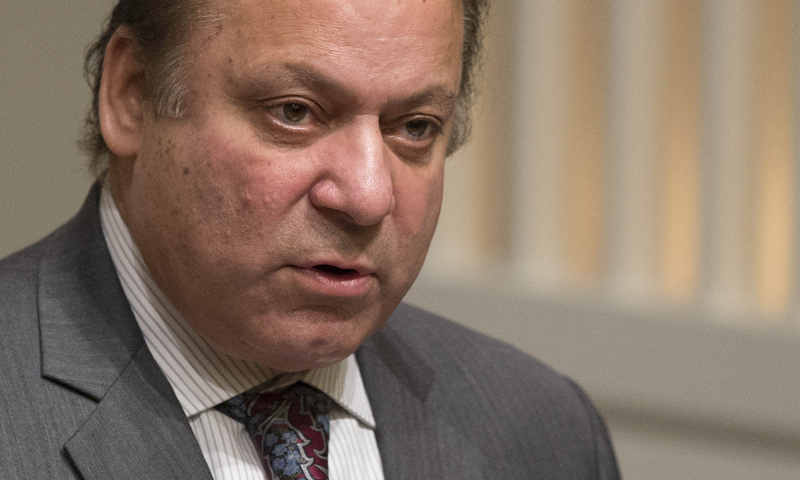
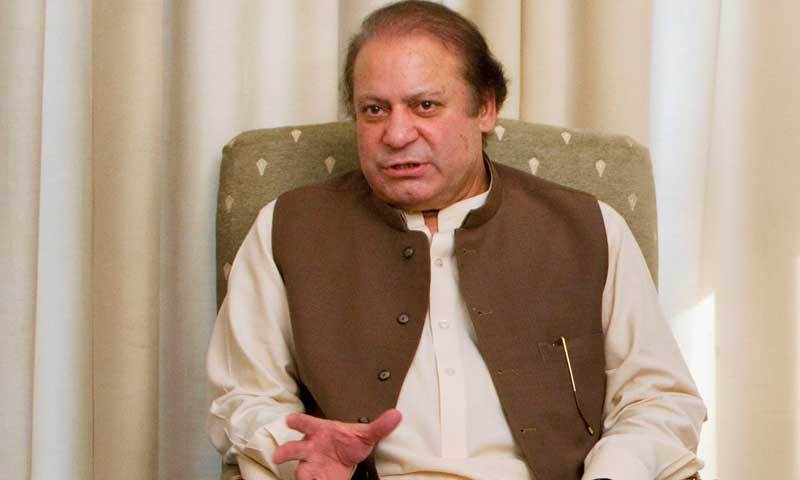
QUETTA: Prime Minister Nawaz Sharif inaugurated on Friday the 404MW Uch Power Project-II in Dera Murad Jamali, Balochistan, DawnNews reported. Addressing the ceremony, the premier said the government would fulfill the electricity shortage in the country within two and a half years' time. He stressed on the need for carrying forward all institutions together for the country’s prosperity. On the occasion, the premier also announced that new power lines would be laid in Balochistan’s Nasirabad and Sibi Division areas. This was the second major power project to be inaugurated by the prime minister in a week. Earlier on April 21, the premier had inaugurated commissioning of additional power units at the Guddu Thermal Power Plant.

Facebook acquires fitness tracking mobile app Moves

SAN FRANCISCO: Facebook Inc has acquired the maker of a mobile app that can track the distance consumers walk or run and measure the calories burned, giving the social networking company an entree into the nascent market for fitness and health monitoring technology. Facebook did not disclose the price it paid for ProtoGeo Oy, the 2-year-old Helsinki company that makes the Moves app. A Facebook spokesman said the price for ProtoGeo, which has fewer than 10 employees, was not anywhere near what the company had paid for other higher-profile acquisitions recently. Facebook has begun 2014 by going on a shopping spree, paying $19 billion for mobile messaging service WhatsApp in February and $2.3 billion for virtual reality headset maker Oculus VR a couple of weeks later. Fitness tracking is attracting the attention of large and small technology companies, with companies such as Fitbit and Jawbone selling electronic bracelets that measure the wearer's activities. In March, Google Inc announced a special version of its Android operating system aimed at smartwatches and other types of wearable computers. The Android Wear project will enable devices that can be outfitted with a variety of sensors to track a user's heart rate or measure the distance jogged, Google said. With the Moves app, Facebook can enter the market without developing its own wearable computing hardware. The app uses a smartphone's built-in sensors to track a person's physical activity, recognizing movements such as walking, cycling and running. Facebook said Moves, which would continue to operate as a separate app, fit into its recent strategy of offering a variety of standalone mobile apps, such as Instagram for photo-sharing, Facebook Messenger for messaging and WhatsApp. Sampo Karjalainen, whose official title is "designer CEO" of ProtoGeo, began working at Facebook's Menlo Park headquarters last week, the Facebook spokesman said. The free Moves app has been downloaded more than 4 million times for iPhone and Android phones, according to ProtoGeo.

Blast in Karachi's Delhi Colony kills four, wounds more than 20

KARACHI: An explosion took place near a mosque in Delhi colony area of Karachi killing at least four persons,including a woman, and injuring more than 20 others, DawnNews reported. Provincial Information Minister Sharjeel Memon talking to media persons at the blast site confirmed that four persons had died in the explosion. He also said that three government vehicles were damaged in the attack and that these vehicles were the apparent target of the blast. The information minister said that there had been an escalation in such incidents after the expiry of ceasefire announced by the Tehreek-i-Taliban Pakistan (TTP). The blast shattered the windows of several nearby buildings, damaged motorcycles and completely destroyed a vehicle bearing a government number plate. DIG south Khaliq Sheikh said that blast was carried out through a bomb planted on a motorcycle. Security personnel also claimed to have taken two suspects into custody who were shifted to an undisclosed location for further questioning. According to initial reports, the blast took place near the location of a carpet showroom in the area which was situated between two mosques. Other eyewitness reports said that the explosion occurred when people were leaving the mosques after offering Friday prayers. The casualties were shifted to the Jinnah Postgraduate Medical Centre. A huge plume of smoke was also visible above the area, following the blast. Security personnel cordoned off the area as a search operation went underway. The loud explosion was heard in adjoining areas of Clifton, Gizri and several phases of Defence Housing Authority. No group or individual claimed responsibility for the incident till the filing of this incident. The incident comes a day after police officer Shafiq Tanoli and three others were killed in an explosion near Karachi's old wholesale vegetable market.

Thursday, April 24, 2014

Prison art: unshackled

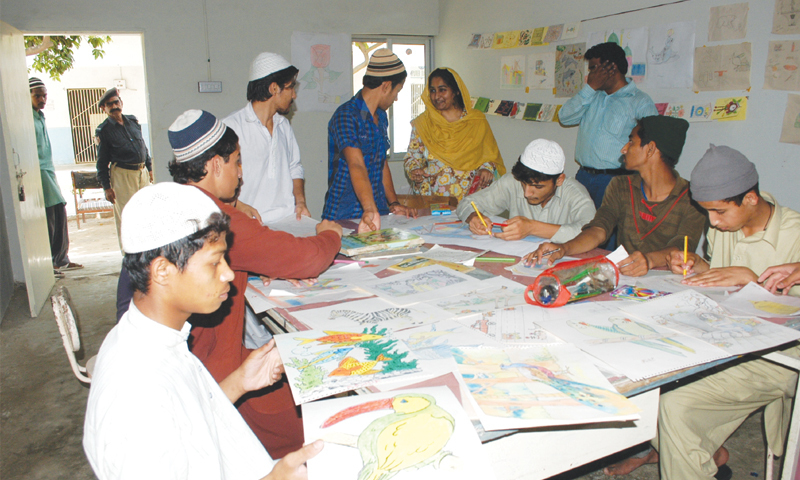
The exhibition of paintings done by the inmates of the Karachi Central Prison at Alliance Francaise, Karachi, recently, was at par with any show by promising artists. Without attempting to deprive Alliance the credit for hosting this exhibition year after year, I felt that the best way to judge the exhibition was to see the artists at work. Though an earlier request was turned down, I was pleasantly surprised to find the IG Prison Sindh, N.H. Mangan more than willing to let me have a detailed visit not just to the art class room of the Karachi Central Prison male inmates, but also the ones for debutant artists in the adjoining juvenile jail and women’s jail. Art classes, the IG’s pet project, started first in the men’s section in 2008 when he was superintendent of jail. Now that he is the IG and holds the responsibility of all jails in Sindh, he is working on a plan to introduce the subject for all the jailbirds in the province. The, soon to start, art classes in the New District Jail in Malir (commonly called the Landhi Jail) is a step in the same direction. By the way, Mangan is himself an ardent art collector and often purchases works of the inmates. Escorted by the coordinator of the art project, Abdul Wahid Khairi and Sikandar Jogi, the art teacher of male inmates, I first went to the juvenile jail. On the way I was told that the amount generated through sales at exhibitions and at an outlet on the premises go to the artists themselves. How they get the materials — canvas, colours, paper, pencils etc. — is a logical question. There are donors, such as Aftab Tapal, whose generosity comes to their rescue. “We teach everything from sketching and painting to sculpture. I would like to teach them print making also but sadly we don’t have a print making machine,” rued Jogi, a graduate of the Central Institute of Arts and Crafts, Karachi. One wishes someone could chip in with that. It was heartening to watch boys in the Youthful Offenders Industrial Institute, which is the official name of the juvenile jail, totally engrossed in their work. They were all newcomers to fine art and were being tutored by the soft-spoken but highly motivated Firdous Siddiqui, who holds a master’s in fine arts from the University of Punjab. One boy was yawning, not out of boredom but because he couldn’t get a wink the night before. Reason: no prizes for guessing: load-shedding the previous night. As we were leaving the premises, we had a hurried look at other classes. Firdous led us to the women’s jail, where the class was held earlier in the morning and the women were now attending to their chores. A girl in her early 20s, who introduced herself as Ayesha, brought her sketches. For a beginner they were quite nice. But the most impressive works were abstract pieces of oil on canvas by Anab Hameed, who spoke English impeccably. She teaches the language to children of fellow inmates. Anab is accused of murder and has been in the jail for 10 months, along with her co-accused boyfriend.
Firdous took our leave as Khairi and Jogi took me to the imposing 115-year-old building of the Karachi Central Prison. The inmate artists who were quietly practising their skills — sculpting, sketching and painting — had the advantage of working in an air-conditioned room. Needless to say, the AC was also donated by a philanthropist. I was particularly impressed by Abdul Aziz Bugti, who has been convicted of murder. He is condemned to death, not once but four times, according to him, and to serve rigorous imprisonment for 200 years. “My fault is that I was Akbar Bugti’s driver,” he said. Initially, he spent his time sulking, but when he took to painting he did so with a vengeance. His portrait of a young Baloch on display at the Alliance exhibition was done highly skilfully.
Hasnain Raza, an articulate young man clad in a shirt and jeans, has been convicted of being an accomplice in a murder case but he has filed a clemency appeal with the Sindh High Court. “I am hoping against hope,” he said, and perhaps as a reflection of his attitude the colours in his paintings are quite bright. Kazim Shah had displayed his relief of Faiz Ahmed Faiz near the entrance. This depiction, in plaster of paris, did bear some resemblance to his favourite poet. Maybe the Faiz Museum in Lahore could purchase it. The two art teachers said that due to their trials many prisoners, young and not so young, male and female, have to miss their art classes. The IG Prison Sindh has promised that an exhibition of paintings of women inmates will be held soon. How soon? I didn’t ask.

PM calls for minimum loadshedding

ISLAMABAD: Prime Minister Nawaz Sharif was informed on Wednesday that about 40 per cent of the gas lost by the Sui Southern Gas Company Ltd (SSGC) and Sui Northern Gas Pipelines Ltd (SNGPL) was attributable to theft. The prime minister directed the authorities concerned to take strict action against those involved in gas and electricity theft. “Leakage from the systems is unacceptable because the government has now provided a legal framework for stringent action against electricity and gas theft,” he told a meeting at the Prime Minister House. During a briefing on the electricity crisis, Mr Sharif said that minimum loadshedding should be carried out to save consumers from inconvenience in summer. He instructed the authorities concerned to speed up a dues recovery drive and submit a report to him within a week. The prime minister called for strict action against the heads of all inefficient power distribution companies. He was informed of the proposed loadshedding schedule for the next four months. The meeting was informed that the SNGPL and SSGC were facing gas losses of up to 375 million cubic feet per day (mmcfd). About 80 per cent of the unaccounted for gas (UFG) was attributable to leakages and theft, and 20 per cent to meter errors. In 2012-13, the SNGPL had UFG of 210 mmcfd (12 per cent of the gas in the network) and the SSGC 115 mmcfd (10 per cent). Officials of the ministry of petroleum and natural resources told the meeting of the measures taken to control gas losses and theft. The short-term measures included theft control, pressure profiling, leak rectification and replacement of defective meters. The medium and long-term measures included segmentation of distribution networks, pipeline rehabilitation, improvement of measurement accuracy and measures to protect the networks, they said.

PM orders reshuffle in bureaucracy

ISLAMABAD: While the news media remained focused on the defence ministry’s application to the Pakistan Electronic Media Regulatory Authority (Pemra) for cancellation of Geo TV channel’s licence, it was business as usual at the Prime Minister’s Office on Wednesday where Prime Minister Nawaz Sharif spent a busy day. The prime minister ordered reshuffle in the federal bureaucracy besides holding two lengthy back-to-back meetings on the state of Pakistan International Airlines (PIA) and the most important one on the schedule of loadshedding over the next four months. According to the Prime Minister’s Office, Nadeem Hassan Asif has been appointed secretary of the establishment division. Before that Mr Asif was working as principal secretary to the president, a comparatively unimportant assignment within the federal bureaucracy. Prior to his posting with the president, Mr Asif also served for a short stint of around six months at the prized position of Chairman of the Capital Development Authority (CDA). But he couldn’t pull along well with members of the CDA board. Mr Asif has replaced Mr Shahid Rashid in the establishment division, who will now serve as the secretary of statistics division, not a sought-after assignment. Another important posting was of new secretary of industries, Raja Hassan Abbass. The government is working on plans for privatisation of the Pakistan Steel Mills, which falls under the administrative control of the ministry of industries. Ms Rukhsana Saleem will be the new secretary of climate change, a position earlier held by Mr Abbass. Sikandar Sultan Raja, a Grade 20 officer, has been sent to Gilgit-Baltistan as the Chief Secretary. His possible transfer from the position of the Director General of Immigration and Passports may be due to his differences with the Minister for Interior, Chaudhry Nisar Ali Khan, his reporting boss. An official of the passport office told Dawn that Mr Raja had earned the ire of Chaudhry Nisar by objecting to his decision to allow the Foreign Office to send their officers on postings abroad which were actually meant for passport office. In his letter to the interior minister, Mr Raja had argued that since the staff of the passport and immigration office had served on positions in foreign missions to deal with issuance of machine readable passports, the assignment couldn’t be handed over to the Foreign Office. Chaudhry Nisar, according to the sources, had taken exception to his objection. Mr Raja has replaced Younas Dhaga, who will now work as the secretary of housing and works, a position which has been vacant for quite some time. The prime minister also approved promotion of 10 officers of Inland Revenue Service (IRS) from Grade 20 to 21. They are: Sardar Munawer Zaman, Ms Seema Majeed, Ghulam Kazim Hosain, Sajaad Haider Khan, Muhamamd Irshad Nadeem Dar, Waqar Ahmed, Lubna Farrukh, Ikram Ghani, Tariq Pashaa and Tasneem Rehman. Eight officers of the Foreign Office were also promoted to Grade 21. They are: Iftikhar Aziz, Tasneem Aslam, Afrasiaab Mehdi Hashmi, Sohail Mehmood, Khalid Usman Qaider, Ayaz Hussain, Farooq Amil and Nadeem Riaz. And three cases recommended for promotion from Grade 20 to 21 were sent back to the Central Selection Board.

Pakistan joins the 3G club

ISLAMABAD: The four cellular service providers bidding on licences for next generation mobile technology emerged the winners of Wednesday’s bidding war, with Mobilink, Telenor and Ufone picking up licences for 3G services while Zong being the only bidder to acquire a licence for both 3G and 4G services. Mobilink and Zong bid for the ‘superior’ 10MHz band, while Telenor and Ufone preferred to bid on the cheaper 5MHz band. Although Mobilink, having acquired the 10MHz band, qualified for a 4G licence too, they opted not to go all the way. This means one 4G licence is still up for grabs. Minister of State for Information Technology Anusha Rehman said that the licence would soon go under the hammer again. Bidding began at 10am and continued until a little after 7pm at the Marriott Hotel. Bidders competed in eight rounds of 45 minutes each. A total of four 3G licences were auctioned and both Telenor and Ufone got the ‘shorter end’ of the spectrum. “It was a strategic decision. We want to provide internet services for all our customers but at low costs. The 5MHz frequency is all that is required at the moment,” said Telenor Pakistan Chief Corporate Affairs Officer Muhammad Aslam Hayat. Ufone had also shown an interest in acquiring both 3G and 4G licences, but on the day, they did not qualify. Under PTA rules, Ufone has to purchase the 10MHz band to be eligible for a 4G licence. According to a Pakistan Telecommunication Authority (PTA) spokesperson, cellular companies with weaker frequencies would have to install more booster towers in their coverage areas, depending on how many cities they wanted to cover. A taste of things to come Visitors to the auction got a taste of next-generation mobile speeds at the stalls of various cellular vendors. Telecom reps showed off the astonishing speeds boasted by 3G services and demonstrated the power of high speed internet services on compatible mobile handsets. Cellular companies will have to offer a minimum download speed of 256 kilobytes per second (kbps) under the stipulations of the 3G licence, which is four to eight times faster than current download speeds of 30-100 kbps that are currently on offer. PTA Chairman Dr Ismail Shah said: “Meeting the budgetary targets is just one small aspect of this sale. We are looking at bigger benefits such as the creation of nearly 900,000 jobs and the development of newer, faster applications that will contribute to the improvement of educational, health and financial standards.” The YouTube question Following the demonstration of the speeds of mobile internet, one of the first questions thrown at the officials was regarding the unblocking of video sharing website, YouTube. “The IT ministry is following the Supreme Court’s orders and wants to block all objectionable content on the website before unblocking it for the public. We are working on a way forward and will have a final answer by mid-May,” IT minister Anusha Rehman said.

Pakistan Modi’s remarks encouraging: Pakistan envoy

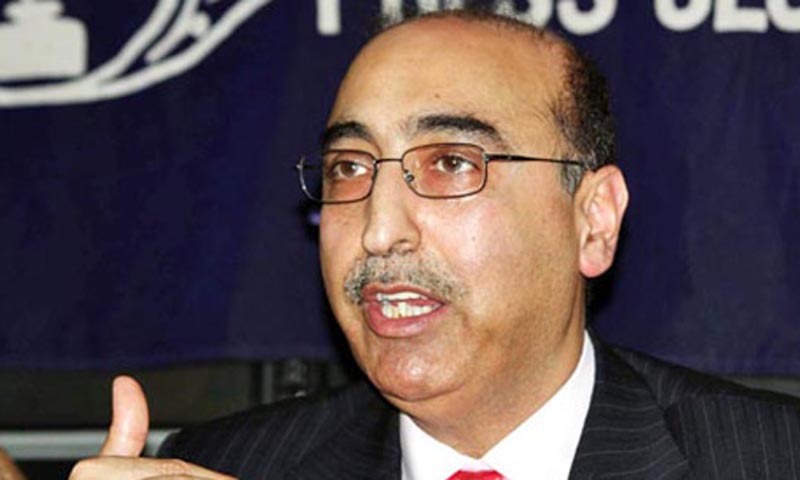
NEW DELHI: Pakistan said on Wednesday it was “encouraged” by comments from India’s election frontrunner Narendra Modi who stressed cooperation with foreign governments if he was elected prime minister. Critics fear that if elected Mr Modi will adopt a tough foreign policy that could see relations deteriorate with Pakistan and China. But Pakistan High Commissioner Abdul Basit said he welcomed Mr Modi’s comments in a television interview that he would pursue the policies followed by former BJP premier Atal Bihari Vajpayee. “I was very much encouraged. They were very positive. It gives us hope that if he is elected as prime minister we should expect more positive things,” Mr Basit told journalists in New Delhi. Mr Vajpayee sought several times during his tenure to make permanent peace with Pakistan. New Delhi broke off peace talks with Islamabad after the 2008 Mumbai attacks in which 166 people were killed by Pakistani gunmen. Making a strong pitch for a resumption of the talks, Mr Basit said dialogue was the only way to resolve outstanding issues such as Kashmir. Mr Basit said the Pakistani government wished to change the “narrative between the two countries into one of cooperation and trust. The envoy also said that his government was “keenly looking forward to a government with which Pakistan (can engage) quickly, comprehensively and meaningfully... and move from conflicting relations”. He added that “terrorism is a common enemy of both countries” and that those who believed Pakistan harboured terrorists “misunderstood the country”.

Read how Google and Facebook helped 7-year-old lost girl reunite with her family

Mumbai: The modern day technology including Facebook and Twitter might be addictive but it is not a complete waste after all. You will understand it better after reading this story. The 7-year-old girl Danisha Bokadia who was lost in the High Street Phoenix mall in Mumbai on Sunday was re-united with her parents with the help of a family who noticed the girl in the mall. Along with this family, Facebook and Google also played their parts in the reunion of Danisha with her parents. While the girl was sobbing quietly at a corner in the mall after separating from her parents, the 8-year-old Purva noticed the girl and told her father about it. Danisha who was visiting the mall with her parents studies in Walsingham School in Walkeshwar. Nobody noticed the little girl crying with her eyes searching here and there for her parents. It was then that the 8-year-old Purva, a student of Christ Church, saw her and guessed she might have been lost in the big mall and directed her father Dev Chatterjee towards the girl. Dev Chatterjee told Mumbai Mirror 'Our daughter spotted this girl alone and crying. Realising she must be lost; Purva drew our attention to her. When we approached her, she confirmed she couldn't find her parents.' Chatterjee immediately used Facebook and Google to track the father of the girl after Danisha told him about the company where his father works in. Danisha did not remember the phone number of her father Amit Bokadia but told Chatterjee that he works in Gururaj technologies. Chatterjee typed the detail of Bokadia into Facebook and searched for his profile. He sent him several messages regarding his lost daughter but received no response. Thereafter, he looked up for Amit Bokadia's company on Google and managed to get his phone number from Gururaj Technologies. He called him up and told about his missing daughter. 'I immediately called and told him we had found his daughter. We were so happy we could reunite them. It's unfortunate that so many people were walking around and yet no one noticed this poor child', Chatterjee told Mumbai Mirror. Amit Bokadia who was worriedly looking for his daughter everywhere was relieved after Chatterjee's phone call. 'So many children come to the mall and it's very easy for them to get lost. My child was old enough to remember my name and my company's name. What if the child was younger and hadn't learned to speak?' Bokadia said. Bokadia, who was thankful to the technology and Purva and her family, said that there should be more help desks at malls as small children are often separated from their parents in the rush. Image Courtesy: Mumbai Mirror Picture: Purva, 8,with her father Dev Chatterjee who helped reunite 7-year-old Danisha Bokadia with her family (Left to Right)

Auction analysis: Opening act done … the real game starts now

KARACHI: The much-awaited spectrum auction took place yesterday with Pakistan historically embracing the third-generation (3G) and 4G mobile technology. The auction’s successful conclusion was a welcome sight for all — the government, cellular mobile operators (CMO), their customers and industry experts as well. An in-depth analysis shows that while the government hailed it as a major achievement – and it was – there were a few areas where it did fall short.
Every single stakeholder praised the transparency of the process with some even terming this a major achievement of the auction. “The auction was held in an open and transparent way and concluded without any controversies,” Islamabad-based expert on Information Communications Technology (ICT) Parvez Iftikhar told The Express Tribune. “To me, this was the biggest success in the whole process.” Iftikhar’s views were also echoed by the telecom industry that seemed satisfied with the outcome. “The process has been very transparent and provided a level playing field to all operators,” Telenor Pakistan said in a statement. “We are satisfied with the end result as it is in line with our investment and overall ambition of providing internet to all.” Ufone Chief Executive Officer (CEO) Abdul Aziz, too, was pleased after the CMO managed to earn some spectrum in the 3G band. “This is a major milestone not just for Ufone but also the telecommunication industry of Pakistan in general,” he said. Though the government was not able to sell the entire available spectrum, the results were almost in line with the target it had set a year ago. During his budget speech for fiscal 2014, Finance Minister Ishaq Dar had set a target of $1.2 billion under non-tax revenues. The amount was supposed to be earned from the spectrum auction. The government managed $1.1 billion. The government was able to sell the entire 30 megahertz (MHz) spectrum it had in the 3G band, while also making money for the 10MHz spectrum in the 4G band. The 850 MHz spectrum, which was reserved for a new player, and another 10MHz of spectrum in the 4G band remained unsold. Iftikhar, a leading consultant on the 3G spectrum, said the government should be able to auction the unsold spectrum in a couple of months, which could take their total earnings – including the amount it raised on Wednesday – to $1.6 billion. The former managing director of Universal Service Fund, however, insisted the auction’s success should not be attributed to the earnings alone. Iftikhar is not the only ICT expert with such an opinion. Martin Sims, a London-based expert on spectrum evaluation, expressed similar views. “In the Pakistan auction, as in auctions generally, there is an excessive focus on the amount raised and much of the thinking is simplistic and misguided,” said Sims, who is associated with UK-based Policy Tracker. “It is not the case that the more money is raised more successful the auction.” The amount raised, Sims says, seems to be within reasonable expectations, particularly seeing the number of players. “An injection of capital for the treasury is always welcome but this is the warm-up act and not the main event.” While the government seems to have done well overall, there are some areas that experts believe it could have done better. “Pakistan Telecommunication Authority (PTA) should not have restricted the 850MHz spectrum – of the defunct Instaphone – to new operators,” said Iftikhar. This is a lucrative spectrum all over the world and has demand in Pakistan, he said. “Had they not restricted this to a new player, it would have gotten sold,” he said. Iftikhar further said the PTA should not have tied the 4G spectrum with the 10MHz spectrum in the 3G band. “By doing that, they restricted operators who bought 5MHz spectrum to bid for 4G.” If this condition wasn’t in place, there might have been some competition in that area, he added. Sims voiced the same view. “Failing to sell all the licences in the most popular 4G/LTE band – 1800 MHz – does not seem a mark of success,” he said. The prices achieved, too, are on the lower side compared to other auctions in other countries. The global average auction price is $4.17 billion and that for developing countries is $2.68 billion, said Sims – higher than what Pakistan earned. On the bright side, the fact that four mobile operators went home with some spectrum in 3G showed the industry is going to remain competitive, which would keep prices under pressure and, in turn, benefit consumers. While Wednesday’s auction was certainly a landmark achievement by the government of Pakistan, Islamabad could have done much better had it auctioned these licenses a decade ago. If Pakistan had auctioned the licenses 10 years ago, the economic benefit would have been greater, with the software industry having a much longer time frame to take benefit from the technology. Published in The Express Tribune, April 24th, 2014.

Inefficient: FBR chief admits govt withholding Rs97b refunds

ISLAMABAD: The top taxman of the country admitted on Wednesday that the government was withholding Rs97 billion refunds of taxpayers – an amount if extracted from latest collection brings actual growth in revenues to a level that is even below the nominal rate of national output. “The total payable refunds to taxpayers as of today are Rs97 billion,” said Federal Board of Revenue (FBR) Chairman Tariq Bajwa, who has been struggling to achieve even the downward revised annual collection target of Rs2.345 trillion. For the current fiscal year 2013-14, the Parliament’s approved target is Rs2.475 trillion. It was for the first time that any government official admitted that the FBR owed such a big amount to taxpayers, vindicating the business community and economists who were crying foul about the FBR’s claim of achieving over 16% growth in revenue collection. Bajwa was speaking at the platform of the Senate Standing Committee on Finance and Revenue. However, Bajwa maintained that the amount the government owed to taxpayers was less than the comparative period when the outstanding refunds stood at Rs99 billion. As of April 22, the FBR has collected Rs1.671 trillion in taxes – claiming that it was higher by Rs222 billion or 15.3% over the collection made in the comparative period of the previous fiscal year. By extracting the amount payable to taxpayers, the actual collection comes to Rs1.574 trillion, higher by just Rs125 billion or 8.6% over the previous year. The 8.6% growth in collection is far below the nominal Gross Domestic Product (GDP) growth rate. The nominal GDP is determined by calculating inflation plus GDP growth rate. During the first nine months of this fiscal year the inflation rate was 8.6% while the official average growth rate in the first six months (July-December) was 4.1%, bringing the nominal GDP rate to 12.7%. According to leading tax experts, any growth in collection below the nominal GDP rate indicates evasion in taxes, highlighting inefficiency of the FBR. Bajwa did not disclose the actual refund claims, despite repeatedly being asked by Senator Ilyas Bilour of ANP. The other day Bilour had claimed that the FBR has blocked Rs450 billion refunds – a claim which went uncontested despite FBR’s chief sales tax being present in the meeting. Bajwa said till April 22, the FBR has paid Rs87.3 billion in refunds to taxpayers, higher by Rs10.8 billion or 14% over the amount paid in refunds in the comparative period. He claimed that the FBR has developed a robust system of refund payments and even his relatives are not paid refunds before their turns. However, the committee contested the chairman’s claim and said that most of the time the FBR’s systems were not properly working in a deliberate attempt to delay refund payments. Published in The Express Tribune, April 24th, 2014.

Sectarian violence: Over 2,000 people killed in 5 years, Interior Ministry tells Senate

ISLAMABAD: The Senate was informed by the Interior Ministry on Wednesday that the monster of sectarianism had devoured at least 2,090 lives over past five years, with militancy hit Federally Administered Tribal Areas (FATA) on top with 867 killings. The figures were revealed in a written reply from the ministry of interior during the question hour. Balochistan, which has seen deadly attacks on the resident Shia Hazara community, witnessed 737 killings. Sindh, where a number of doctors, professors religious leaders belonging to the their sect have been targeted in recent years, 252 were killed over sectarian differences between January 2008-January 2009. Punjab, which saw some of the worst riots in the country last year following a clash of two groups in Rawalpindi on Ashura that resulted in a curfew, 104 people were killed in sectarian violence over five years. Khyber-Pakhtunkhwa 22. Gilgit-Baltistan, which has belied its largely peaceful outlook with incidents of sectarian violence, saw 103 people falling victim to sectarian violence. Five people lost their lives in Islamabad in sectarian attacks. The exact number will probably be a bit higher since the reply provided covered the period from January 2008 to January 2014. Senators from different political parties contested the figures provided by the ministry and also asked the state minister about number of convictions of those who were arrested on charges of sectarian violence. However, the minister did not answer that question, further irking the members. Madrassas getting funding from aboard The government also confirmed during Wednesday’s session that some seminaries were getting financial support from abroad. “Some seminaries/madrassahs in the country are receiving financial support from foreign Islamic countries. The remittances are received through banking channels,” the interior ministry confirmed in its written reply to a question by Pakistan Peoples Partys Sugra Imam. The state minister for interior Balighur Rehman said that the State Bank of Pakistan had started compiling data of all such remittances. The ministry’s reply, however, did not contain any estimates on funding coming through other channels. Legislation on cards to take away role of GHQ in issuing POF weapons Awami National Party’s Zahid Khan was concerned that POF Wah Cantt was not issuing weapons to some parliamentarians despite having obtained the prerequisite approvals from the ministry of interior. He accused that ministry authorities were hurdle in issuing these weapons. Minister for defence production Rana Tanveer informed the house that 256 cases were pending before his ministry where applicants, including 17 of parliamentarians, had attained no objection certificates to purchase weapons from Wah Cantt. Tanveer said that his ministry was working to amend the law which would do away with the role of GHQ in issuing weapons to such cases. He further said that a total of 239 Parliamentarians were issued weapons by POF Wah Cantt from 2009 to 2014. Senate disapproves a bill and an ordinance Having numerical majority in the Upper House, the Opposition parties managed to disapprove a bill and a presidential decree with majority vote. MQM’s Nasreen Jalil presented report on Sales Tax Amendment Bill 2014 that sought to annul a Supreme Court’s directives on correction of tax mechanism for CNG sector. She also moved a resolution to disapprove the Bill, which was adopted by majority through voice count. After the disapproval in Senate, future of the proposed law is bleak, unless the government amends it before approving it from the National Assembly. The Senate also rejected by majority vote the PMDC Amendment Ordinance that sought to vest the federal government with powers to control of the regulatory body. The Ordinance was laid before the Senate last week and as per Constitution any member can move a resolution calling for its disapproval. The disapproval motion was jointly moved by PPP Senators Farhatullah Babar and Raza Rabbani. Senator Babar said that the PMDC was an autonomous regulatory body which under a federal legislation was responsible for establishing uniform minimum standard of medical education, regulate the conduct of medical and dental practitioners across Pakistan and monitor and maintain standards of medical education. He reminded the House that all regulatory bodies, the medical education; and related institutions fell under items listed in Part-II of the Federal Legislative List, the policy formulation for which was the responsibility of Council of Common Interest. Babar said that under Article 154 of the Constitution, policy formulation in matters listed in part-11 of the Federal Legislative List is the responsibility of the Council of Common Interest and not of the federal government and PMDC being a regulatory body was the responsibility of CCI, adding that the federal government cannot take over the functions of the regulatory body. The resolution was the put to vote which the House disapproved the ordinance before it could be transformed into a permanent law. Minister for Planning and Development Ahsan Iqbal laid before the House another report of Pakistan Vision 2025 and Millennium Development Goals.

First of its kind in Pakistan: 3G-4G auction fetches $1.1 billion

ISLAMABAD: Pakistan on Wednesday successfully completed the auction for next-generation telecom spectrums – the first of its kind in the country – raising $1.112 billion or Rs111 billion from the process. The Pakistan Telecommunication Authority (PTA) had offered three bands for the 3G spectrum – with a total available frequency of 30MHz – and two bands for the 4G spectrum. Out of the four competitors participating in the auction, only Zong managed to secure licences for both 3G and 4G spectrums; the other three – Mobilink, Telenor and Ufone – secured only 3G licences. While the PTA managed to sell all three bands of the 3G spectrum on offer, it could only sell one 4G licence after Ufone – the only other bidder for the spectrum – was disqualified on technical grounds. The $1.112 billion that the country has earned from the sale is just $17 million or 1.6% higher than the reserve price of $1.095 billion for these licences. The $210 million on account of the unsold 4G licence is excluded from calculations. “But surely, it will usher in an era in which the country’s youth will have accesses to modern telecom services and create thousands of new jobs,” said Minister of State for Information Technology (IT) Anusha Rahman. After the last round of bidding, PTA Chairman Dr Ismail Shah announced “all spectrums in 2100MHz (3G) have been sold.” “But we could only sell one licence in 1800MHz (4G) as Ufone was unable to qualify,” he said. Shah explained that a bidder only qualified to bid for the 4G spectrum after winning a minimum 10MHz in the 3G spectrum. He said that despite bidding for 15MHz in the 3G spectrum, Ufone could only win 5MHz. CMPAK Limited, better known as Zong, bid the highest – $306.9 million – for a 3G licence in the 10MHz band, making it eligible for getting a 4G licence at a base price of $210 million.The base price for 3G was set at $295 million. Of the total $1.112 billion earned by the government, Zong – which is fourth largest among Pakistan’s five existing telecom players – paid $516.92 million for the two licences. “Zong is very excited for becoming the only party to win both 3G and 4G frequencies and will roll out the services at a fast pace,” said Sikandar Naqi, the adviser to the chief executive officer of Zong. While Mobilink – the largest telecom player in the country with 29% market share – also won a licence in the 10MHz band, it opted against bidding for a 4G licence. The final 10MHz band was divided into two 5MHz slots, one of which was won by both Telenor and Ufone each. Mobilink paid $300.9 million for a 3G licence in 10MHz, making it the second highest bidder. Telenor and Ufone, however, got 3G licences at base price, creating suspicions of collusion. Ufone, by choosing to bid for 15MHz, had also forced PTA to break one 10MHz band into two. Meanwhile, the PTA chairman said the decision to sell the last 4G licence will be taken soon. “PTA’s decision to not allow Ufone to bid for a 4G licence after it failed to fulfill the requirement was a good decision… it ensured that the process remained transparent,” Finance Minister Ishaq Dar said while speaking at a news conference after the auction. Asked whether the PTA will forfeit the money deposited by Ufone after the telecom operator won less than it had bid for, Dar said the decision will be taken after receiving input from the law ministry. ‘Govt earned more than it expected’ Talking to reporters, the finance minister said the government had earned more than it had initially estimated. He said the government could still earn at least Rs50 billion more from the last remaining 4G licence, in addition to the Rs111 billion it had earned from the sale already. One more licence is also being kept for a new entrant, he added. Dar said the government, by successfully conducting the auction, has established that it has the ability to fulfill the promises it has made to the nation. He said the introduction of new telecom technologies will create hundreds of thousands of new jobs. The minister hinted at giving tax relief to users of telecom services, but said a final decision will be taken in the upcoming budget. On issue of YouTube, he said in addition to the Supreme Court’s directives for keeping the video-sharing portal blocked until the removal of blasphemous material, Prime Minister Nawaz Sharif has also directed PTA to remove videos showing pornography and mutilated bodies of security personnel. Published in The Express Tribune, April 24th, 2014.

Jet planes bomb militant hideouts in Khyber Agency

KHYBER AGENCY: Jet planes bombed hideouts of militants in various areas of Khyber Agency early on Thursday, Express News reported. The operation was carried out on a tip-off that militants who were involved in the Sabzi Mandi blast in Islamabad and the attack on the police in Charsadda were present in the area, military sources said. No loss of life was reported as of yet. The attacks An explosion on Nowshera Road in Charsadda early on April 22 left three people dead and 33 others injured including 12 policemen. On April 9, a high-intensity remote-controlled blast in Sabzi Mandi in Islamabad had left at least 22 people dead and dozens injured. Previous bombings On February 27, gunship helicopters had carried out shelling in tehsil Kulachi, FR Dera Ismail Khan in which three suspected militants were killed. This was the first time that the Pakistan military had conducted shelling in the settled area of Khyber-Pakhtunkhwa. At least 30 militants perished as warplanes pound their hideouts on February 25 in the South and North Waziristan, according to military officials. The airstrikes mainly took place in Datta Khel and Shawal areas of North Waziristan where militant training facilities and compounds are said to be located. On February 23, airstrikes were carried out in the remote Tirah Valley of Khyber Agency in which security forces killing at least 38 militants, including key commanders. Six hideouts were also destroyed, they had added. Just a day earlier, on February 22, security forces had carried out shelling on militant hideouts in Thall sub-district of Hangu, killing at least nine insurgents. On February 19, at least 30 suspected insurgents were killed and several others got injured as military jets and gunships had bombed their hideouts in the North Waziristan and Khyber agencies.

Former SHO Shafiq Tanoli killed in Karachi suicide blast

KARACHI: A suicide blast in the Old Sabzi Mandi area of Karachi left four people including former SHO Shafiq Tanoli dead and 15 other people injured, Express News reported on Thursday. According to initials details, Tanoli’s house was the target of the blast. The former SHO has been targeted at least seven times before. One of Tanoli’s brothers, Rasheed, told the media that his uncle and cousin were among the deceased as well. Tanoli’s family members had born the brunt of his work in the past. Tanoli’s younger brother, Naveed, was killed the same day when Tanoli, the then SHO of Supermarket Police Station, had arrested the murderers of Geo News reporter Wali Khan Babar. Tanoli was the investigating officer for the murder case. The injured in today’s attack, who also include Tanoli’s family members, were taken to Abbasi Shaheed Hospital. Rescue teams and the police have reached the site of the explosion and a shop was destroyed in the blast as well. Background The man, who was always determined to fight violence, joined the police force in 1989 when he was in his early twenties. He was also active during the army operation in the 1990s – a time when officers were scared to mention they were from the police force. Tanoli had also worked for the CID, and was involved in the arrest of Lyari’s Arshad Pappu, inviting the wrath of his followers. He had been attacked twice in Pak Colony, twice in Mauripur, once each in Liaquatabad, Sachal and Old Sabzi Mandi.

Wednesday, April 23, 2014

Movie how a mom cares her child without arms

Bangladesh court orders Khaleda's trial go ahead

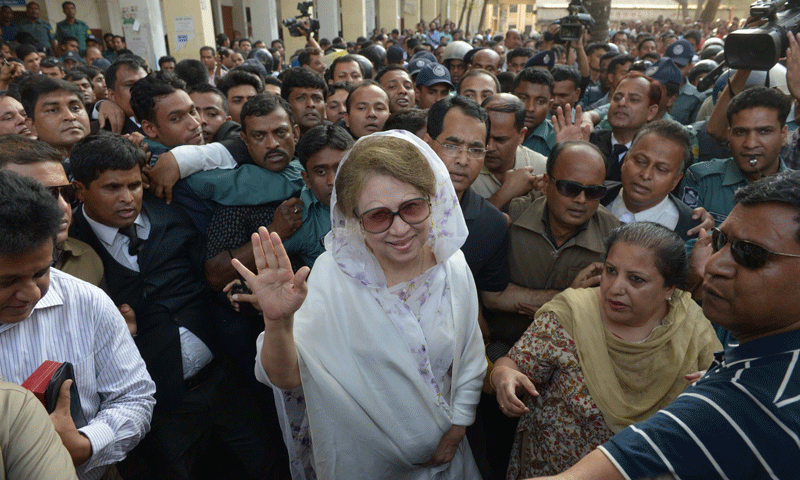
DHAKA: A Bangladesh court ruled Wednesday opposition leader Khaleda Zia should stand trial for embezzlement in a case that could see her jailed for life, a prosecutor said. The High Court rejected the former two-time premier's appeals to halt the trial, which had been expected to start on Monday after she was indicted on charges of embezzling more than $650,000. “Both her appeals have been rejected. There is no bar to continue her trial in the two cases,” deputy attorney general Mohammad Selim told AFP. A panel of two judges said the charges framed against Zia should stand and the trial could now go ahead in a special anti-corruption court in Dhaka, Selim said. Zia's lawyers have called the charges politically motivated, aimed at destroying her Bangladesh Nationalist Party (BNP), which has vowed to topple the government of arch rival Prime Minister Sheikh Hasina. Zia was indicted just weeks after Hasina was re-elected in a Jan 5 general election which the centre-right BNP and its 18 allies boycotted and denounced as a farce. Police detained thousands of opposition officials and supporters and charged many more during and after the election, which was the bloodiest in the country's short history. Zia's lawyer Sanaullah Miah said he would now lodge an appeal in the Supreme Court, the country's highest, in a final attempt to stop the trial from going ahead. “It is now clear that the government wants to put Zia in jail. That's why we are not getting any justice in any court,” he told AFP. Prosecutors say Zia and three of her co-accused siphoned off 31.5 million taka (about $400,000) from a charitable trust named after her late husband Ziaur Rahman, a former president who was assassinated in 1981. She is also accused of leading a group of five people, including her eldest son Tarique Rahman, in embezzling 21.5 million taka ($270,00), funds which were meant to go to orphanage set up in memory of her late husband.

Round six of 3G spectrum licenses auction ends without change

ISLAMABAD: The sixth round of auction process for 3G licenses concluded at $902.82 million on Wednesday without any change from the previous two rounds and a $17.82 million increase in the bids since their begining, DawnNews reported. The total opening price of the four lots of 3G licenses was $885 million while there was an increase of $5.9 million in Lot D and $11.92 million in Lot A at the end of the sixth round auction. At the end of the auction's first round there was no increase in the bid price whereas there was an increase of $5.9 million in the bid price of Lot D at the end of the second round. Moreover, an increase of $5.9 million and $5.92 million in the bid price of Lot A had taken place by the end of the third and fourth rounds of the auction process. Chairman Pakistan Telecommunication Authority (PTA) Dr Syed Ismail Shah had earlier told Dawn that the first round of the license auction process had concluded with the four competing companies agreeing to the base price. Initially, three 10 MHz 3G licences and two 10 MHz 4G licences were announced for auction but currently the auction for four lots of the 3G spectrum are underway. The addition of another lot of the 3G spectrum licenses was made in accordance to a stipulation in the information memorandum for the spectrum auction. The auction for the 4G licenses would take place after the completion of the 3G licenses auction. The second and third rounds of the auction for 3G licenses, began with a two per cent incremental bid price.
The PTA committee is authorised to increase the bid price by one to three per cent per round. There are a total of eight rounds of the auction process. The base price for a 3G licence is $295 million and for a 4G licence it’s $210m. Mobile phone companies can bid for one 10MHz bandwidth licence or the entire spectrum, comprising three 10MHz licences (a total bandwidth of 30MHz). The four companies participating in the bidding had earlier logged on to the software of the Pakistan Telecommunications Authority (PTA) for the process. According to PTA officials, the four bidders were assigned different colours, and each bidder would bid through the colour allotted to them instead of through their respective names. The PTA expects to receive more than $1.3 billion from the auction. The introduction of 3G and 4G spectrum in the telecom sector is expected to revolutionise the way subscribers stay connected. 4G provides even faster speeds and ultra-broadband services, putting data-intensive services such as online gaming, high definition mobile TV and video conferencing within the reach of the average consumer.

5 drinks to shrink your love handles

Drinking has always surpassed eating, be it saving time or helping in weight loss! For a fact your daily intake makes a lot of changes around your body regularly. You might as well swing this fact to your benefit. Some very simple beverages can do wonders for your body and improve your health. Cut down on your calories and fats by drinking these five amazing drinks that will reduce your weight. Read on: Tea (without sugar) Green tea has been proven to boost metabolism and speed up weight loss. Try it hot or iced with a bit of honey for a low-sugar sweet drink. It is filled with antioxidants, which can make your body Toxin-Free. Vegetable juice Vegetable juice (can, bottled, or homemade) is an excellent way to get the fiber and nutrients the body needs to fuel your weight loss. It keeps you fuller longer and the flavors do a great work of satisfying the taste buds. Water Water is the most effective remedy for weight loss with no side effects whatsoever. You could put fresh lemon slices, cucumber, or even slices of tomato without adding many calories to add some flavor to the otherwise boring water. Black coffee A morning cup of coffee can watch over your weight by providing a boost of caffeine that suppresses hunger. Also, coffee heats up the body and boosts metabolism. Just make sure to stick to as little sugar as possible. Skim milk Low-fat or skim milk makes up for all the vitamins minus the added fat. Milk is the best source of lean protein, vitamin D, and calcium that can help build your muscles and keep your bones strong. Also it is delicious.

REVEALED: Modi's wife Jashodaben whisked away to Ramdev's ashram after being named in affidavit

New Delhi: BJP’s Prime Ministerial candidate, Narendra maybe the most prominent media savvy leader in the country but he is equally clandestine about his personal life. After filing the nomination in Varanasi and letting the cat out of the bag, Narendra Modi’s forgotten half, Jashodaben too came into media’s glare. Much has been talked about Jashodaben for the last few weeks but no media house had the chance to speak to her. Ever imagined why? In a recent exclusive eyewitness story done by THE WEEK, an astounding news was revealed, THE WEEK claims right after Narendra Modi filed his nomination in Varanasi, Jashodaben was picked up and packed off to Modi’s ardent supporter and Yoga Guru Ramdev Baba’s ashram in the Himalayas. April to September is pilgrim season in north India, when the faithful from across the country flock to the Char Dham in the Himalayas. For devotees from Gujarat, the journey this year offers not just spiritual bliss but also a fair share of intrigue. There are whispers that one of the ashrams of yoga guru Baba Ramdev near the Neelkanth Mahadev temple in Rishikesh in Uttarakhand is hosting Jashodaben until the elections are over and the media interest in her wanes. According to sources in the Vishva Hindu Parishad, soon after Modi acknowledged Jashodaben as his wife, Hindu activists and security professionals dressed as pilgrims arrived on her doorsteps in three white SUVs. They told her that her long-standing wish for a Char Dham yatra had come true. Sources said the group took her to Ahmedabad, where she boarded a chartered flight to Aurangabad near the Uttar Pradesh-Uttarakhand border, and then to Ramdev's isolated mountain-top ashram at Rishikesh. Labourers in the ashram say a lady was seen arriving in a white vehicle on April 13. “Jashodaben is protected by top-level security people with ties with the Gujarat security services. Perhaps, she does not even know that those with her are not pilgrims but people tasked with keeping her away from the public eye,” said a source close to Swami Swaroopanand Saraswati, the Shankaracharya of Dwarka Peeth, who recently spoke out against Modi. Despite Jashodaben's vanishing act, the atmosphere at her brother Kamlesh's home is upbeat. Strangers and unemployed youth are pouring in to meet Jashodaben and inquire about her famous husband. Modi's acknowledgement has put the spotlight on her relatives and they seem to be enjoying it.
Origins of the controversy over Modi-Jashodaben’s marriage: The year was 1968. The house of Damodardas and Hiraba Modi in Vadnagar in north Gujarat was bustling with activity. One of their six children, Narendra, 18, was getting married. Though there had been pre-marriage ceremonies for a few days, the Modis, strapped for cash, had kept the celebrations restrained. Clad in kurta, pyjama and safa (turban), the groom came out of the house with his family and friends. Some members of the family got into a jeep with the groom and the rest boarded a state transport bus, which was hired for the wedding, with others. Their destination was Brahmanwada, about 50km from Vadnagar, where the bride, Jashoda, lived. Her father, Chimanlal Modi, was a school teacher. When the groom's party reached Brahmanwada, Narendra was made sit on a horse. “He looked good,” says Punja Patel, 75, who attended the function. Patel, however, remembers the wedding for another incident-a patharnu (thick cotton sheet on which people sit), he had given to the Modis, went missing from the venue. Narendra's friends say he was reluctant to get married. “He was engaged to Jashoda a year before the marriage. But unlike other teenagers, he never spoke about her. In fact, he kept telling us that he wanted to serve the country and was not interested in marriage,” says Nagji Desai, 64, an ayurvedic practitioner who was a classmate at Shri B.N. High School in Vadnagar. The wedding was a simple affair. “When we reached, we were offered tea, gathiya and jalebi,” says Desai. Though Narendra remained serious throughout the function, Jashoda, who was one and a half years younger than the groom, appeared happy. Desai says she wore a red panetar (a traditional Gujarati sari) and a green modiyu (an ornament that Gujarati brides wear on the forehead). Lunch was served after the wedding. Desai still remembers it had mohanthaal (a sweet dish), puri, vegetable, dal and rice. Jashoda left her home with Narendra for Vadnagar, where his mother welcomed them by applying kumkum(vermilion) on their foreheads, says Desai. A relative performed the ritual of untying the knot of a cloth the couple had worn on their shoulders. Then they played a game in which they were asked to find a ring in a container of milk and flowers. The one who finds the ring, it was said, would rule the marriage. “Narendra won,” says Desai, though it still appeared to be a happy day for Jashoda. The next dawn, however, broke with a shocking news. “Narendra took the 6 a.m. train to Ahmedabad,” says Desai. “He returned only after some 30 years.” It came as a shock to Narendra's friends, too, as he had not told them about the plan. “He gave in to parental pressure to get married,” says Jasud Khan Pathan, 64, a retired bank manager who was also a classmate at Shri B.N. High School. “That he has been married is true. But the fact is that they never lived together.” According to Desai, Jashoda went to her parents' home after a few days, which was customary. When she returned to Vadnagar, Narendra's parents were said to have told her that she could stay with them as long as she wanted to. It is said that she stayed at the in-laws' place for a few months and went back home. She continued her studies as her husband had asked her to and became a school teacher. Now retired, she lives with her brother Ashok and sister-in-law in Unjha near Vadnagar. It was a controversy in waiting. No sooner Narendra Damodardas Modi, the BJP's prime ministerial candidate, acknowledged in his affidavit while filing nomination papers from the Vadodara Lok Sabha constituency that he was married than the media rushed to Unjha in search of Jashodaben. They were told that she had gone on a Char Dham pilgrimage, and would be back only on May 17, a day after the Lok Sabha election results are scheduled to be announced. Ashok, however, later said she was back. It could be the fear of offending the powerful man (undoubtedly, Modi revealed his marital status in the affidavit only because there was a Supreme Court directive against leaving any column blank), Jashodaben's family is reluctant to answer any questions about the Gujarat Chief Minister. And the irony is unmistakable. While Modi, who enjoys Z-category security owing to a terror threat, is seldom asked about his wife, Jashodaben and family remain open to questioning by society and the media. While Modi and his party are spending hundreds of crores of rupees for media slots, Jashodaben and family are struggling to avoid attention. “My sister-in-law has no problems with him [Modi]; then what do we say?” asks Ashok's wife. Ashok, who runs a small business, says Modi had his reasons not to admit that he was married. “Since he was apracharak [of the Rashtriya Swayamsevak Sangh] he could not disclose his wife's name; but he always had feelings and now he has expressed his feelings by naming her in the affidavit,” he says. Has Modi ever provided any kind of support to her or the family because of his “feelings”? “The family did not need help and she was a teacher,” says Ashok, confirming that the couple never had a married life, as Modi left home soon after their wedding. Kamlesh Modi, Jashodaben's youngest brother who lives in Brahmanwada, is even more elusive. All that he says is that they are proud that Modi is from Mehsana district. The extended family, however, is not so closed. Daksha Modi, who is married to a nephew of Jashodaben, Rakesh, is seemingly angry. “After Modi acknowledged my aunt as his wife, his elder brother Sombhai described the marriage as aupcharikta (formality). What is formality?” she asks. “At times, we tell her to go to Gandhinagar. But she says, 'What is the need? I get my pension'.” According to Daksha, Jashodaben regularly follows Modi on television and in the newspapers, and prays for him to become the prime minister. She does not like anyone criticising him. Daksha is sure that Jashodaben will not say a word against Modi even if she is offered a fortune.
The worlds of Modi and his in-laws are poles apart. Kamlesh's home is no lap of luxury and his wife, Sitaben, does not wear designer clothes. She receives guests in a small room with two charpoys and overhanging steel buckets. It is evident that she and Jashodaben have had hard lives. Sitaben, however, is a firm supporter of Modi. She is wary of Congressmen, who in the past had exhorted Jashodaben to speak out against Modi. “Do not criticise Modiji,” says Sitaben. “He has sacrificed a lot for the country. We don't blame him for neglecting his wife.” Detractors, however, say Modi left his wife in the lurch. “A primary school teacher in Gujarat earns approximately Rs. 15,000. In the 1970s, the salaries were much lower and her life must have been full of hardship,” said Madhusudan Mistry of the Congress, who is contesting against Modi in Vadodara. Despite the controversy, political parties seem unwilling to reach out to Jashodaben. Perhaps, they fear that if they did, she would come out in support of Modi. Shabnam Hashmi of the NGO Act Now for Harmony and Democracy says Jashodaben's public image as a religious and conservative woman will be used to bolster the kind of womanhood that fits the RSS ideology well. Despite all the media attention, very little is known about Jashodaben. The many photos of Hindu deities that crowd the walls of Kamlesh's house indicate that she is as religious as her relatives. Students of the Rajosana Primary School near Brahmanwada, from where she retired in 2010, recall an affectionate and popular teacher who used to teach social sciences, elementary maths and Gujarati language. School photographs show her surrounded by students, most of them Muslim, and villagers speak of her in tones bordering on reverence. “She used to rise very early and feed the cows chapattis and jaggery before leaving for school,” said a villager. “She was very religious but was fond of all her students, irrespective of their differences.”

Afghan election result delayed due to fraud probe

KABUL: Afghanistan´s presidential election result has been delayed by two days due to fraud investigations and will now be released on Saturday, officials said Wednesday as they vowed to sift out fake votes. Partial results from the April 5 election to succeed President Hamid Karzai have already been released, with former foreign minister Abdullah Abdullah ahead of his main rival Ashraf Ghani after half of the ballots were counted. Hundreds of serious fraud allegations are being probed in an attempt to ensure a cleaner election than in 2009, when Karzai retained power in a vote marred by rampant cheating. "Committed to determining results that reflect the will of Afghan voters, the IEC is conducting thorough investigations of all irregularities," the Independent Election Commission said in a press release. "While these investigations have delayed the process slightly, they are critical to the accuracy and integrity of final results." The latest partial results put Abdullah in the lead with 44.4 percent followed by former World Bank economist Ghani on 33.2 percent. If no candidate gains more than 50 percent, a second-round election between the two leading names is tentatively scheduled for May 28.The IEC said further partial results would be announced on Thursday. Overall turnout is set to be nearly seven million voters from an estimated electorate of 13.5 million people -- far above the 2009 turnout. The incoming president will have to lead the fight against a resilient Taliban insurgency as US-led combat troops leave Afghanistan this year, and must also strengthen an economy reliant on declining aid money. Eight candidates ran in the election, with polling day hailed a success by Afghan officials and foreign allies as the Taliban failed to launch a major attack despite threats to disrupt the vote.

Blog Archive