Monday, April 28, 2014

Sunny Leone sheds it all for a Diamond Traders Party? Hubby Daniel claims pictures are over 10 yrs old

Sunny Leone seems to be finding it difficult to do apart from her porn-star image. The news that has taken all social media platforms by storm is that former porn-star Sunny Leone has stripped again, and this time for Diamond Traders party in Pune. If a leading entertainment website is to be believed, 'baby doll', who until last week was being adulated for her Ragini MMS 2 hit number, has made headlines for what seems to have earned her a whopping amount. There are photos and videos of her strip tease performance to back the news that have gone viral. News is that Sunny Leone has raked in a hefty amount of Rs. 40 lakh for her performance at the social meet of diamond traders. The private party was held at a posh venue on Mumbai-Pune Highway. The event might have earned her a whopping amount, but this move by Ms. Leone might jeopardize her dream of working with the Khans and the A-listers of Bollywood. While she seems to be shying away from any bold scenes in her movies, she continues to act like a tease for her fans. In fact, until now, the sexy siren seemed to be making all efforts to move past her raunchy history of strip teases and porn films to take on garb of rather demure and beautiful diva, capable of earning a name in Bollywood. While her fans are going ga-ga over the reported strip performance, in the heat of the moment, she tweeted to rubbish the news as she wrote, “April 18 was shooting @TinaNLolo and night was at @Mayyurrgirotra store launch, please do some fact checking before printing lies." Sunny Leone's husband Daniel Weber also claimed that the pictures are either photoshopped or over 10 yrs old."With a little effort and research u will know sunny was shooting Tina and LOlo and at night was at the store opening of Mayyur Girotra on April 18.We don't comment on such rumors as these pictures are spread by Obsessed fans from her past. They are either photoshopped or over 10 yrs old. Many news channels where at the store opening to validate the truth. We expect the same from your news publication. Thanks," Daniel Weber said. Whether it was a slip on Sunny’s part as she could not resist the offer of a hefty amount, or whether it is just the grapevine about the sexy siren doing rounds is not known yet, but if anyone is happy about her leaked images, it is her fans!
In fact, until now, the sexy siren seemed to be making all efforts to move past her raunchy history of strip teases and porn films to take on garb of rather demure and beautiful diva, capable of earning a name in Bollywood.
Whether it was a slip on Sunny’s part as she could not resist the offer of a hefty amount, or whether it is just the grapevine about the sexy siren doing rounds is not known yet, but if anyone is happy about her leaked images, it is her fans!
The event might have earned her a whopping amount, but this move by Ms. Leone might jeopardize her dream of working with the Khans and the A-listers of Bollywood.
While she seems to be shying away from any bold scenes in her movies, she continues to act like a tease for her fans.
Sunny started her Bollywood career with Pooja Bhatt directed Jism 2 opposite Randeep Hooda.

Mumbai: 5 drunken naval officers arrested for molesting woman in Khar pub

Mumbai: Five officers from the Indian navy were arrested by the police on charges of physically assaulting and molesting a woman at Khar pub on Saturday night. All of them were in inebriated condition, when they were arrested by the local police. Reportedly, all the five accused chased the woman, who is a banker and hails from Gujarat and her businessman husband, from Khar (West) to Borivili in two autorickshaws, after getting drunk. As per police, the five arrested men work in the electronics department of the Naval Dockyard. One of the men passed derogatory remarks against the woman which led to scuffle between them and her husband, inside the pub. Thereafter, the bouncers mediated and pushed the 5 men out of pub. However, they didn’t return to their place and kept waiting for the couple. After the couple came out and boarded an autorickshaw, they too followed them in 2 separate autorickshaws. It was then the woman contacted Khar police and registered her complaint. The police advised them to come under the Borivli flyover, where the police intercepted the two autos and caught the five men. A medical test confirmed all the accused were drunk during the time of incident.

Narendra Modi warns Bangladeshi immigrants to pack their bags and baggages

Serampore: Threatening to deport Bangladeshi immigrants, if NDA comes to power, party’s prime ministerial candidate Narendra Modi announced in a rally in Serampore in West Bengal that his party doesn’t believe in vote bank politics and illegal inhabitants are only being welcomed here with red carpets for getting easy votes. Alleging Trinamool Congress head and incumbent chief minister if West Bengal Mamata Banerjee of getting indulged in vote bank politics Modi said "I want to warn from here, brothers and sisters write down, that after May 16, will send these Bangladeshis beyond the border with their bags and baggages." "You are spreading the red carpet for the Bangladeshis for the sake of votebank politics," he said in this largely mixed constituency, where there is a large chunk of Hindi-belt population who are the main work force in the jute mills here. "If people from Bihar come, they seem to be outsiders to you, if people from Odisha come, they seem to be outsiders to you, you feel bad if Marwaris come. But if some Bangladeshi comes, your face seems to shine," he said. "When I say what about the employment of the youths, they say what about secularism. When I say what about the welfare of farmers, they say what about secularism. I say what about two square meals for the poor, they say what about secularism. I talk of security for women on whom atrocities are being met out, they say what about secularism. "This vote bank politics has darkened the future of India's youth," he said.

Sindh Assembly passes bill declaring marriage below 18 punishable by law

KARACHI: The Sindh Child Marriage Restraint Act 2013 was passed in the provincial assembly on Monday, declaring marriage below the age of 18 punishable by law, Express News reported. According to the new bill, in cases of underage marriage the parents, bride and groom can all be sentenced to three years in prison and can be fined with Rs45,000. The Sindh Assembly is the first assembly in the country to pass a bill of this kind. The bill was presented in the assembly last year by Sindh Minister for Culture Sharmila Farooqi as well as provincial minister Rubina Saadat Qaimkhani. Both of them were part of an eight-member committee which was tasked on August 1 with preparing drafts in consultation with the stakeholders. The legislation cover child marriages, honour killings, harassment of women and acid attacks. Farooqi submitted her version, titled Child Marriages Prohibition Act, 2013, of the draft in the Sindh Assembly on August 20. Qaimkhani’s draft, titled The Child Marriages Eradication Act, had been scrutinised by the law and women development ministries. She had said that she has re-drafted the bill tabled in 2011 by former women development minister, Tauqir Fatima Bhutto. The Child Marriages Prohibition Act had classified the offence as cognizable, non-bailable and non-compoundable. The Child Marriages Eradication Act, however, had held it only as a cognizable offence. Civil society activists, bureaucrats and the media believe it will take time to implement the bill, for which Health and Nutrition Development Society, an NGO, has been struggling for the last two years. Sharing the history of the first such bill, Sindh Law department’s additional secretary Aslam Shaikh had earlier stated that a bill was introduced in 1929 and the age of a girl for marriage was fixed at 14 years. He had said that with an amendment, the age limit was made 16 in 1965. The enforced Child Marriage Restraint Act, 1929 awards three-month maximum imprisonment and Rs1,000 fine.

India police find body of murdered Briton in plastic bag

NEW DELHI: Indian police said Monday they had found the body of a murdered Briton wrapped in a plastic bag and dumped outside shops in New Delhi. The 40-year-old man had a British passport in his pocket which police said bore the name Rodick Andrew Reymond. The body was found on Sunday morning at a market in the capital, a Delhi police spokesperson said. “It is a murder. We found the body in a decomposed state,” said spokesperson Vijay Kumar. Local newspapers reported that the man, found wrapped in a large blue plastic bag, appeared to have been beaten around the head. He also had burn marks on his face, according to reports, although this could not be confirmed with police. “Other details will be known after the autopsy report,” an investigating officer from Nizamuddin police station told AFP. Police were trying to determine whether his badly damaged passport was genuine, the Hindustan Times said. The passport showed he had arrived in India two months ago on a tourist visa, the Times of India said.

War-ravaged Syria may face worst wheat harvest in 40 years

AMMAN / ABU DHABI: War and drought have crippled Syria’s wheat crop, with some experts now forecasting output of the staple food could fall to around a third of pre-war levels, and possibly even below 1 million metric tons for the first time in 40 years. Agricultural experts, traders and Syrian farmers who talked to Reuters gave crop estimates ranging from one million metric tons to 1.7 million at best, a more pessimistic range than that given by the United Nations earlier this month. Before the war, Syria produced around 3.5 million metric tons of wheat on average, enough to satisfy local demand and usually permit substantial exports, thanks in part to irrigation from the Euphrates river that waters its vast eastern desert. The last time its wheat harvest failed to exceed one million metric tons was 1973, although catastrophic droughts have pushed the crop close to that level in 1989 and 2008. “This year the maximum that Syria will reach in terms of local wheat production will not exceed 1 million metric tons,” a Middle East-based commodities trade source with knowledge of Syrian grain markets said. “One of the main factors limiting production is that it is becoming increasingly difficult to produce it given the extent of the war. There is genuine fear on the ground in traditional production areas and the risks are high.” The UN’s World Food Programme (WFP) had cited an estimate of 1.7 million to two million metric tons for this year and said that rainfall relied on for crops in Syria’s northwestern region was less than half of the average since September. “There are a host of factors, starting from the start of plowing to soil fertilization to harvesting and transport and marketing, and the whole process is disrupted, all is reduced to a minimum level,” Hillal Mohammad, a UN agricultural expert based in Amman, said. Before the war, the Syrian government typically bought around 2.5 million metric tons of wheat each year to distribute to bakeries that feed the public subsidized bread, and to bolster its strategic reserve. Government purchases of domestic wheat have declined and are expected to fall further as chaos caused by civil war and drought hurt the state’s ability to secure supplies. Nearly a third of Syrians have either fled the country or are displaced within it, and swathes of territory are in the hands of rebels fighting to overthrow President Bashar al Assad, where the government food distribution system has crumbled. The agriculture ministry told state media earlier this month that wheat was being grown on 1.2 million hectares of land but did not give an estimate of how much would be produced or bought by the government. Syria typically planted 1.7 million hectares before the war, according to the US Department of Agriculture. Experts doubt the Damascus government’s ability to forecast figures accurately, citing the difficulty of gaining access to most crop growing areas. “It’s difficult for agricultural officials in a country where state organs have effectively lost administrative control of large swathes of territory in the main grain producing Jazira area to assess the crop sown in these areas, let alone estimate production,” said an agricultural expert with close knowledge of Syria, who spoke on condition he not be identified. Agriculture ministry officials declined to comment on the matter when contacted by Reuters. Yusef Abu Ahmed, a farmer in Atma, a northern village near the Turkish border, said by telephone that the length of wheat stalks was about 20 centimeters compared with 80 centimeters in normal years. Some farmers have pumped underground water to compensate for poor rain, but the high cost of diesel has limited that choice for others in the western agricultural belt of Idlib, Aleppo and Homs, where wheat production is mostly rain-fed. “Our wheat straw will end up being used for grazing because of the poor rain this season,” said Ibrahim al-Sheikh, a 36 year-old farmer in the plains of Halazoun, in rebel held northwestern Syria. Disruptions to state procurement With drought hitting its rain-fed wheat crop in the west, the hope for Syria seems to lie in its irrigated crop lands in the east, which before the crisis constituted almost 60-70 per cent of the country’s total wheat production. Some local farmers told Reuters they have sown large tracts of land using elaborate irrigation canals and dams that preceded the crisis, and have escaped widespread damage. The agriculture ministry says it set aside 80 billion Syrian pounds ($539.88 million) to buy wheat and barley this season. Still, even with the funds for procurement set aside and with irrigated lands escaping the drought, the government is not guaranteed to get its hands on the production. “Even if there is production, marketing is severely disrupted,” the UN’s Mohamed said. “It’s getting worse for farmers getting seed and fertilizers etc, and for the state’s elaborate procurement system, with collection and gathering centers almost no longer functioning,” he said. In many parts of Syria’s main eastern breadbasket area known as al-Jazira, which spans Hasaka, Deir al Zour and Raqqa provinces, the government is not in control. The area around the now rebel-held city of Raqqa alone produces around a quarter of the national harvest. One local resident from a farming family said the militant Islamic State of Iraq and the Levant (ISSL) that governs Raqqa and its rural hinterland have told farmers they are free to dispose of their wheat as they choose, even selling it to Turkish traders. Government officials do have good access to areas in Hasaka, Hama and some areas in the northeastern part of the country near the Kurdish-held Qamishli city, another agricultural expert said on condition of anonymity. But the situation in the country overall remains murky.

Egypt Brotherhood chief among 683 sentenced to death

MINYA: An Egyptian court on Monday sentenced Muslim Brotherhood leader Mohamed Badie and 682 supporters to death, a lawyer and prosecutor said. The same court also reversed 492 death sentences out of 529 it passed in March, commuting most of those to life in prison. The defendants sentenced on Monday were accused of involvement in the murder and attempted murder of policemen in the southern Minya province on August 14, the day police killed hundreds of ousted president Mohamed Morsi’s supporters in clashes in Cairo. Several female relatives waiting outside the courtroom fainted on hearing news of the verdict. “My son does not even pray, he does not even know where the mosque is,” said one woman, whose son was among the 529 sentenced to death in March. The rioting last August 14 erupted as news spread that police had killed hundreds of Morsi supporters while dispersing two protest camps in Cairo. The court’s verdicts can be appealed at the Court of Cassation, which would probably order a new trial or commute the sentences for the 529 already given the death penalty, legal expert Gamal Eid said. Defence lawyers boycotted the last session, branding it “farcical” after the mass death sentencing which the United Nations denounced as a breach of international human rights law. Defence lawyer Khaled Elkomy claims that 60 per cent of the 529 defendants, including teachers and some doctors, have evidence that “proves they were not present the day they were accused of attacking the Matay police station” in Minya, a statement released by human rights group Avaaz said. The government has defended the court’s handling of the case, insisting that the sentences were passed only “after careful study” and were subject to appeal. Prosecutor Abdel Rahim Abdel Malek defended the charges against the 529. “We have strong evidence that incriminates all those sentenced to death,” he told AFP. “We have videos, witness accounts… documents that prove that the Muslim Brotherhood had called on its supporters to attack police stations and public and private property in case the sit-in at Rabaa al-Adawiya (in Cairo) was broken up, and that’s what happened,” he said. Last month’s death sentences sent a chill through opponents of the military-installed regime, which has held mass trials of thousands of those alleged to be Muslim Brotherhood supporters since Morsi’s ouster. At least 1,000 people have been sentenced since December, all in groups of 10 or more. Jail terms passed range from six months to life, as well as the death penalty. Amnesty International says that more than 1,400 people have been killed in the police crackdown since the army overthrew Morsi, Egypt’s first elected and civilian leader. Morsi and Badie, jailed as part of the crackdown, each face several trials.

Lahore’s serial killer ‘wanted to teach gays a lesson’

LAHORE: Short in stature and softly spoken, paramedic Muhammed Ejaz was probably destined for a life of relative anonymity – until he began killing gay men he met online. The 28-year-old father-of-two was arrested last week and confessed to three brutal murders, saying he wanted to send out a message about the “evils” of homosexuality, though police insist he had sex with his victims first. The killings have sent shockwaves through Lahore’s underground gay community, who fear Ejaz could be lionised as a hero in a conservative society where homosexuality is stigmatised. In an interview with AFP from his prison cell Sunday night, Ejaz, who sported a neat trimmed beard and was kept shackled, expressed remorse over the killings but said he was acting to stop wrongdoing. “My way was wrong. It is tragic that the families have lost their relatives but they were spreading evil in society and I had to stop it,” said Ejaz, who is due to appear in court on Monday. “I wanted to warn them to stay away from this evil.” The killings happened in March and April, according to police officer Asad Sarfraz, who headed the investigation. The victims were a middle-aged retired army Major and two other men, both in their twenties. All three were found with their necks broken and had been sedated. After examining their mobile phone call logs, police were able to identify Ejaz’s number and found another former lover whom they used as a honey trap to lure him to a meeting a week ago, where they arrested him. Ejaz, who was married in 2011 and has two infant children, said his family knew nothing of what he had done and insisted that he was not gay himself. “I started going on Manjam two months ago using my mobile phone, and found that the gays are everywhere in Lahore,” he said, referring to a popular social networking website. “They are spreading evil and transmitting diseases. They cannot control themselves,” he added. Ejaz said he was the victim of sexual abuse by an older boy when he was around 10 years old and had led a deeply unhappy childhood. “I have hated them ever since what happened to me,” he said. The case has shone an unwelcome spotlight on Pakistan’s closeted gay community, who are often afraid to come out to their families and in the absence of gay venues rely on the Internet and mobile apps to arrange clandestine dates. With sex outside marriage both illegal and deeply frowned upon, same-sex partners are generally able to avoid the same level of scrutiny unmarried heterosexual couples come under. With the case due to be heard in court on Monday, one member of Pakistan’s gay community said he was worried Ejaz could be hailed as a hero by some conservative Muslims. “The problem is that paedophilia and homosexuality are often conflated, so people think eradicating homosexuality means eradicating child abuse,” he said. Ejaz had been a sexually active member of the gay community for several months, the man claimed. “It seems he was motivated by self-hatred and internalised homophobia,” he said. “The worry is – will it inspire others to do the same?”

Major Amir separates himself from peace talks

ISLAMABAD: Former Inter-Services Intelligence official Major (retired) Amir has decided to separate himself from the peace talks with the Tehreek-e-Taliban Pakistan (TTP), Express News reported on Monday. He was part of the first government intermediary committee formed by Prime Minister Nawaz Sharif on January 29. He said that he will inform Interior Minister Chaudhry Nisar Ali Khan soon about the reasons for his separation from the negotiations. The retired major reportedly stated that people who were part of the negotiations had started to use the talks as a “political stunt” which is why he decided to separate himself. On April 23, government negotiators and Taliban intermediaries had agreed to form a subcommittee to look into reservations from both sides in an effort to keep the nascent peace dialogue process. This was done at a joint meeting of the government negotiating team and the Tehreek-e-Taliban Pakistan’s intermediary committee. The meeting was convened by the interior minister to look into the situation against the backdrop of TTP’s refusal to extend their 40-day ceasefire. The government has already made it clear that it would not be possible to move ahead with talks in the absence of ceasefire.

Blast in Karachi's Orangi Town leaves 3 children dead

KARACHI: A blast in Karachi’s Orangi Town left three children dead and injured 11 others, Express News reported on Monday. The explosion reportedly took place in a madrassah in Frontier Colony. Police said that the blast took place in one of the rooms of the madrassah. According to initials details, it seems that the madrassah was the target of the attack, police said. “The explosion, which targeted a religious seminary, killed at least three male students,” a senior local police official, Javed Alam Odho told AFP. He said the police were trying to ascertain whether it was a planted bomb or a hand grenade that had been thrown. Rescue teams reached the area and the injured were taken to Abbasi Shaheed Hospital for medical treatment. A senior doctor at the Abbasi Shaheed hospital, Parshotum Rathore, confirmed the number of deaths and said those who died in the attack were between 10 and 12-years-old. He put the number of injured at more than 12 and said the condition of four of those hurt was critical. A police official told the media that there were between 15 and 20 children present in the madrassah at the time of the explosion. He added that the all the children were between seven and 14 years of age. Police reached the site of the explosion and cordoned off the area. Evidence was collected from blast site and the Bomb Disposal Squad was also summoned. Nobody has so far claimed responsibility for the attack.

Unpaid bills: Gas supply to PM House, Parliament disconnected

LAHORE: Only a few days after Prime Minister Nawaz Sharif ordered serious action against electricity and gas bill defaulters, the gas supply to his own official residence was cut off over unpaid bills worth Rs4.7 million. Roznama Express correspondent Zia Tanoli reported on Monday that Sui Northern Gas Pipelines Limited (SNGPL) has disconnected gas supply to the Prime Minister House Islamabad, Parliament lodges, Convention Centre and Federal Shariat Court among other government offices. According to the SNGPL spokesperson, Parliament House has dues worth Rs1.3 million, Parliament Lodges Rs770,000, Federal Shariat Court Rs224,000 and Governor House Rs8.8 million. All the defaulters had been sent notices several times but no response was received, the spokesperson said. Interestingly, PM Nawaz had chaired a high-level meeting on April 23 regarding the overall electricity and gas distribution system where he had ordered strict action to be taken against electricity pilferers and bill defaulters. He had directed the authorities to not even spare government installations and offices.

MHA STATISTICS: UP witnessed maximum communal riots in last two years, Gujarat ranks no 5

New Delhi: Elections 2014 is almost equivalent to a mudslinging match, the political parties are digging up dirt on their opponents to take them down this election season. BJP’s PM candidate may have n immaculate image as far as corruption is concerned but the blot of 2002 Gujarat riots are hard for Modi to shake off. Narendra Modi has been targeted over the riots for over a decade, he is strongly criticised over his incompetence to take stock of the situation. SP supremo, Mulyam Singh too has attacked Modi over the issue, but as per the statistics released by the home ministry, the figures of communal riots in Uttar Pradesh in the last two years of SP’s reign is much more than that of Gujarat, in fact in 2013 the percentage of riots increased by 25%.
If facts and figures are to be compared, Uttar Pradesh has witnessed more communal riots in Akhilesh’s reign than Gujarat did in Modi’s reign. In 2012-2013, Uttar Pradesh was top of the list of the states witnessing maximum riots Gujarat ranked fifth in the same list. In 2012 the state of Uttar Pradesh reported 118 communal clashes, Gujarat reported 57 clashes while in 2013 UP registered 247 of such incidents, Gujarat on the other hand saw 68 riots. 118 people lost their lives in communal clashes in Uttar Pradesh in the year 2012 and 247 deaths were reported as a result of communal outbreak in 2013. While in Gujarat 5 and 68 people lost their lives in 2012 and 2013 respectively. Uttar Pradesh, a key state in the race for power in New Delhi, is witnessing a resurgence of communal politics after a brief lull in the early 2000s. While the Samajwadi Party’s attempts to win back Muslim support seem to have hit a roadblock after the Muzaffarnagar riots, the Bharatiya Janata Party hopes to revive its earlier appeal by promoting Narendra Modi and the Hindutva agenda. Though the earlier weakening of identity politics was expected to bring in a development-oriented politics, the state remains underdeveloped and caught between political parties that still play the same old electoral cards of division and promotion of strife. These riots are seen as the political parties ploy to gain in these election. As per home ministry’s records, Uttar Pradesh and Gujarat are not the only states who feature in the list of escalating communal violence, Karnataka, Rajasthan, Madhya Pradesh and Bihar too witnessed increased communal clashes in 2012-2013.
Karnataka reported 69 and 73 incidents in the year 2012 and 2013 respectively. While Bihar reported 21 incidents in 2012 in which three people dies and 172 were injured, in 2013 63 communal clashes were reported and seven people lost their lives and 283 people were injured. The breakup of Muslim votes in 2004 and 2009 elections in Uttar Pradesh. 2004 Congress – 14.3% BJP – 2.5% BSP – 10.10% SP – 61.6% Others – 11.4% 2009 Congress – 24.6 % BJP – 5 % BSP – 18.5 % SP – 30.20% Others- 21.7 % The breakup of Muslim votes in 2004 and 2009 elections in Gujarat. 2004 Congress – 61.9 % BJP – 18.9% Others- 19.6% 2009 Congress – 66.7% BJP – 12.4% Others – 21%

UN urged to curb sexual violence in conflict zones

ISLAMABAD: More human and financial resources should be invested in the security sector reforms and disarmament, demobilisation and reintegration efforts to erect barriers against sexual violence in conflict situations all over the world, according to Pakistan’s permanent representative to the United Nations. Masood Khan was speaking during the Security Council’s debate on “Women and Peace and Security”. According to a press release issued here on Sunday, he said that missions with relevant mandates played a key role in combating sexual violence and Pakistan, as a leading participant in peacekeeping, had contributed meaningfully to the effort. “Gender sensitisation as a core cultural value has been a mandatory part of our training for peacekeepers. Pakistani women have served as police officers, doctors and nurses in different missions in Asia, Africa and the Balkans,” he said. Ambassador Khan underlined the need for properly training and equipping UN personnel operating in conflict zones to provide better service to the victims of sexual violence. “The Inter-Agency Network on Action against Sexual Violence is a useful platform. The inclusion of women protection advisers in peacekeeping operations is making a difference on the ground,” he said. The envoy said the UN had done a lot but more needed to be done. Referring to the UN secretary general’s report which noted that the situation had worsened in some parts of the world, he said: “Our collective efforts should focus on converting commitments into concrete, action-oriented preventative measures. We should collectively create a culture of zero tolerance for sexual violence.” He called for increased participation of women in the processes of decision making on ceasefires, peace agreements and post-conflict peace building. He said the issues of sexual violence and the overall objectives of protecting the rights of women and children needed to be pursued by the Security Council and the UN system in a holistic way. Earlier, UN Secretary General Ban Ki-moon and his Special Representative on Sexual Violence in Conflict, Zainab Hawa Bangura, spoke to the council.

FIA busts illegal ‘bulletproof’ workshop in Islamabad

SLAMABAD: Three people were taken into custody on Sunday when a team from the Federal Investigation Agency (FIA) raided a motor workshop in sector G-12, where ordinary vehicles were being bullet-proofed. According to an FIA official, the workshop was operated by a private company based in sector E-11. "At the time of the raid, there were two vehicles - an SUV and a 4x4 truck - which were being converted into bullet-proof vehicles," he said. "Those in custody include company owner Muhammad Ahsan and his two partners Riaz Hussain and Jumair Ahmed. The workshop has been sealed," he said. Inam Ghani, director at FIA, told Dawn that the workshop was discovered when the Ministry of Interior received an application from a complainant in Karachi, asking to verify a no-objection certificate (NoC) he had obtained for acquiring a bullet proof vehicle. "The NoC sent in by the complainant turned out to be fake, so an inquiry was ordered. A Karachi-based corporation was identified as the source of the forgery and FIA arrested the company's owner, his son and the company's general manager," Ghani said. "Upon investigation, it was discovered that Ashfaq, a section officer at the Ministry of Interior was involved in forging NoCs for bullet proof vehicles and would charge Rs 110,000 for each one he supplied. While Ashfaq eluded arrest, his computer was confiscated," he said. "Based on date recovered from the computer, we learned that Ashfaq had forged as many as 29 NoCs. The E-11 based company was also among the recipients of these forged documents," Ghani told Dawn. Ghani explained that it was illegal to make or acquire a bullet proof vehicle without a specific licence that could only be issued by a special section within the Ministry of Interior. "Right now, only eight companies in the country are licenced to work with bullet proof vehicles," he said. Even most well-to-do people cannot currently afford to import bullet proof vehicles because of prohibitively-high duties. Obtaining a bullet proof conversion for an existing vehicle is considered a cheaper alternative. An official of the Islamabad police said the government should legalise such workshops, rather than forcing people to import expensive vehicles. "If somebody wants to protect their house, they need to get barbed wire installed," he said, adding that it was the responsibility of the state to protect its citizens, but if the citizens were willing to invest in their own security, the government should support them.

1,300 Muslims leave Central African Republic capital

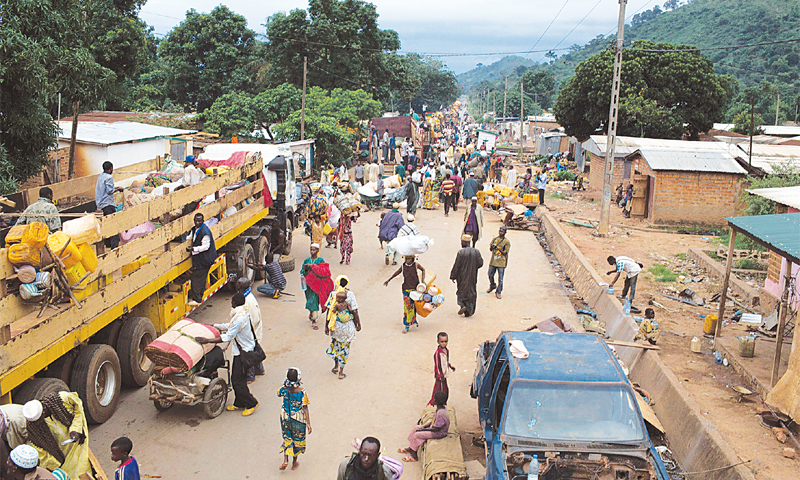
BANGUI: Heavily armed African and French peacekeepers escorted some of the last remaining Muslims out of Central African Republic’s volatile capital on Sunday, trucking more than 1,300 people who for months had been trapped in their neighbourhood by violent Christian militants. Within minutes of the convoy’s departure, an angry swarm of neighbours descended upon the mosque in a scene of total anarchy. Tools in hand, they swiftly dismantled and stole the loudspeaker once used for the call to prayer and soon stripped the house of worship of even its ceiling fan blades. One man quickly scrawled “Youth Centre” in black marker across the front of the mosque. Others mockingly swept the dirt from the ground in front of the building with brooms and shouted “We have cleaned Central African Republic of the Muslims!” “We didn’t want the Muslims here and we don’t want their mosque here anymore either,” said Guy Richard, 36, who loads baggage onto trucks for a living, as he and his friends made off with pieces of the mosque. Armed Congolese peacekeepers stood watch but did not fire into the air or attempt to stop the looting. Soon teams of thieves were stripping the metal roofs of nearby abandoned Muslim businesses in the PK12 neighborhood of Bangui. “Pillage! Pillage!” children cried as they helped cart away wood and metal. “The Central Africans have gone crazy, pillaging a holy place,” said Congolese peacekeeper Staff Sgt. Pety-Pety, who refused to give his first name, as the mosque came under attack from militants known as anti-Balaka in their trademark wigs and hats with animal horns. Sunday’s exodus further partitions the country, a process that has been under way since January, when a Muslim rebel government gave up power nearly a year after overthrowing the president of a decade. The United Nations has described the forced displacement of tens of thousands of Muslims as “ethnic cleansing.” While previous groups have been taken to neighbouring Chad, Sunday’s convoys were headed to two towns in the north on the Central African Republic side of the border. The long-chaotic country’s political crisis has prompted fears of genocide since it first intensified in December when Christian militants stormed the capital in an attempt to overthrow the Muslim rebel government. They soon began attacking Muslim civilians accused of having collaborated with the much despised rebels. The rebel leader-turned-president ultimately resigned, and mob killings of Muslims and mutilation of their bodies took place on a near-daily basis in Bangui earlier this year. Tens of thousands of Muslims were escorted to safety in neighbouring Chad, though earlier convoys were fraught with violence. Militants lined the streets and attacked departing trucks, at one point beating a man to death after he fell from his vehicle. The violence against Muslims has drawn international concern, prompting the world’s largest bloc of Islamic countries to send a 14-delegate fact-finding mission to Central African Republic starting Tuesday. In an effort to avoid chaos, Sunday’s convoy had been scheduled to depart at dawn, not long after men prayed in the mosque for the last time and lightning flickered in the dark sky. It took hours, though, for the families to load up their wares, from plastic jugs for water to bicycles, and even satellite dishes and chairs. In starting a new life in an unknown city, many said they were bringing anything of value that they could take could be sold there to make money. Tonga Djobo, 75, in a long flowing gown, prayer cap and orthopedic shoes, steadied himself with a stick he used to prod cattle that also doubled as a cane. He said he first came to Central African Republic 47 years ago from neighboring Chad.Today would be the last day of his life he would spend in Bangui, he declared, joyously pumping his fists in the air. Meanwhile, his wife and family carted their wares all wrapped in bright wax-print fabrics to their assigned truck and waited to board.—AP

Attack on Nato container injures six in Khyber

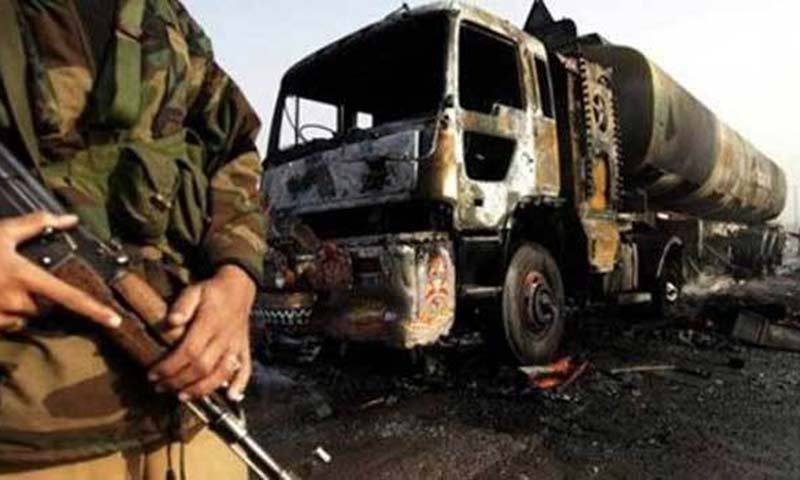
PESHAWAR: At least six people were injured on Monday when a Nato container was attacked by unidentified gunmen on the Pak-Afghan Highway in the Khyber tribal region. The two nearby vehicles were also damaged as a result of the incident. According to official sources, the militants open fired at a Nato container and injured the driver of the vehicle following which the Khasadar forces personnel retaliated. The security forces and rescue teams immediately reached the site of the incident and cordoned off the area. The injured were shifted to a nearby hospital. A search operation was conducted by the security officials following the incident during which almost 12 suspects were arrested in Jamrud tehsil.

PM chairs security committee meeting

ISLAMABAD: Prime Minister Nawaz Sharif was chairing a meeting of the Cabinet Committee on National Security (CCNS) at the PM House on Monday. The committee was expected to discuss a number of issues relating to internal and external security. Interior Minister Chaudhry Nisar Ali Khan, Chief of Army Staff General Raheel Sharif, Director-General Inter-Services Intelligence (ISI) Lt-Gen Zaheerul Islam and others were present at the meeting. Formed last August, the CCNS is the highest civil-military coordination forum on matters of national security and defence. The top security body is headed by the prime minister and has foreign, defence, interior and finance ministers; Chairman Joint Chiefs of Staff and the three services chiefs as its members. Earlier this month, the committee had met and decided to continue seeking opportunities for peace with the Tehreek-i-Taliban Pakistan (TTP).

Modi says if he becomes PM he will hunt Dawood

NEW DELHI: BJP leader Narendra Modi has said if he wins the elections he would bring fugitive underworld don Dawood Ibrahim to India to be tried for the 1993 blasts in Mumbai. He told a Gujarati news channel on Saturday that the previous administrations had not tried hard enough. Dawood stands convicted in absentia in India for the blasts, together with several Mumbai accomplices. Several pro-Modi analysts, including former diplomats, are showing interest in targeting Pakistan-based clerics and other extremists allegedly involved in terror activities in India. Mumbai’s DNA newspaper said on Sunday that a former police officer, who investigated the blasts, was of the firm opinion that the don could indeed be brought to India. He told DNA: “Modi is a man of tremendous willpower and a go-getter. These qualities are needed at the top-most level to operationalise a plan to eject Dawood out of Pakistan. “I am not saying this as a member of the BJP, but as a professional cop who has dealt with organised crime for several years. It should not be a difficult task.” The paper said a 1993 plan was prepared by the Mumbai police to send a crack team of five highly motivated officers with fake passports to Karachi to eliminate Dawood. But, it said, New Delhi, then ruled by the Congress, never gave the go-ahead for this undercover operation. DNA said Chhota Rajan, a sworn rival of Dawood, stated on Friday night that some years ago he had sent a hit squad, including Farid Tanasha and D.K. Rao, to Karachi to eliminate Dawood. “Dawood was scheduled to come to offer prayers at a dargah near his home in Karachi. My boys were lying in wait. But he never turned up and the operation had to be called off,” he disclosed. Sources in the intelligence community, however, told the paper that such an operation is not as simple as it appears. Dawood’s alleged chief lieutenant Chhota Shakeel had told DNA a few months ago that: “Dawoodbhai koyi halwa nahin hai ke usko uthake koi be le jaa sakta hai. (Dawood is not a piece of halwa that anyone can take him away).” Pakistani diplomats have expressed their keenness to work with Mr Modi should he become prime minister. They have underscored his declaration of seeking peaceful ties with all countries as a pointer to his intentions towards Pakistan.

IMF asks govt to raise age of retirement

ISLAMABAD: The International Monetary Fund has advised the government to increase the retirement age and contain pensions bill as part of a reform programme. Pakistan’s federal expenditure on salaries and pensions is estimated at about Rs450 billion, including pension expenses of about Rs171bn for the current financial year. Provincial pay and pension bills are much higher than the federal bill. As part of public expenditure reforms programme, the IMF has suggested increase in the retirement age as a way out of rising pension bill due to improved life expectancy rate. This is one way of reducing the pension bill and, at the same time, making better utilisation of expertise of senior bureaucrats. There have been proposals from the senior bureaucracy for increasing retirement age to 62 years from 60 but the federal and provinial governments have discouraged such proposals mainly because of political incentive in providing jobs to a growing younger population. Of the federal government’s pension bill of about Rs171bn this year, about Rs125bn pertained to retired workforce of the armed forces. “Public wage bill reforms should target structural change that strengthens the link between pay and productivity, improve hiring process and ultimately raise efficiency in the provision of public services,” said the IMF, adding that this should also be coordinated with reforms in other areas, especially in labour intensive health and education sectors to ensure that objectives are aligned. Furthermore, the increase in the wage bill should be commensurate with the provision of services and growth of fiscal space, it said. The IMF advice came at a time when the government is reluctant to increase salaries and pensions in the next budget to absorb the impact of over 100 per cent raise already provided by the PPP government. But the government is under pressure from its employees for a raise. Sources said the Economic Advisory Committee of the government which shared its initial thoughts with the federal government over the weekend as part of budget-making consultations is also reported to have viewed that about 120pc increase in salaries in five years of the PPP government had worsened the government’s service delivery. Due to these increases, the share of salaries in the administrative expenditure had increased from 60pc to 88pc. The IMF is of the view that regardless of whether the immediate goal is to contain the growth of the wages bill or to create the fiscal space to accommodate a large one, an important challenge is to attract the necessary staff to ensure that public services are provided in an efficient manner. “Increasing the link between pay increases and employee or team performance and periodically assessing employment levels in line with the functions of the government should ensure retention of skills while improving efficiency”. It said that reforms to public sector wages and employment could generate substantial savings and bolster long-term growth, particularly where public sector wages are higher than those prevailing in the private sector or the size of the public employment is disproportionate to the services provided to the economy. But the IMF is opposed to voluntary separation. It said downsizing that is part of reorganisation of government services and that target specific positions and functions is likely to be more successful in achieving permanent reduction in employment than an untargeted, across-the-board cut in employment. “The literature on civil service reform suggests that voluntary departure schemes have not been very effective, as they suffer from adverse selection problems.”

Sunday, April 27, 2014

India: Pakistani couple in trouble with newborn baby

NEW DELHI: The newborn baby has become an offense for Pakistani couple in India as the Indian authorities stopped them at Munabao railway station over document row. Mai Fatima and her husband Mir Muhammad --- residents of Ghotki in Pakistan --- had gone India two-and-a-half months back to meet Fatima's aging father. Their visa was originally for one-and-a-half months but was later extended by another month when Fatima's father suddenly passed away. Fatima had come to India she was seven months pregnant and on April 14 she gave birth to a baby boy at a private hospital. Indian local municipal council had issued a birth certificate in the name of Sohail Khan. When the couple along with the newborn left for Pakistan via the Thar Express they were stopped at Munabao railway station. The Indian authorities stopped the couple and asked them to get the relevant documents (passport or visa) from Pakistani High Commission in India. The immigration officers asked them to either go back to Pakistan leaving the child behind or complete the documentation of their baby.

Multan two sisters killed over family feud

MULTAN: Two missing teen sisters have lost their lives over family enmity, as their bodies were recovered from a canal located on Nawabpur Road yesterday here, Geo News reported. Police said that the three teen girls Shahida, 5, Shahar Bano, 9 and Zohra, 7 daughters of Iqbal Hussain resident of Enayetpur in the outskirts of Multan had gone to a wedding party along with their grandmother yesterday and from where they were kidnapped. The bodies of Shahar Bano and Zohra have been found from Shujabad Canal today, while Shahida was still missing, police said. Police registering a case on the complaint of the affected family arrested one lady Nasreen and her husband Mazhar.

Mardan: Father, 2 sons killed in rivals’ firing

MARDAN: A father and his two sons were killed in the rivals’ firing, while one person sustained injury on Sunday here, Geo News reported. Police said that three persons were killed and one passer-by sustained injury in firing by a group of armed persons at Umarabad, who managed to escape from the scene. A father and his two sons included among the dead, while the injured passer-by has been shifted to the hospital for medical aid, police said.

ILF 2014: On failed state test, Pakistan passes with a ‘D’

ISLAMABAD: Pakistan might not be a failed state, but it is certainly trying its best to get there. An interesting book launch session at the Islamabad Literature Festival for Syed Muhammad Shabbar Zaidi’s “Pakistan: Not A Failed State” and Babar Ayaz “What’s Wrong With Pakistan” discussed, among other things, the economic and political failures of the governments of Pakistan. While Zaidi’s book focuses more on the economic history, Ayaz focuses on policy issues and all-round history. Moderator Zahid Hussain began by stating the different points of view both books present on the same issue, Zaidi read from the book and explained how his seven phases, starting with consolidation of imperialism in 1947, to stagnation and turmoil in the present day. His most poignant points were that economic policy always comes from abroad, and there are no ‘economic allies’, referring to how cheap labour in China had destroyed local industry and how — migrant labour and their remittances — are actually a sign of Pakistan being on the road to failed statehood. While Zaidi largely defended Pakistan as not being a failed state, Ayaz, who had dedicated his book to the millions of victims of terrorism around the world, suggested the country is much closer to the brink. “The west and [the region] see Pakistan as a hub of terrorism. Pakistan is a trust-deficit country. Nobody trusts us, and we trust no one,” he said, explaining how this applies to the army and civilians, the judiciary, the media, and the provinces. Ayaz also brought up how Pakistan was born from secular demands such as parliamentary representation in united India, but these demands were forgotten and replaced with a rallying cry for religion. He said religion has been exploited for short-term political gains since before Pakistan was even proposed, and the country is suffering from the fallout. He also criticised the false narratives used by political and military rulers, including the false claim that we were attacked when we were actually instigators in all six wars fought by Pakistan or our proxies. “Religious extremism flourishes when the state patronises a religious ideology to exploit its own people.” Zaidi explained how Pakistan shows some characteristics of a failed economy. While approving of the brain drain as talented people trying to be the best they can be, he said exporting cheap, unskilled labour to the Middle East and Europe, and the state’s inability to collect taxes are bad omens. “Forget Balochistan, you can’t even collect taxes in Raja Bazaar.” Published in The Express Tribune, April 27th, 2014.

Inflow: Zong to make licence payment in dollars

ISLAMABAD: In a move suggesting China’s helping hand, Zong, a Chinese company, has decided to make the $516 million payment on account of next-generation spectrum licences in dollars. The move would help the country add to its foreign currency reserves. Minister of State for Information Technology Anusha Rahman said that Zong will invest $1 billion in the next two to three years in Pakistan. Talking to media persons here at the PTA headquarter, she said that the government was also negotiating with the company for local manufacturing, technology transfer and research innovations to help boost the employment and investment opportunities in Pakistan. “We also asked the operators to establish their mobile sale point for new technology here in Pakistan to avoid any complications,” Rahman said. She also informed that negotiation is under way with another company to make the payment in dollars but, added that, the name could not be revealed yet. She further informed that Warid cannot avail 4G services without the PTA’s permission. This was also confirmed by the PTA chairman. CMPAK Limited, known as Zong, gave the highest price of $306.9 million for the 3G licence in the 10MHz band, making it eligible for getting a 4G licence at the base price of $210 million. The base price for 3G was $295 million. Out of the little over $1.11 billion fetched by the auction, Zong paid the highest amount of $516.92 million for two licences. According to the Pakistan Telecommunication Authority website, Zong’s market share was closing in on Ufone’s. “Zong is very excited in becoming the only party to win both the 3G and 4G frequencies and will roll out the services at a faster pace,” said Sikandar Naqi, Advisor to the Chief Executive Officer of Zong. Meanwhile, in a press conference, Telenor Chief Marketing Officer Ifran Wahab Khan said that the auction process was transparent and his cellular company will reach the rural areas too with its vision of ‘internet for all’. Khan said that the issue of high taxation on telecommunications was also discussed in a meeting with Finance Minister Ishaq Dar, who promised to address this concern of the operators in the upcoming budget. Dar observed that the induction of the spectrums will add technological resources to Pakistan’s socio-economic sectors. The CEOs of all the Cellular Mobile Operators observed that there will be more appetite for the spectrums in the coming months. Rehman also said government collaboration with the mobile companies for the telecommunication development of the country is desirable for all. She emphasised on developing areas like e-health, tele-centers and e-education. Published in The Express Tribune, April 27th, 2014.

Awkward mix-up: Arrest warrant issued for 15-month-old in wall-chalking case

GUJRAT: In another befuddling case, a civil judge on Saturday issued an arrest warrant for a toddler, among others, for failing to appear in a hearing involving wall-chalking in Jalalpur Jattan during the 2013 parliamentary elections. District Court Judge Muhammad Asif issued warrants for the arrest of 15-month-old Muhammad Ibrahim, PML-N MNA Nawabzada Mazhar Ali Khan, MPA Major (retd) Moin Nawaz and advisor to Bilawal Bhutto Zardari, Nawabzada Ghazanfar Ali Gul for violating the Election Commission of Pakistan (ECP) rules regarding the prohibition of political graffiti. Officials from the Saddar Jalalpur Jattan police station included these names in a report submitted to the court which detailed the violation of ECP orders in NA-104. The accused failed to show up at Saturday’s hearing, upon which Judge Asif issued the arrest warrants. Father of baby Ibrahim, Constable Tasawwur said that District Police Officer (DPO) Gujrat Rai Ijaz Ahmed had assured him three months ago that the name of the toddler would be removed from the case. Meanwhile, as the news was broadcast by the electronic media, Nawabzada Ghazanfar Ali Gul appeared in the court and was subsequently ordered to be presented at the next hearing on May 15. The staff at the DPO’s office, however, seemed to be clueless about the case and was instead asking journalists for details. Asked how a toddler could be accused of wall-chalking, DPO Ahmed said, “This incident took place a year ago. Last month, we wrote a letter to Civil Judge Farzana Farman to remove the name of the child from the report. Justice Farman was changed and transferred, and the new judge, Muhammad Asif, was not quite aware of the child’s age.” He added that Judge Asif has been informed of the infant’s age and that the matter should be resolved immediately. Published in The Express Tribune, April 27th, 2014.

Shoe-throwing: Committee to submit report in 48 hours

LAHORE: The Punjab Home Department has appointed Additional Inspector General of Police Special Branch (SB) Muhammad Amlish to investigate the shoe-throwing incident on Chief Minister Shahbaz Sharif, The Express Tribune has learnt. A meeting was held with senior officers of the Home Department, police, Special Branch and VIP security to discuss how to proceed with the probe. The committee will submit its report in 48 hours. The incident took place on Thursday when a reporter threw a shoe at the chief minister during a ceremony. Sources familiar with the meeting said that the security arrangements of the chief minister have been revisited. According to a participant of the meeting, ‘ordinary journalists’ will not be allowed to attend VIP functions. Published in The Express Tribune, April 27th, 2014.

Completion of term: SC board orders release of foreign inmates

LAHORE: The Supreme Court on Saturday ordered to release all those foreign inmates who had completed their jail terms. An SC review board, headed by Justice Nasirul Mulk, heard the case. As proceedings started, the officials of the home department produced 46 foreign national inmates, who had been convicted for various crimes including illegal border crossing, smuggling and narcotics smuggling in the country. The officials told the court that the inmates belonged to different countries such as India, Bangladesh and Kenya. They said the prisoners had completed the sentence terms. After hearing the submission of the home department’s officials, the review board ordered the government to release all those foreign national inmates. The board also directed the government to provide basic necessities of life and health services in jail. Published in The Express Tribune, April 27th, 2014.

Govt may have to sell shares of state-owned assets to WB arm

ISLAMABAD: In return for the World Bank Group’s (WBG) assistance in breaking gridlock on low growth and low productivity, Pakistan may have to sell shares of state-owned entities (SOEs) to an arm of the international lender and approve non-discriminatory trade policies to normalise ties with India. The draft of the Country Partnership Strategy (CPS) 2015-19 sheds light on the plans WBG believes are necessary to take Pakistan out of the trap of low growth and low productivity. During the last five years, the average growth in Pakistan remained below 3% while the investment-to-national output ratio alarmingly dropped to 12%. The WBG is expected to approve the strategy on May 1, which Finance Minister Ishaq Dar has said will be ‘a new Pakistan day’. The bank will offer Pakistan $11 billion in five years and will be directly involved in formulating policies at the federal and provincial levels. The WB investment arm, the International Finance Corporation (IFC), may also buy stakes in some of the entities, which are up for grabs.
Without specifying the enterprises the WBG is interested in, the document reveals that as part of the strategy to reform SOEs, “the IFC will support the privatisation transactions in the financial and infrastructure sectors through strategic investments.” The policy matrix – a carrying set of milestones that the WB will target – also states that the IFC will make ‘direct investments’ and mobilise investors for the divestment of large bank shares. It was not immediately clear whether the IFC can buy shares in a public sector company. According to some government functionaries, it cannot make direct investments. Others argue the IFC can become a partner in a consortium of strategic investors. The WBG will push its agenda to get at least five state-owned entities restructured or privatised, at least three of which will be in the power sector. According to sources in the Ministry of Finance, the IFC is interested in making direct investments in the Lahore Electricity Supply Company (Lesco) and Faisalabad Electricity Supply Company (Fesco). The international lender will approve an at least $500 million loan under the Growth and Investment Programme in the first phase to accelerate the privatisation of these entities. It will also push for improving trade across borders and has set a goal for the development and approval of a ‘non-discriminatory policy on international trade’. The policy will be solely aimed at India, the only country that Pakistan recognises and does not freely trade with. To facilitate trade, the WBG will finance projects to reduce the average waiting time at the Karachi port and Wagah border by 20%. It will finance a trade facilitation and logistics project at Wagah border, the IFC intercity transport project and an IFC-funded freight train project. Under the CPS 2015-19 package, Pakistan will also have to approve a credit information law. The provincial governments of Punjab and Sindh will set up new courts to resolve commercial disputes. The key target for these actions is reducing the number of days required to start a business from 21 days to 11 days. To enhance productivity, the WBG will push for the elimination of Statutory Regulatory Orders to end distortive policies in the agriculture sector. It has designed projects to raise yields of major crops like wheat, cotton and paddy, by at least 20%. The group also plans to push for simplifying import tariffs. Tariff reform would reduce the average tariff rate to levels close to 10%, with reduced dispersion, and would pay off in the longer term by allowing all Pakistan’s producers to benefit from cheaper inputs, according to the draft CPS. Published in The Express Tribune, April 27th, 2014.

Modaraba scams: ‘Conmen looted over 32,000 people in a year’

LAHORE: The number of Modaraba cases have increased to 57, looting Rs21.68 billion from the public, according to brief report prepared by the National Accountability Bureau (NAB) made available to The Express Tribune. In April last year, there were only five Modaraba cases, but now the number has spiked to 57, making it an uphill task for the anti-graft body to arrest the culprits and recover the money. NAB Chairman Qamar Zaman Chaudhry has strictly directed the body’s Rawalpindi bureau to arrest all the accused at all costs including those who have fled the country, said officials. He has also sought for a fortnightly progress report. Currently, NAB is investigating five major Modaraba scams involving an amount of Rs20.52 billion, affecting 32,325 people. These cases include M/s Fayyazi Gujranwala Industries, Mezban Trading Company, al Wasey Group, Taxila Islamic Traders Pvt Ltd and M/s Elixir Group. Recoveries of Rs1.29 billion have been made in these cases. Separately, the anti-graft body has verified eight complaints of Modaraba scams amounting to Rs541.65 million, looted from 457 people. Officials revealed that NAB has also approached the Malaysian and Thai governments for Mutual Legal Assistance (MLA) under Section 21 of the National Accountability Ordinance (NAO), 1999, to arrest those who have fled the country. The accused convinced people in mosques and madrassas against the present banking systems and invited investment in the name of Modaraba and Musharika (Islamic investments) in cash. The plunderers promised to pay monthly profit of Rs5,000 to Rs9,000 per Rs100,000 and distribute profit from collected money without any real business. These fraudulent companies have maintained no proper record of investors and have reportedly ‘buried’ the temporary documents that were prepared to woo people. To trap more people in their net, the accused were paying some amount to the investors as ‘monthly profit’ and this amount has been calculated as around 40% of the total investment in these fraudulent schemes, NAB officials explained. The NAB is considering launching an awareness campaign for the public to prevent any possible future losses in similar scams, NAB spokesperson Ramzan Sajid told The Express Tribune. The major affected areas include Hazara Division, Federally Administered Tribal Areas, Malakand Division, Potohar Division and Azad Jammu and Kashmir. While reviewing the claims of victims, it surfaced that a majority of the people affected include retired armed forces personnel, retired government servants, overseas Pakistanis and those affiliated with Tableeghi Jamaat. Published in The Express Tribune, April 27th, 2014.

World with more women leaders will be a better place: Malala

NEW YORK: “A world with more women leaders will be a better world, and Hillary Clinton is helping make that possible,” Malala Yousafzai said in an appreciation piece in the latest issue of Time magazine. Hillary Rodham Clinton’s “life and leadership show women what we can achieve if we believe in our own strength and if we channel our inner creativity, compassion and determination,” wrote the activist, who was in the Time’s list of 100 most influential people. She observed that “Hillary Clinton is a symbol of strength for women across the world. It was she who famously said, “Women’s rights are human rights.” “She not only spoke those words, but also dedicated her life to empowering women around the world through politics and philanthropy. “She has been a source of strength for many women leaders, including myself, my family and those who stood by me after I was attacked,” said Malala. “Continue your mission, be strong, we believe in you is what she said to me, my father and the rest of the Malala Fund team when we met her last year at the Clinton Global Initiative awards.”

TTP mastermind of Dera Ismail Khan prison break killed: Police

PESHAWAR: A key commander of the outlawed Tehreek-i-Taliban Pakistan (TTP), was killed during a gun battle, police sources claim. The Station House officer (SHO) of Kulachi Police Station, Haroon Khan said one terrorist has been gunned down during the encounter as a probe into the incident continues. Upon receiving a tip-off about the presence of the alleged militant, the police conducted an operation in the Kulachi area. During an exchange of fire between police personnel and the militants, the commander - also allegedly one of the masterminds of the Dera Ismail Khan prison break - was killed. Dozens of heavily-armed Taliban insurgents had freed nearly 175 inmates, including 35 ‘high-profile militants’ in the prison break in 2013. The militant killed today belonged to Noorzai tribe and was a resident of Rori village and was involved in other terrorist activities as well. The commander was wanted by the authorities in connection with another attack in the Loni area of Kulachi, police sources said. One killed in blast on peace committee At least one person was killed and three others were injured in a blast in the Landi Kotal area of Khyber tribal region. The deceased belonged to the Tawheed ul Islam peace committee. Official sources say that the vehicle of Tawheed ul Islam peace committee activists was targeted in Landi Kotal’s Zakakhel area destroying the vehicle completely. The peace committee holds Lashkar-i-Islam militant group responsible for the attack. Meanwhile the Zakakhel tribesmen and the Afghan refugees living in parts of Bara tehsil have been warned by the Lashkar-i-Islam militant group to join them or leave the area. The Lashkar-i-Islam and Zakakhel tribesmen have been fighting for the last one year and renewed threats would further deteriorate the situation in the area. Khyber tribal area is a part of Pakistan’s semi-autonomous Federally Administered Tribal Areas (Fata) on the Afghan border. The Taliban and other Al Qaeda-linked groups, who stage attacks in both countries, are known to have strongholds in the zone. Gun attack kills one, injures two others In a separate incident, one person was killed and two others were wounded when unidentified armed gunmen opened fire at a house in Peshawar’s Daudzai area. Police personnel and rescue teams immediately reached the site of the incident and shifted the injured to a nearby hospital. Sources from the rescue teams confirmed that the incident left one person dead and two others injured. Women were also among the victims. About a dozen assailants attacked a house in Garibabad area of Daudzai, police sources said. However, it has not been confirmed as yet if the incident was a militant attack or a personal feud. Exchange of fire kills three in Bannu Separately, at least three people were killed in an exchange of firing between two rival groups at Bannu Township chowk near Link Road. Police sources said the incident was the result of an old enmity. Weapons and explosives recovered Security forces on Sunday claimed to have recovered explosive-filled drums and suicide vests near a police post in Chamkani area in the outskirts of Khyber Pakhtunkhwa's provincial capital city of Peshawar. Police sources said the recovered drums were filled with more than 50 kilograms of explosives and were equipped with prima cords. The Bomb Disposal Squad was summoned to defuse the explosives. Also, two suspects were arrested and huge quantity of arms and ammunition was recovered from a pick up on Ramak Road in southern Dera Ismail Khan, according to police sources. Police claimed to have seized about pistols, five Kalashnikov rifles and 25,000 rounds of bullets.

Lashkar-i-Islam threat forces tribal families to leave Bara

PESHAWAR: After threats from the Bara-based outlawed Lashkar-i-Islam, scores of Afghan and Zakakhel tribesmen from Khyber tribal region’s Bara area on Sunday have started shifting to safer places. Tribal and the official sources confirmed that the Mangal Bagh-led Lashkar-i-Islam had warned Afghan refugees and the Zakakhel Shinwari tribes, a sub-tribe of the Afridis, and known their tribal fierceness, living in the area to announce allegiance to the Lashkar or leave Bara where the banned group is still known to have stronghold. Most of these people were settled in Akakhel, Sipah, Malikdin Khel and Shalobar areas in Khyber region who were given the deadline of April 27, 4 pm to take either of the options as their decision. The tribals in Bara area said that the militants of Lashkar-i-Islam had visited them personally and asked them to support the banned organisation while warning that they would have to leave the area in case they decided else wise. An Afghan refugee Rehman Gul who was leaving from Bara via Bara Qadeem check post, to a safer place told Dawn that the banned outfit has threatened the refugees to vacate the area. He said that they had been living in Bara for the past 27 years and now were forced to leave. “I am moving to my relatives’ place in Baghbanan area near Urmar, which is safer than here,” he added. Qayyum Khan, the in-charge of the Police checkpost at Bara Qadeem, on the border of restive Bara region said that so far between 10 to 15 families had crossed the border with their luggage and they were still many moving out from the area. When asked about the reasons for the movement of these people, he said although the exact reasons were not known but many of the displacing people had said that they were forcibly evicted by some Bara-based militant groups. Another Afghan named, Abdul Qadeem who was also shifting his family said: “I was asked to provde fighters, or money, to Mangal Bagh, the chief of Lashkar-i-Islam, either of which I couldn’t so I had to move out.” “We had been living peacefully for the past many years with the locals and now we don’t want to become a party in their personal fight,” he said. He added that there were hundreds of Shinwaris and Afghans who would have to leave the region if they choose not to be a part of the fight. A political administration official who wished not to be identified said that the militant group wanted to recruit people forcibly from the areas and that’s why they were forcing the Afghans and the other tribes to give them fighters or money to supplement their strength.

SHOCKING: Gurgaon based doctor rapes sister for 9 years under mother's watch

Gurgaon: A 33-year-old doctor was alleged of raping his sister for 9 years. He works in a top private hospital in Gurgaon. His 27-year-old sister lodged a complaint in the police station after which he was arrested on Saturday. The woman has alleged that her mother was aware of her brother's heinous act and still she did not report the incident. According to police, the woman living in Delhi is a senior officer in Union government. She has filed an FIR in the Manesar police station. According to the FIR, her brother has been raping her since 2005 when she was studying in 12th standard. The victim said that it continued even after she was married and her mother was also aware of it. The police said that the accused doctor was arrested just hours after the victim filed the complaint. Though, the victim has denied undergoing the medical examination. The victim said that she was tolerating the gruesome act for years only because her complete family was dependent on him and he was the only brother to 5 sisters. Other than this, she was also afraid of infamy. She said that she left home and started living with her elder sister but whenever the accused doctor visited their home, he used to rape her.

Thane: Kidnappers murder 12-year-old boy, father identifies chopped off body parts

Thane: On April 17, a 12-year-old boy was kidnapped in Kalyan city of Thane district. Parents of the victim lodged a complaint. Later, the boy’s father Uttambhai Gucchali, 39, a jeweller, received a call for ransom of Rs. 50 lakh. Boy’s parents were trying to find ways to get back their son. But, a couple of days back police recovered chopped off legs at Givindwadi flower market. The ossification test revealed that the body parts belong to a male aged around 12. The boy’s father identified his son’s body parts. On Sunday, some other body parts were recovered from the drain. Bazarpeth police, which was investigating the case, said four suspected killers of the boy had been identified and efforts were on to nab them.

EC bans baba Ramdev from holding meetings in Lucknow after 'honeymoon' remark

Lucknow: The Election Commission finally banned baba Ramdev from holding press conferences or public meetings till May 16 in Lucknow. The ban is imposed on him till elections are over but only in Lucknow region and not the state. The decision came after his 'honeymoon' remark over Congress vice president Rahul Gandhi. At a program in Lucknow on Friday, Ramdev had said, 'He (Rahul Gandhi) goes to Dalits' house for honeymoon and picnic. Had he married a Dalit girl, then his luck could have clicked and he would have become the prime minister.' At least 3 FIRs were registered against Ramdev in this context in Lucknow. Though, he has apologised for his vulgar remarks. He had said 'I had no intention to insult honourable Rahul Gandhi or Dalit community. But this is also true that Rahul Gandhi goes to houses of poor and uses that opportunity as publicity stunt, picnic or tourism', he said, adding "I express regret if the use of that term has hurt the feelings of any community, especially Dalit community.' 'The statement I made has been misrepresented. The term honeymoon period is over is commonly used in political language. I tried to use it in that sense', Ramdev claimed. EC came out with new guidelines against making malicious statements about the personal life of an individual on Saturday. It said people who violate this guideline will face strict action.

Gun attack kills one, injures two others in Peshawar

PESHAWAR: At least one person was killed and two others were wounded on Sunday when unidentified armed gunmen opened fire at a house in Peshawar’s Daudzai area. Police personnel and rescue teams immediately reached the site of the incident and shifted the injured to a nearby hospital. Sources from the rescue teams confirmed that the incident left one person dead and two others injured. Women were also among the victims. About a dozen assailants attacked a house in Garibabad area of Daudzai, police sources said. However, it has not been confirmed as yet if the incident was a militant attack or a personal feud. Weapons recovered In a separate incident, two suspects were arrested and huge quantity of arms and ammunition was recovered from a pick up on Ramak Road in southern Dera Ismail Khan. Police have seized about five Kalashnikovs, pistols and 25,000 rounds of bullets.

Hamid Mir blames ‘ISI within ISI’ for attack

KARACHI: Senior journalist Hamid Mir, who is currently being treated after escaping an attack on his life in Karachi last week, blamed ‘ISI within ISI’ for orchestrating the attack in an interview with BBC Urdu on Saturday. Speaking during his first interaction with the media after the attack, Geo TV’s senior anchorperson said that he has been threatened again to leave the country by same elements who he alleged were behind the attack. He said he has been told to leave Karachi and Pakistan as “it will be a long fight.” “People visit me in guise of friends but leave after conveying threatening messages of the foes,” said the senior journalist answering a question about source of the recent threats. “They say you better leave Pakistan…it’s not safe for you anymore. Only yesterday a highly responsible person came to visit me and told me that I will be attacked again.” Mir said the people who were threatening had always been a part of the country’s strong military establishment and they were conveying messages of differing nature to him. He said those who keep an eye on journalists’ movement and tape their telephone calls were behind the attack. “Only these people may know what flight Hamid Mir will take to reach Karachi. Which car will pick him up at the airport and at what time he will come out from the airport. They knew where to attack the car and chose a corner where CCTV camera wasn’t functioning,” he added. The journalist said he was pointing towards ‘ISI within IS,’ adding that a person namely “Major Wajahat” called him during a live show and despite giving the authorities all the details nothing has been done as yet. “The most worrisome fact is that Jihadist outfits attached to Taliban, which have been banned by the government, are protesting in favour of ISI,” he said. “These banned jihadist groups which are protesting against me and in favour of ISI, aren’t these ISI within ISI?” he questioned. Hamid Mir, in his official statement through his brother Amir Mir on Thursday, had held the Inter Services Intelligence (ISI) responsible for orchestrating the attack. He had said the ISI officials were apparently unhappy about his famous talk show, Capital Talk, being broadcast on Mama Qadir’s long march over missing Baloch persons. Mir claimed that the intelligence agency was also unhappy of his criticism aimed at the ISI in different Capital Talk shows.

CM concedes corruption in canal project

DERA MURAD JAMALI: Balochistan Chief Minister Dr Abdul Malik Baloch has disclosed that embezzlement of funds in the Pat Feeder Canal expansion project in Nasirabad district has been unearthed and legal action will soon be initiated against those involved in it. Speaking to newsmen at a lunch hosted by PML-N legislator Mir Muhammad Khan Lehri in his honour here on Saturday, he said a report regarding corruption in the project had been received by the provincial government. He said the report had confirmed embezzlement of funds and suggested legal action against several people, including engineers and other government officials and a contractor. The chief minister said: “We have succeeded in reducing corruption in the province to some extent.” Replying to a question, he said both the federal and provincial governments were serous in resolving the Balochistan issue. “We are trying our level best to bring all stakeholders to the negotiating table because it is the only way to solve all problems.” Dr Baloch said the law and order situation had been improved to some extent by taking concrete steps and the government was taking more measures in this regard. He said development plans could not be implemented without maintaining peace and order. He said strict action would be taken against teachers and doctors who remained absent from duty and asked the administrative officers to monitor their attendance. Dr Baloch said Prime Minister Nawaz Sharif had issued instructions for laying two transmission lines to ensure supply of electricity to Sibi and Nasirabad divisions from the Uch Power Plant-II. He said his government was striving to make the Levies more effective by proving its personnel training, weapons and equipment, but he was of the view that this force could not meet the challenges of the modern era like police.

South Korean prime minister resigns over ferry sinking

SEOUL: South Korea's Prime Minister Chung Hong-Won tendered his resignation on Sunday over the sinking of a passenger ferry that left more than 300 people dead or missing. “I offer my apology for having been unable to prevent this accident from happening and unable to properly respond to it afterwards,” he said. “I believed I, as the prime minister, certainly had to take responsibility and resign.” The government, along with almost all other branches of officialdom, has come in for fierce criticism over the disaster, and the handing of the rescue operation. “I wanted to resign earlier but handling the situation was the first priority and I thought that it was a responsible act to help before leaving. “But I've decided to resign now not to be any burden on the administration,” he said.

Blog Archive